Off the Record: Real-Time Voice Reshaping That Keeps AI From Transcribing Your Meetings

Off the Record uses real-time voice reshaping to stay intelligible to humans while defeating AI transcription tools.
As AI meeting transcription tools proliferate, users are quietly losing control over their own voice data. Off the Record, a new Product Hunt launch, uses real-time voice reshaping to disrupt the acoustic feature extraction that speech recognition models rely on — without affecting human comprehension. It targets two scenarios: AI notetakers in meetings and hidden AI copilots in remote interviews. The approach mirrors image-protection tools like Glaze and Nightshade, representing a growing trend of user-side adversarial defense against AI surveillance. The product is still early-stage, with open questions around cross-model effectiveness, call quality impact, and potential misuse.
When AI Meeting Transcription Becomes a Privacy Threat
Video conferencing has become a staple of modern work, and with it has come a wave of AI-powered meeting tools — ones that automatically transcribe calls, generate summaries, and even serve as hidden "cheat assistants" during job interviews. While these tools boost productivity, they've introduced a largely overlooked privacy problem: every word you say could be fully recorded and analyzed by machines without your knowledge.
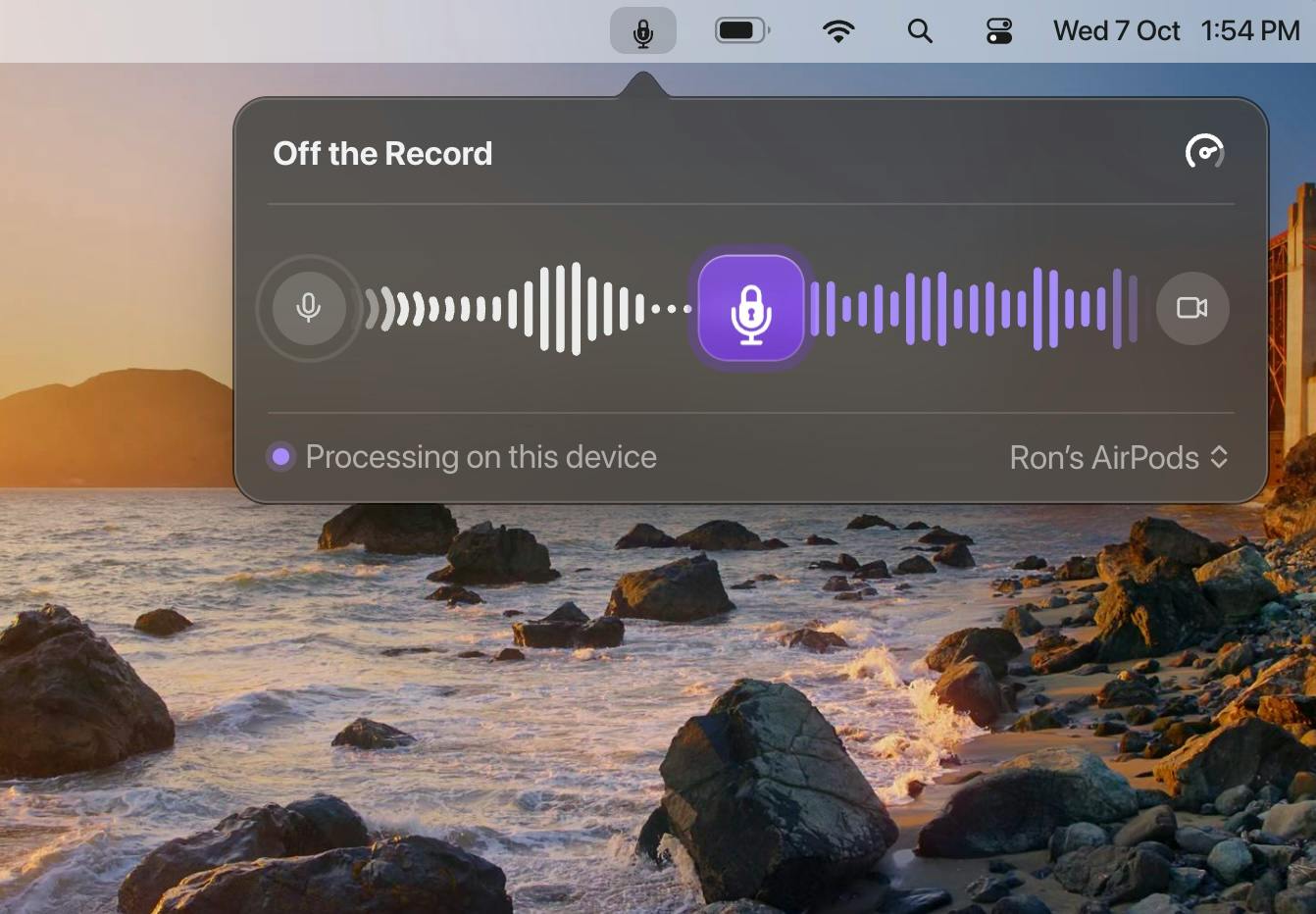
A new product on Product Hunt called Off the Record is designed to address exactly this concern. Its pitch is blunt and straightforward — "Block AI from transcribing your meetings." Developed by Ron Masas, the product launched to 75 upvotes and ranked 11th on its debut day, listed under three categories: Privacy, Meetings, and Security.
How It Works
The core mechanism behind Off the Record is real-time voice reshaping. In short, it processes and transforms your voice as you speak, so that the human on the other end of the call can still understand you perfectly — while automated transcription tools struggle to accurately capture what you're saying.
This "intelligible to humans, opaque to machines" approach is genuinely clever. It doesn't simply inject noise — that would make you harder for everyone to understand — but instead exploits the gap between human auditory perception and how machine speech recognition models work. The human brain is remarkably good at tolerating and filling in distorted speech; even slightly warped audio can be understood in context. Speech recognition models, on the other hand, rely on clean, consistent acoustic features. When the input signal is deliberately altered in targeted ways, transcription accuracy drops significantly.
According to the product description, Off the Record is specifically designed to counter two types of scenarios: AI notetakers in meetings, and hidden interview copilots that may be running during job interviews or negotiations. The latter is especially noteworthy — as remote interviews become the norm, it's not uncommon for one party to use AI to transcribe the conversation in real time and generate suggested responses. Off the Record aims to neutralize these tools at the source.
This technical approach is generally known in academia as Adversarial Perturbation for Speech. Researchers have found that mainstream speech recognition models — such as OpenAI's Whisper, Google's Speech-to-Text, and transcription APIs from major cloud providers — are trained on specific distributions of acoustic features, including phoneme boundaries and formant frequencies. By injecting nearly imperceptible perturbations into the audio signal, it's possible to systematically disrupt the model's feature extraction process, causing it to output garbled text or high error rates. Human auditory cortex, with its built-in context completion and error tolerance, is largely insensitive to these perturbations. It's worth noting that different speech recognition models use different acoustic modeling architectures, meaning perturbations tuned for one model may not work equally well against all others — this is one of the core technical challenges facing products in this space.
Why This Product Matters
The emergence of Off the Record reflects a broader trend taking shape: the rise of anti-AI surveillance tools. As the barrier to voice transcription continues to fall, almost anyone can silently deploy a recording bot in a meeting. Users are gradually losing control over their own voice data.
From a technical philosophy standpoint, products like this represent an "adversarial defense" approach — rather than trying to shut down AI tools directly, they manipulate the input signal to make AI outputs unreliable. This belongs to the same lineage as adversarial examples in computer vision, and tools like Glaze and Nightshade that protect against AI training by poisoning image data. As AI capabilities grow stronger, the demand for user-side "anti-recognition" measures is growing in parallel.
That said, Off the Record is still in its early stages. Its 75 upvotes and just 2 comments suggest it hasn't yet been widely tested. Several key questions remain: How much does real-time voice transformation affect the normal call experience? Does it work consistently across different speech recognition models (like Whisper and various cloud transcription APIs)? And perhaps most practically — when the other party can simply ask you to disable the tool, how well will it be accepted in real-world communication?
Glaze and Nightshade are image protection tools developed by a team at the University of Chicago. Glaze adds invisible pixel-level perturbations to artists' work, preventing AI image models from accurately learning their style. Nightshade goes further, using "data poisoning" to cause models to form incorrect conceptual associations after training. Both tools gained widespread attention in the art community, validating both the technical feasibility and market demand for user-side resistance to AI. Off the Record applies similar logic to the audio domain — but faces an additional challenge: image protection can be applied offline before uploading, whereas voice protection must be completed in real time with millisecond-level latency. This demands more from local compute resources and makes it harder to strike the right balance between audio fidelity and disruption strength.
The Double-Edged Nature of Privacy Tools
Any tool capable of "defeating AI" inevitably cuts both ways. Off the Record can protect ordinary users from unauthorized transcription, but it could equally be used to circumvent legitimate meeting records or obscure genuine responses during an interview. The product itself is neutral — what matters is the context and whether all parties have given informed consent.
In many jurisdictions, recording and transcribing meetings already requires participant consent. From this angle, Off the Record looks more like a form of "default protection" — a way for users to actively safeguard their voice data when they can't verify whether the other party is recording.
For people who frequently join online meetings, participate in remote interviews, or handle sensitive business communications, tools like this open up a new privacy option. Whether it can truly mature into a reliable solution depends on the consistency of its technical performance and on broader societal awareness of voice privacy as a right worth protecting.
Related articles

Free Unlimited Claude Code Solution: Agnes AI + CC Switch Setup Guide
No paid subscription needed — pair the free AI platform Agnes AI with the open-source tool CC Switch to provide a backend for Claude Code, enabling unlimited free calls to text, image, and video models. This guide covers the full setup, test results, and usage boundaries.

A Complete Zero-Cost Guide to Getting Started with Claude Code for Beginners in China
A beginner's guide to Claude Code for users in China: two installation methods (command line and IDE plugin), full configuration steps for replacing the official API with the free domestic LongCat model, and a hands-on demo of building a small tool with natural language, plus tips.

When the NSA Gets Involved: The AI Supply Chain Crisis Behind Open-Source CVEs and API Key Hijacking
Multiple open-source projects disclosed severe CVEs in one day, PHP flaws alarmed the FBI, and Railway and OpenCode were breached with API keys stolen. This article breaks down the vulnerability window, AI-accelerated exploitation, and the AI supply chain crisis behind the API key black market, with a developer defense checklist.