Ollama Cloud Deep Dive: One Subscription to Run DeepSeek, GLM, and More Open-Source Models
One Ollama Cloud subscription unlocks 20+ open-source models with transparent token pricing and time-zone perks for China.
Ollama Cloud extends the popular local LLM tool to the cloud, moving inference to data centers while keeping the same CLI experience. The revamp brings transparent per-token pricing with no service fees — a single subscription covers 20+ open-source models including DeepSeek, GLM, Kimi, and Qwen. The Pro plan at $20/month includes ~$60 in credit, with input as low as $0.15 per million tokens. Model choice matters more than plan choice, as token efficiency varies up to 6×. Access works via terminal, agent integration, or OpenAI-compatible API. Chinese users enjoy a natural time-zone advantage, as US peak pricing hours fall in the middle of the night in Beijing.
Ollama, the world's most popular local LLM runtime, recently overhauled its cloud service. The core changes: transparent per-token pricing, no service fees, and a single subscription that gives you direct access to dozens of open-source models including DeepSeek, GLM, Kimi, and Qwen. For users in China, this may be one of the most compelling token subscription options available right now. Based on hands-on testing from a Bilibili content creator, this article breaks down Ollama Cloud's positioning, model library, pricing structure, and its unique advantages for Chinese users.
What Exactly Changed in Ollama Cloud
Ollama's core experience has always been "one command, run a large model locally." The cloud version essentially changes just one thing — it moves inference from your machine to Ollama's data center, while everything else stays the same.
When you type ollama run glm-5.3-flash in your terminal, Cloud still uses the same Ollama, the same commands — it's just that a large-parameter model running in a data center is doing the work behind the scenes. This "seamless migration" design lowers the switching cost, letting you freely toggle between local and cloud.
One important clarification: this is not a reseller of official vendor APIs, nor is it routing through official API pools. Ollama runs native open-source model weights directly on dedicated compute, hosted in partnership with NVIDIA cloud providers. The official privacy policy promises no logging and no training on user data — a relatively clean stance.
It also works as a drop-in API. Ollama.com provides an OpenAI-compatible interface, so coding agents like Claude Code and Codex can connect to it directly.
Model Library: 20+ Open-Source Models Under One Subscription
The model library is Ollama Cloud's biggest selling point. One subscription covers 20+ open-source models spanning today's major open-source players:
- DeepSeek V4 Flash and V4 Pro
- GLM 5.3 and GLM 5.3 Flash
- Kimi K3 and K2.7
- Minimax M3, Qwen 3.5's 397B variant
- GPT-OSS 120B and 20B, plus other open-source models
Kimi K3 alone has approximately 2.8 trillion parameters, making it one of the largest open-source models available. A model at this scale is essentially impossible to run on consumer hardware, yet in the cloud you can spin it up with a single command. All models support tool calling, with context windows ranging from 131K to 1M tokens, covering a wide range of task requirements.
For users who want open-source models without the hassle of GPU setup, the breadth of the model library is what sets Ollama Cloud apart from single-model API services.
Tool calling refers to a model's ability to proactively invoke external functions or APIs during response generation — for example, querying weather data, searching a database, or running code. This capability is foundational for building agent applications: without tool calling support, a model can only passively answer questions and cannot autonomously complete multi-step tasks. Context window determines how much content a model can "remember" within a single conversation. A 131K context window corresponds to roughly 100,000 Chinese characters; 1M corresponds to roughly 800,000. For tasks involving long documents, extended conversations, or large codebases, a larger context window means less information truncation and more coherent understanding.
Transparent Token Pricing and Plan Structure
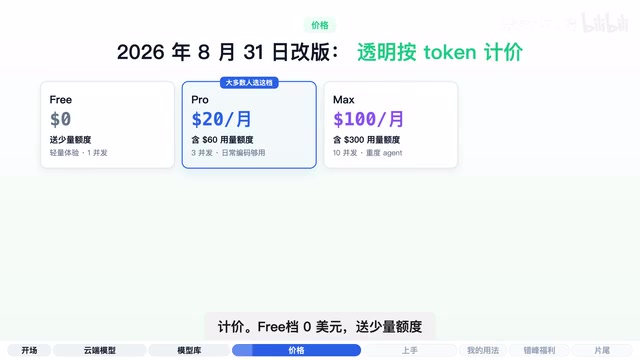
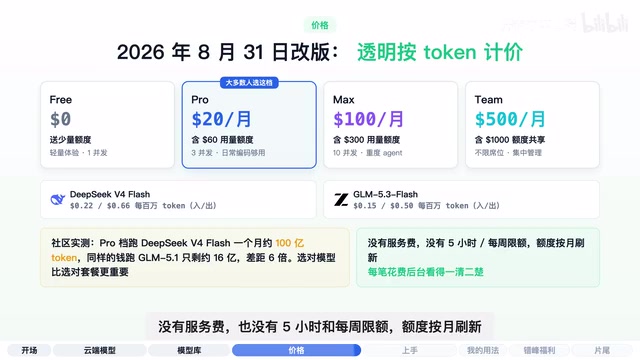
After the overhaul, Ollama Cloud uses transparent per-token pricing with no service fees, no 5-hour usage caps, and no weekly limits — allowances reset monthly. The plan structure looks roughly like this:
- Free: $0/month, with a small complimentary credit
- Pro: $20/month, includes approximately $60 in usage credit
- Max: $100/month, includes approximately $300 in credit, supports 10 concurrent requests
- Team: $500/month, approximately $1,000 in credit, shared across a team
Models are billed per token, with significant price differences. The cheapest option — DeepSeek V4 Flash — runs approximately $0.22 per million input tokens and $0.66 per million output tokens; GLM 5.3 Flash's input price is as low as $0.15 per million tokens.
Community testing shows that the Pro plan running DeepSeek V4 Flash can churn through roughly 10 billion tokens in a month, while the same money spent on GLM 5.1 yields only about 1.6 billion tokens — a 6× difference. This makes one thing clear: choosing the right model matters more than choosing the right plan. The dashboard clearly shows the cost of each individual request, making spending fully transparent.
Token is the fundamental unit for billing and processing in large language models, and it does not map 1:1 to characters. For English, 1 token corresponds to roughly 4 characters or 0.75 words. For Chinese, due to higher information density per character, 1 Chinese character typically maps to 1–2 tokens. "Per million tokens" (1M tokens) is the industry-standard pricing unit. Taking DeepSeek V4 Flash as an example, input at $0.22 per million tokens means inputting roughly 1 million Chinese characters costs under ¥2 RMB — one of the lower price points in today's market. It's also worth understanding that input and output are billed separately: content sent to the model is billed at the input rate, while the model's generated response is billed at the output rate — and output is typically 2–4× more expensive than input. This means generation-heavy tasks (like long-form writing) will cost noticeably more than comprehension-focused tasks.
Three Access Methods: Terminal, Agent, and API
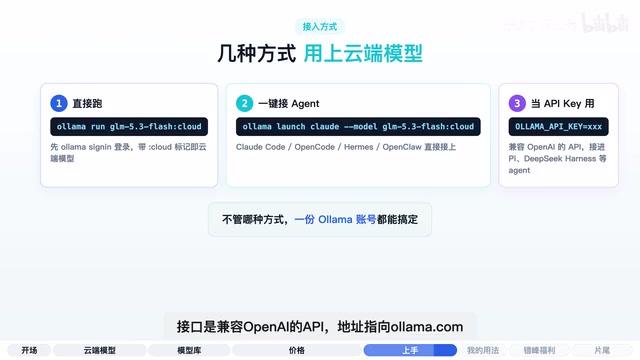
There are three primary ways to access cloud models, covering everything from command-line use to programming agents.
Method 1: Run directly in the terminal. Install the latest version of Ollama, run ollama signin to log in, then use ollama run with the Cloud-tagged model name — for example, glm-5.3-flash-cloud.
Method 2: Connect via Ollama Launch for agents. A single command integrates cloud models into various agent frameworks, including Claude Code, OpenCode, Hermes Agent, and more.
Method 3: Use as a standard API key. Generate an API key — the interface is OpenAI-compatible — and plug it into agent tools like DeepSeek Harness.
More practically, local and cloud models can be mixed freely — small tasks stay local, large tasks go to the cloud, all from the same codebase. The content creator's own setup keeps 6 models on standby (GLM, GLM Flash, DeepSeek V4 Pro/Flash, Kimi K3, Minimax M3), switching based on task size. With a Max plan's $300 monthly credit, only $28.62 was used that month — GLM 5.3 Flash alone handled 3,091 requests, illustrating just how far the credit can stretch.
Ollama Launch is a rapid integration command provided by Ollama. Its core function is to automatically configure model endpoints in local or remote environments, eliminating the need to manually set API addresses, ports, and authentication details. OpenAI-compatible API means Ollama Cloud's API request format is identical to OpenAI's official API — developers simply swap in Ollama's Base URL and API key without modifying any application logic. Any app built on the OpenAI SDK can switch over directly. This design dramatically lowers the migration barrier and is the technical reason tools like Claude Code and Cursor can connect to it out of the box.
A Time Zone Advantage That Particularly Benefits Chinese Users
There's one detail worth highlighting for users in China: the official Peak pricing window is UTC 12:00–18:00 on weekdays, during which some models are priced at double the standard rate.

Converted to Beijing Time, that Peak window falls right in the middle of the night. In other words, Chinese users' peak usage hours are completely offset from the American peak. Using Ollama Cloud during the day in China actually yields faster, more stable performance — because during those hours, GPUs in the US are relatively idle. With the same subscription, Chinese users naturally get access to the best-performing time slots. That's a genuine geographic advantage built right into the time zones.
Summary: Who Is Ollama Cloud For?
Ollama Cloud's positioning is clear: it's an option for people who already use Ollama but don't want to deal with GPU constraints. A wide model selection, a clean privacy policy with official commitments against logging and training user data, and a natural time zone advantage for Chinese users together form its differentiated value proposition.
If you're already using Ollama, or if you want to run DeepSeek and GLM at a lower cost, it's worth starting with the Free plan. One caveat: the data in this article is primarily drawn from a single content creator's hands-on testing. For actual usage and pricing, always refer to Ollama's latest official documentation.
Related articles
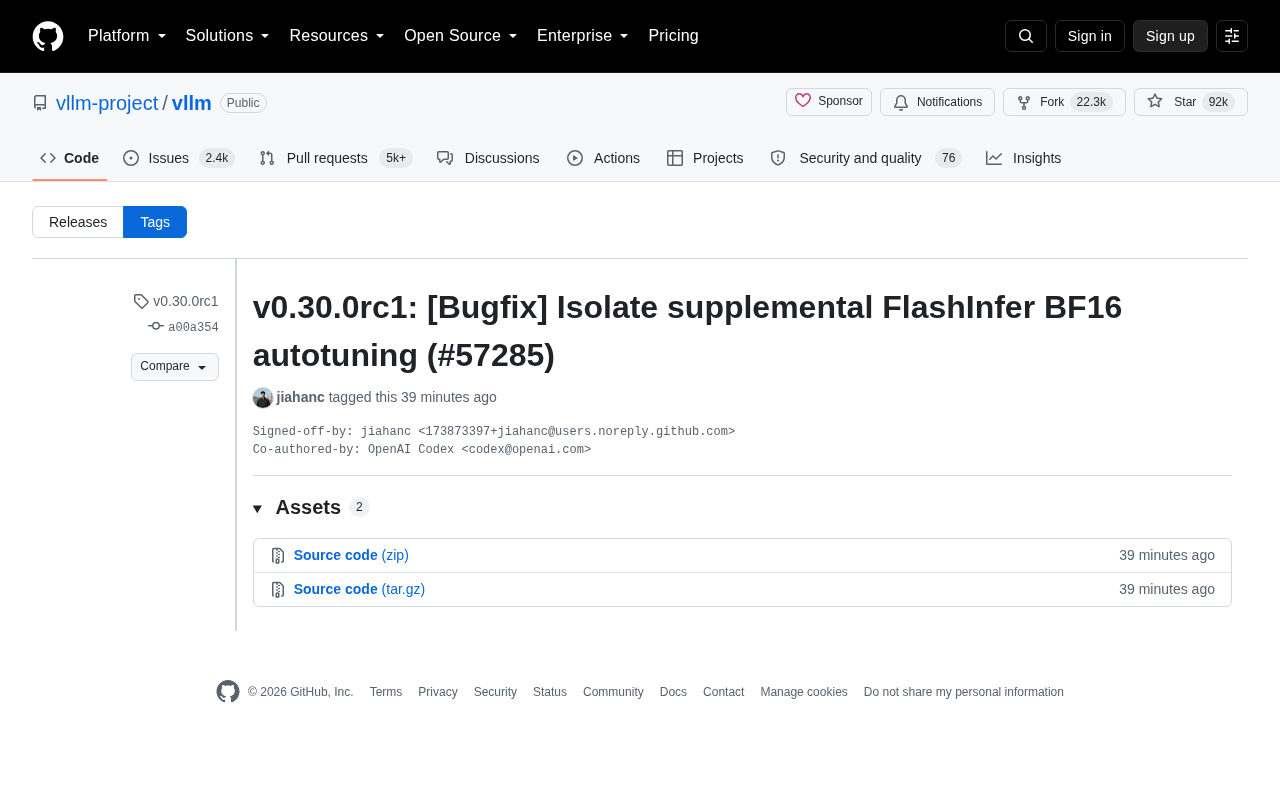
vLLM v0.30.0rc1 Released: Isolates FlashInfer BF16 Autotuning Logic
vLLM v0.30.0rc1 release candidate fixes FlashInfer BF16 autotuning isolation (PR #57285). Learn the technical background and its impact on inference deployment.
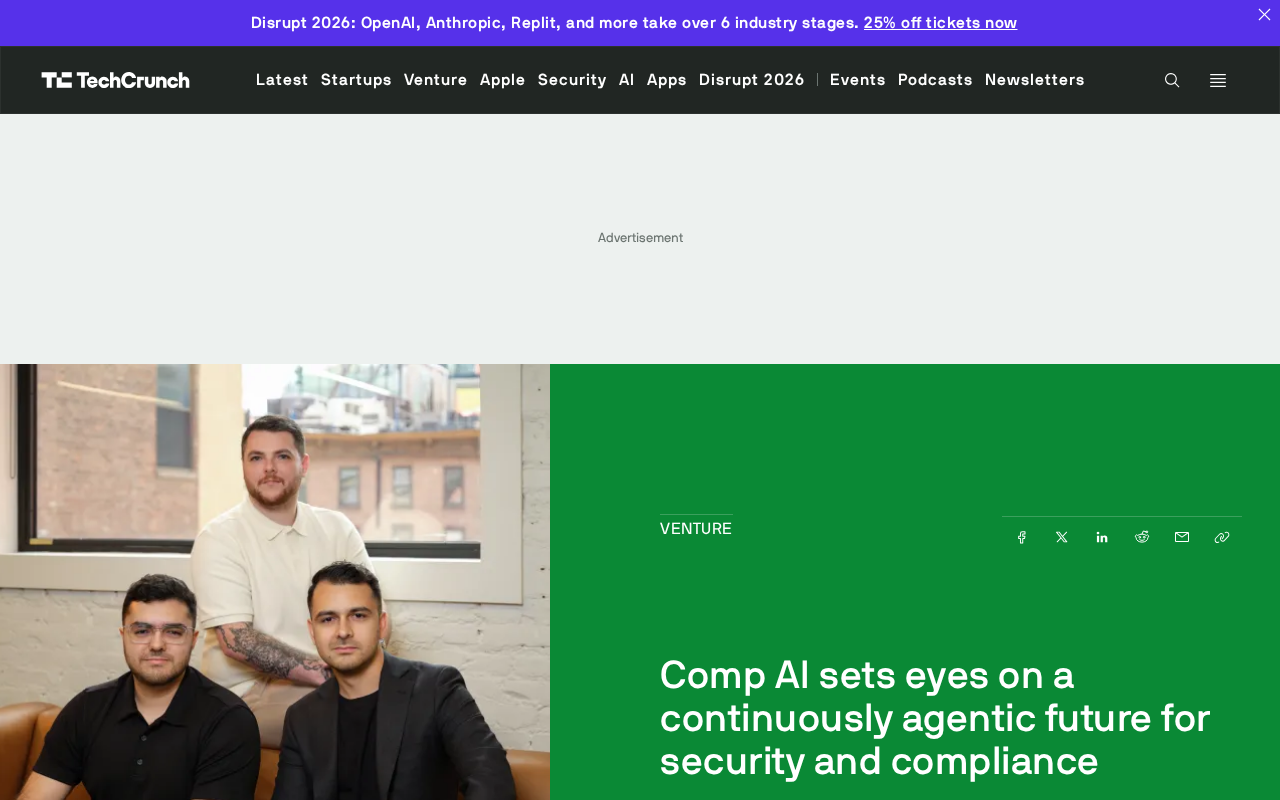
Comp AI Raises $34M Series A, Bets on Agentic Security Compliance
Comp AI raises $34M Series A led by Roo Capital and Grand Ventures, betting on "continuously agentic" AI to transform compliance from periodic audits into real-time monitoring.
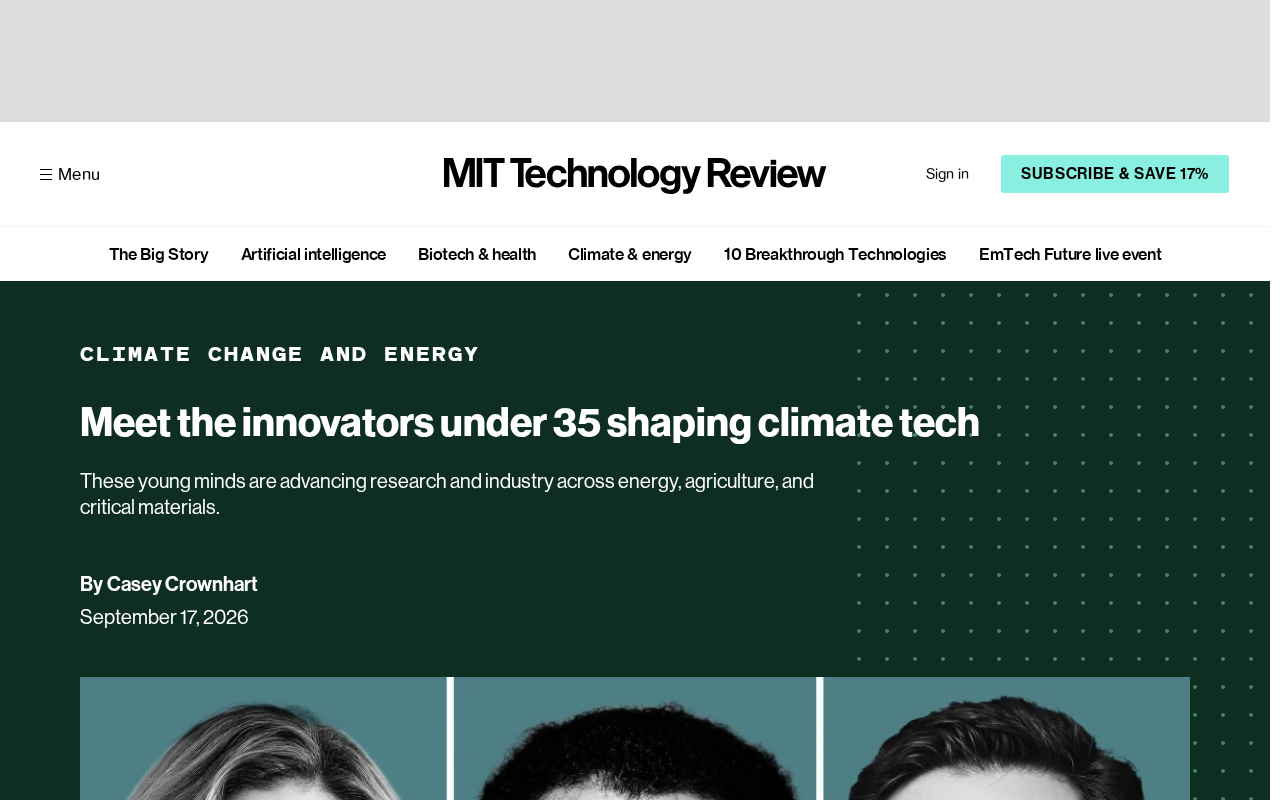
MIT Technology Review's 35 Innovators Under 35: A Climate Tech Edition Explained
MIT Technology Review's latest 35 Innovators Under 35 list focuses on climate tech, spotlighting nine young global innovators. Here's what the list means and why it matters.