Ollama Releases v0.35.1-rc2: Continuous Iteration of the Local LLM Runtime Tool

Ollama releases v0.35.1-rc2 candidate, fixing a CI build context issue ahead of the upcoming stable release.
Ollama published v0.35.1-rc2 on GitHub with an official GPG-verified signature. The key change fixes a missing build context in the CI pipeline (#18742) — an infrastructure fix rather than a user-facing feature. As one of the most popular local LLM runtime frameworks (182k+ GitHub stars), Ollama lets users run Llama, Mistral, Gemma, and more without cloud APIs. The rc2 release signals the v0.35.1 stable version is imminent, with features frozen and final stability validation underway.
Ollama New Pre-Release Version Goes Live
Ollama, the open-source local large language model runtime tool, recently tagged v0.35.1-rc2 (rc stands for Release Candidate) on GitHub. This version was published by maintainer dhiltgen at commit hash b0c1ca4, and passed GitHub's verified signature check (GPG key ID: B5690EEEBB952194), confirming that the release originates from an officially trusted identity.
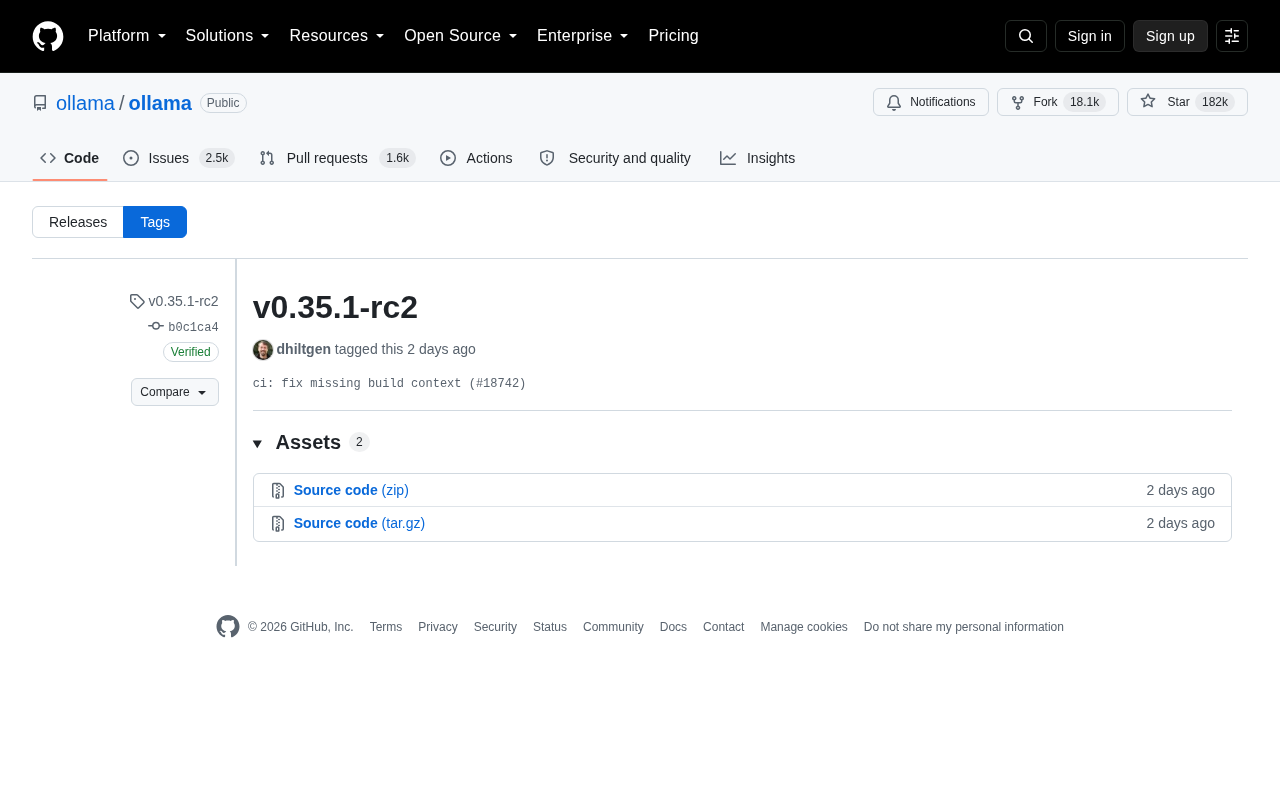
Based on publicly available information, the core change in this rc2 release centers on the continuous integration (CI) pipeline — the commit message reads "ci: fix missing build context (#18742)", meaning it fixes a missing build context issue. This type of change typically doesn't directly affect end-user functionality; instead, it ensures stability in the automated build and release process, representing infrastructure-level maintenance work.
Why Every Ollama Update Is Worth Paying Attention To
Ollama is one of the most popular local LLM runtime frameworks available today. Its GitHub repository has accumulated over 182,000 stars and 18,100 forks, reflecting an extremely active community. It enables developers and everyday users to pull and run mainstream open-source models such as Llama, Mistral, Gemma, and Qwen on their personal computers via simple command-line instructions — no complex environment setup required, no reliance on cloud APIs.
For users who prioritize data privacy, want to run models offline, or are looking to reduce inference costs, Ollama dramatically lowers the barrier to local LLM deployment. This is precisely why even seemingly minor release candidates in its version cadence are closely tracked by the developer community, allowing users to quickly benefit from performance improvements, model compatibility enhancements, and bug fixes.
What Does a Release Candidate Mean?
A Release Candidate (RC) is the final testing stage before a software's official release. rc2 indicates this is the second candidate, typically meaning the team has addressed issues discovered since rc1. At this stage, features are essentially frozen, and the primary goal is to validate stability across a broader range of environments — paving the way for the stable release.
In other words, the appearance of rc2 signals that the official v0.35.1 stable release is not far off. Early adopters can try it now, but for production deployments, waiting for the stable version is generally recommended.
Engineering Maintenance Is Also the Lifeblood of Open Source Projects
This update focuses on "fixing a missing build context" — a classic CI/CD maintenance scenario. A missing build context can prevent automated pipelines from correctly packaging build artifacts, which in turn affects the generation and distribution of cross-platform binaries. For a tool that needs to support macOS, Linux, and Windows simultaneously, the robustness of the build pipeline directly determines whether users can successfully download functional installation packages.
These "unglamorous" commits are precisely what enable large open-source projects to maintain their rapid iteration pace. Compared to eye-catching new features, continuously refined engineering infrastructure is often the true key to a project's long-term health.
CI/CD (Continuous Integration/Continuous Delivery) is a core practice in modern software engineering. Continuous integration means developers frequently merge code into the main branch, with each merge triggering automated build and test workflows to catch issues early. Build context is especially critical in containerized build scenarios (such as Docker) — it defines the range of files and environment information accessible during the build process. If the build context is missing, the pipeline may fail to locate required dependency files or configurations, causing errors or build failures when generating binaries for different operating systems (macOS, Linux, Windows) and CPU architectures (x86_64, ARM). For a cross-platform distribution tool like Ollama, a broken build pipeline could mean that installation packages on the GitHub Releases page are corrupted or incomplete — directly impacting the user experience. Fixing such issues may not introduce new features, but it is an essential prerequisite for ensuring reliable version delivery.
Summary
v0.35.1-rc2 is a transitional milestone for Ollama on its way to the next stable release. While no user-facing new features were disclosed in the publicly available information for this release, the verified-signature release process and the focus on build stability fixes both reflect the project's engineering maturity. Users interested in local LLM deployment should keep an eye out for the upcoming v0.35.1 stable release.
Related articles

"Black October": Did AI Uncover 3% of All Critical Vulnerabilities Ever?
A Reddit post claims 3% of all critical software vulnerabilities ever were found in the past month, dubbed 'Black October.' We break down the statistical issues, how AI-assisted code auditing accelerates discovery, and how developers should respond.

Microsoft Project Gecko: Using AI to Bridge Language Gaps for African Farmers
Microsoft's Project Gecko launches PharmaChat, letting African farmers ask questions in their native language and get precise video clips and farming book chapters via AI. The project also releases three interactive manuals to advance inclusive AI.

Musk's Space Dominance: How Starlink Throttling Undermines Ukraine's Defense
SpaceX's Starshield throttling disabled Ukraine's high-speed interceptor drones, exposing how Musk's private control over low Earth orbit communications affects battlefield dynamics and national security, and highlighting the risks of commercial space militarization and space governance dilemmas.