Ollama v0.40.0 Released: MLX Inference Engine Now Default on Apple Silicon

Ollama v0.40.0 makes MLX the default inference backend on Apple Silicon for native Mac performance.
Ollama v0.40.0 (pre-release) introduces a key change: on Apple Silicon devices, model architectures supported by the MLX runtime will now default to Apple's MLX framework instead of the llama.cpp-based path. Designed for the M-series unified memory architecture, MLX better leverages GPU and memory bandwidth. New models supported include gemma4, qwen3.6, qwen3.5, and Decision-type models like Nimble, tev1, clef, and clef-flash. The command-line experience remains unchanged and the backend switch is fully transparent to users.
Ollama has released v0.40.0 (currently in pre-release), and the most significant change in this update is: on Apple Silicon devices, model architectures supported by the MLX runtime will now run through MLX by default. For developers who regularly run large models locally on a Mac, this is a meaningful change at the infrastructure level worth paying attention to.
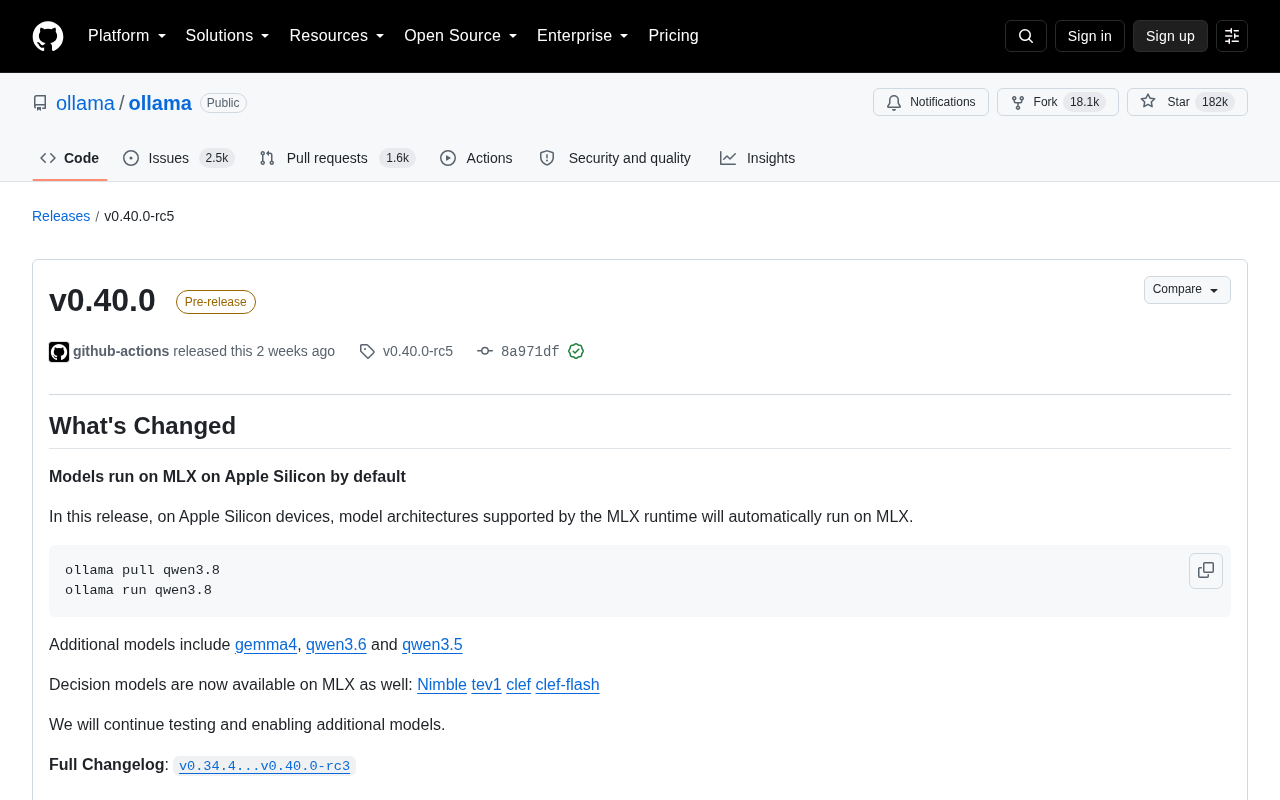
MLX Becomes the Default Backend on Apple Silicon
For a long time, Ollama on Mac primarily relied on the llama.cpp-based inference path. With v0.40.0, Apple's own MLX framework has been promoted to the default position — as long as a model architecture is supported by the MLX runtime, it will automatically execute via the MLX path.
MLX is a machine learning framework designed by Apple specifically for the unified memory architecture of Apple Silicon, enabling more effective utilization of the M-series chips' GPU and memory bandwidth. Setting it as the default means that on compatible models, Mac users can expect inference performance that more closely reflects the hardware's native capabilities — without needing to manually switch runtimes or do any additional configuration.
From a usage perspective, the command-line interface remains as clean and familiar as ever:
ollama pull qwen3.8
ollama run qwen3.8
Users don't need to change anything about how they work just to enable MLX. The switch to the new backend is completely transparent at the usage level.
MLX and llama.cpp — the previous default — differ fundamentally in their design philosophy. llama.cpp is a cross-platform C++ inference library that accesses the GPU on Mac via a Metal backend, but its architecture must accommodate a wide variety of environments including x86, ARM, and CUDA, which prevents it from being deeply tailored to Apple Silicon's Unified Memory architecture. MLX, on the other hand, was built by Apple's team specifically for M-series chips. Its defining feature is that the CPU and GPU share the same physical memory pool, eliminating the need to copy data between the two — which can significantly reduce memory bandwidth bottlenecks and lower latency during inference. MLX also natively supports lazy evaluation and automatic graph optimization, making matrix operations and attention mechanism computations more efficient on Apple Silicon. For users primarily deploying models on Mac, switching to the MLX path is essentially moving from a "general compatibility" mode to a "hardware-native" mode.
Newly Supported Models
The official release notes list the models being enabled alongside MLX in this release. Beyond qwen3.8 shown in the examples, the following are also included:
- gemma4
- qwen3.6
- qwen3.5
Additionally, a set of Decision-type models have also gained MLX support:
- Nimble
- tev1
- clef
- clef-flash
The team has made it clear that this is an incremental milestone — they will continue testing and gradually enabling more models. In other words, MLX coverage is still expanding, and not all models have been adapted yet. This is consistent with the pre-release designation: land the default behavior first, then continue filling out the ecosystem.
The "Decision-type models" mentioned above (such as Nimble, tev1, clef, and clef-flash) are a class of specialized models designed for specific decision-making and reasoning tasks. They tend to be smaller in scale but are optimized for structured output scenarios such as classification, routing, or task planning. Compared to general-purpose conversational models, their value in local edge deployment lies in low latency and low memory footprint — making them well-suited as schedulers in multi-agent systems or decision nodes within workflows. MLX support for these models means developers can build automation pipelines centered on local inference on a Mac, without relying on cloud APIs, which offers advantages in terms of both privacy and offline availability.
What This Means for Local Deployment Users
For local large model users who work primarily on Mac, this change has several practical implications.
First, there's performance potential. MLX is deeply optimized for Apple Silicon, and with it enabled by default, supported models may benefit from improved inference speed and memory utilization. However, actual gains will vary depending on specific hardware and model combinations — the team has not published unified performance benchmarks.
Second, there are compatibility boundaries. Since only some model architectures are currently supported by MLX, users upgrading should check whether their commonly used models are on the supported list. Models not on the list will continue to use the existing inference path — something worth keeping in mind when investigating performance differences.
Finally, there's version stability. v0.40.0 is currently marked as Pre-release, built from the rc5 release candidate. Users who prioritize stability in production environments may want to wait for the official stable release before upgrading; those eager to try the MLX default backend early can validate it in a test environment first.
Summary
Ollama v0.40.0 making MLX the default inference backend on Apple Silicon is a clear signal of Ollama's deeper commitment to the Mac ecosystem. Combined with support for new models like gemma4 and the qwen3 series, Mac users running large models locally can expect an experience that better reflects the hardware's native capabilities. Given that the release is still in pre-release and model coverage continues to expand, users are advised to weigh the timing of their upgrade based on their own use cases, and to keep an eye on the upcoming stable release and progress on model support.
Related articles

Free Unlimited Claude Code Solution: Agnes AI + CC Switch Setup Guide
No paid subscription needed — pair the free AI platform Agnes AI with the open-source tool CC Switch to provide a backend for Claude Code, enabling unlimited free calls to text, image, and video models. This guide covers the full setup, test results, and usage boundaries.

A Complete Zero-Cost Guide to Getting Started with Claude Code for Beginners in China
A beginner's guide to Claude Code for users in China: two installation methods (command line and IDE plugin), full configuration steps for replacing the official API with the free domestic LongCat model, and a hands-on demo of building a small tool with natural language, plus tips.

When the NSA Gets Involved: The AI Supply Chain Crisis Behind Open-Source CVEs and API Key Hijacking
Multiple open-source projects disclosed severe CVEs in one day, PHP flaws alarmed the FBI, and Railway and OpenCode were breached with API keys stolen. This article breaks down the vulnerability window, AI-accelerated exploitation, and the AI supply chain crisis behind the API key black market, with a developer defense checklist.