Ollama v0.40.9-rc1 Released: What Signals Does the llama.cpp Upgrade Send?

Ollama releases v0.40.9-rc1, centered on a synchronized upgrade of the llama.cpp inference engine.
Ollama has released the release candidate v0.40.9-rc1, whose main update is a synchronized upgrade of the underlying inference engine llama.cpp (commit #19194), a commit tagged by dhiltgen and verified via GPG signature. The article explains that llama.cpp iterates extremely fast, and Ollama as a downstream project periodically syncs upstream improvements, typically bringing new model architecture support, more efficient quantization formats, and slight CPU/GPU backend speed gains that require testing. As an rc build, it suits early adopters and testers, while production users should wait for the official release. The article also notes that local inference competition is essentially about underlying engine efficiency, and Ollama's steady, upstream-following iteration is more valuable for private deployment than aggressive expansion; watch community benchmarks after the official release before upgrading.
A "Lightweight" Release That Hides the Steady Evolution of the Inference Engine
Ollama has released v0.40.9-rc1, a release candidate build. Judging from the commit history on GitHub, the core of this update centers on one main thread: synchronizing the upgrade of llama.cpp (commit #19194).
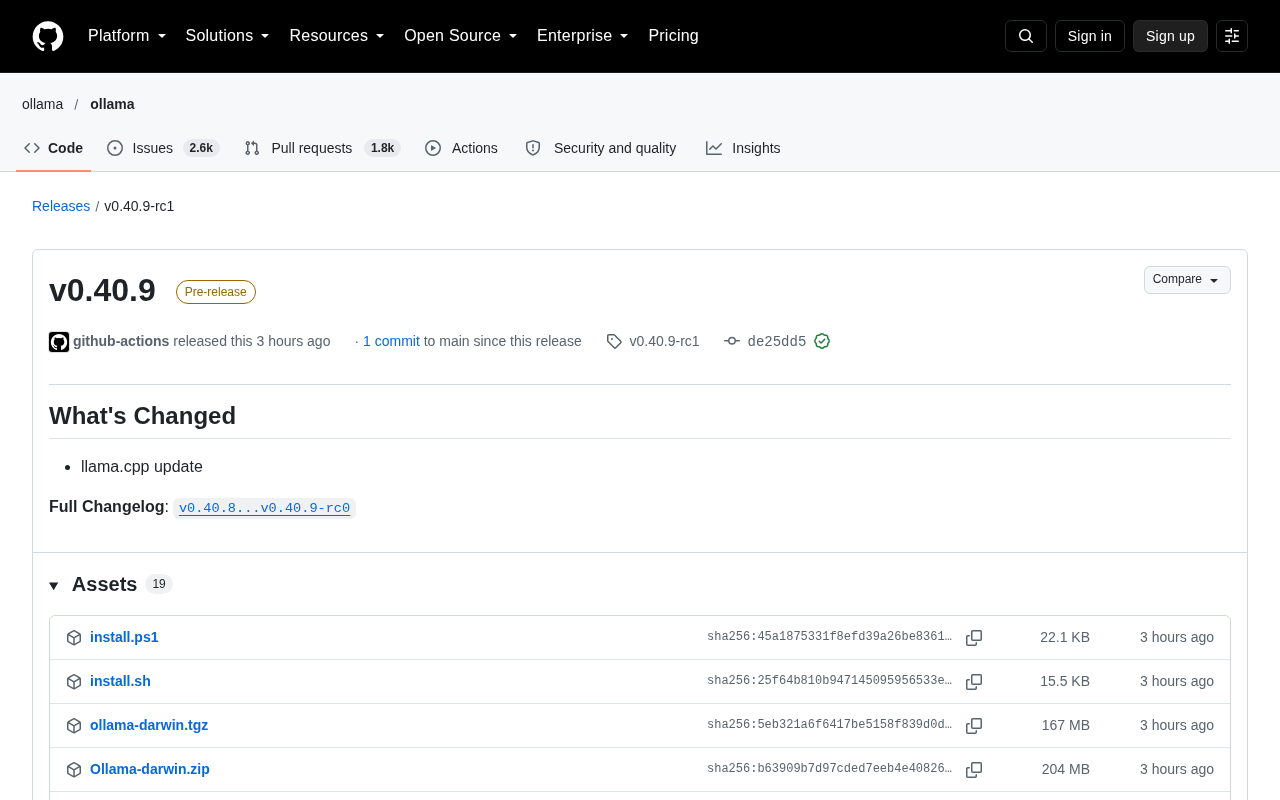
For readers unfamiliar with Ollama, it is currently one of the most mainstream tools for local large model deployment, letting users spin up open-source models like Llama, Qwen, and Gemma with a single command on personal computers, workstations, or even servers. llama.cpp is the workhorse inference engine behind it—responsible for model loading, quantization computation, and inference acceleration. Therefore, whenever Ollama catches up with a llama.cpp version, it often means underlying performance, model compatibility, or quantization support will change accordingly.
You may not have noticed that the tag information on GitHub shows this commit was tagged by dhiltgen, and the commit has a GitHub-verified signature (GPG key ID: B5690EEEBB952194), indicating this is an official release that went through the proper process. The rc1 naming also indicates this is a test round before the official release, and there may be an rc2 afterward or a direct promotion to stable.
What the llama.cpp Sync Upgrade Means
Routine Iteration of Inference Performance and Model Support
The llama.cpp community iterates extremely fast, with optimizations for new model architectures, quantization formats, and hardware backends merged almost every week. As a downstream project, Ollama typically does a concentrated sync after accumulating several upstream improvements. The main change in v0.40.9-rc1 is this sync action.
From a practical standpoint, these updates usually bring several kinds of impact: newly released open-source models can be supported by Ollama more quickly; the computational efficiency of certain quantization formats (such as Q4_K_M, Q8_0, etc.) may improve; and inference speed on CPU and some GPU backends may also see slight improvements. Of course, the specific gains depend on the hardware and model combination and need to be verified through actual testing.
llama.cpp was originally initiated by Georgi Gerganov in 2023, with the goal of implementing large language model inference in pure C/C++,摆脱 dependence on heavyweight frameworks, and thereby running efficiently on consumer CPUs, Apple Silicon, and various GPUs. It comes with its own model quantization toolchain, supports the GGUF model file format, and relies on the ggml tensor library for underlying computation. Precisely because of this, Ollama does not implement its own inference kernel, but embeds llama.cpp as the engine, focusing itself on model distribution, Modelfile configuration, service-oriented APIs, and cross-platform packaging. Understanding this division of labor makes it clear why a "llama.cpp sync" that looks like just a version number bump is actually equivalent to introducing, all at once, the architecture adaptations, operator optimizations, and backend improvements accumulated upstream over several weeks.
The relationship between GGUF and GGML is often confused: GGML is the underlying tensor computation library, while GGUF is a model file container format built on top of it, used to package weights, tokenizers, and metadata into a single file. GGUF replaced earlier legacy formats such as GGML/GGMLv3 and supports more flexible metadata extension, which is also one of the prerequisites for new models to be integrated quickly.
The Q4_K_M and Q8_0 mentioned in the article belong to the k-quant quantization scheme. Quantization is the process of compressing model weights from 16-bit floating point into lower-bit integer representations to significantly reduce VRAM/RAM usage and improve throughput. The naming convention is roughly as follows: Q indicates quantization, the number represents the average bit width, the K suffix indicates the use of k-quant block quantization, and S/M/L correspond to the three tiers of mixed-precision strategy—small/medium/large. The larger the tier, the more high-precision weights are retained, giving better quality but a larger size. Q8_0 is an earlier 8-bit block quantization with high precision but limited compression; Q4_K_M, at the 4-bit level, strikes a balance between size and quality through mixed precision and is one of the most commonly used default tiers in local deployment. The impact of different quantization tiers on inference speed is not linear and also depends on whether the hardware supports the corresponding integer or mixed-precision instructions.
Suggestions for Using rc Versions
Release candidate versions are suitable for users who want to try new things early and help with testing. If you use Ollama in a production environment or in workflows that depend on stability, it is recommended to wait for the official release before upgrading. The main value of rc versions is to expose compatibility issues early, especially behavior with custom Modelfiles, special quantized models, or non-mainstream hardware platforms.
In semantic versioning and pre-release processes, rc (release candidate) refers to a candidate build whose features have been frozen and which is preparing for promotion but is still undergoing final verification. It is usually released with an -rcN suffix after the official version number is determined. If no blocking issues are found during testing, that build may become the official version directly, or an rc2 may be released due to fixes. Adjacent concepts include alpha (early internal verification) and beta (features basically complete and aimed at broader testing). For a self-hosted tool like Ollama, the risks of rc versions are mainly concentrated in binary distribution and runtime compatibility, rather than the features themselves.
The Competitive Rhythm of Open-Source Local Inference Tools
Ollama's strategy of closely following llama.cpp reflects a reality: competition in the local inference space is, to a large extent, competition in the efficiency of the underlying engine. Whoever merges upstream optimizations faster can gain an early advantage in "running a higher token/s on the same graphics card."
That said, Ollama's recent release cadence also shows that the team is continuously polishing engineering details rather than merely piling on features. For a tool widely used by developers and enterprises for private deployment, this steady iterative approach is more valuable than aggressive feature expansion.
For practitioners focused on local AI deployment, it is advisable to pay attention to community benchmark data after the official release, especially the actual inference speed changes brought by the llama.cpp upgrade, before deciding whether to follow up with an upgrade.
One-line Summary
Ollama releases v0.40.9-rc1, with the core being a synchronized upgrade of the llama.cpp inference engine.
Paragraph Summary
Ollama has released the release candidate v0.40.9-rc1. The main thread of this update is the synchronized upgrade of the underlying inference engine llama.cpp (commit #19194), a commit tagged by dhiltgen and verified through GPG signature. The article explains that llama.cpp iterates extremely fast, and Ollama, as a downstream project, periodically syncs upstream improvements in a concentrated way, usually bringing adaptation to new model architectures, improved efficiency of quantization formats, and slight improvements in CPU/GPU backend inference speed, with specific gains requiring actual testing. Because it is an rc version, it is suitable for users willing to try new things early and help expose compatibility issues, while production environments are advised to wait for the official release. The article also points out that competition in the local inference space is essentially competition in underlying engine efficiency. Ollama's iteration strategy of closely following upstream and steadily polishing engineering details is more valuable for private deployment scenarios than aggressive expansion, and it is recommended to watch community benchmark data after the official release before deciding to upgrade.
Related articles

Amphibious Transforming Drone: Beyond 100x Power Savings, What Are the Real Needs?
Is the amphibious transforming drone just a gimmick? Starting from the 100x power difference of the M4 Morphobot, explore real application scenarios and thesis topic ideas, analyzing boundary conditions where pure drones and pure ground robots both fail.

Warhound Raises $200 Million: Genetically Engineered "War Dogs" Paired with Anduril Gear
Warhound raises $200M, backed by Ben Lamm and Palmer Luckey, to genetically engineer dogs for military and law enforcement use and equip them with Anduril gear. This article analyzes its technology direction, funding logic, and ethical controversy.

Claude API Comes to Google Cloud: IAM Integration and SDK Access Guide
Anthropic hosts the full Claude API on Google Cloud with IAM-controlled permissions and unified billing. This guide covers the Vertex AI and Anthropic-hosted entry points, IAM role configuration, and SDK access.