OmniDiff: An Open-Source Content-Aware Git Diff Tool Built in Rust

OmniDiff is a content-aware Git diff tool written in Rust that supports non-text files such as images and PDFs.
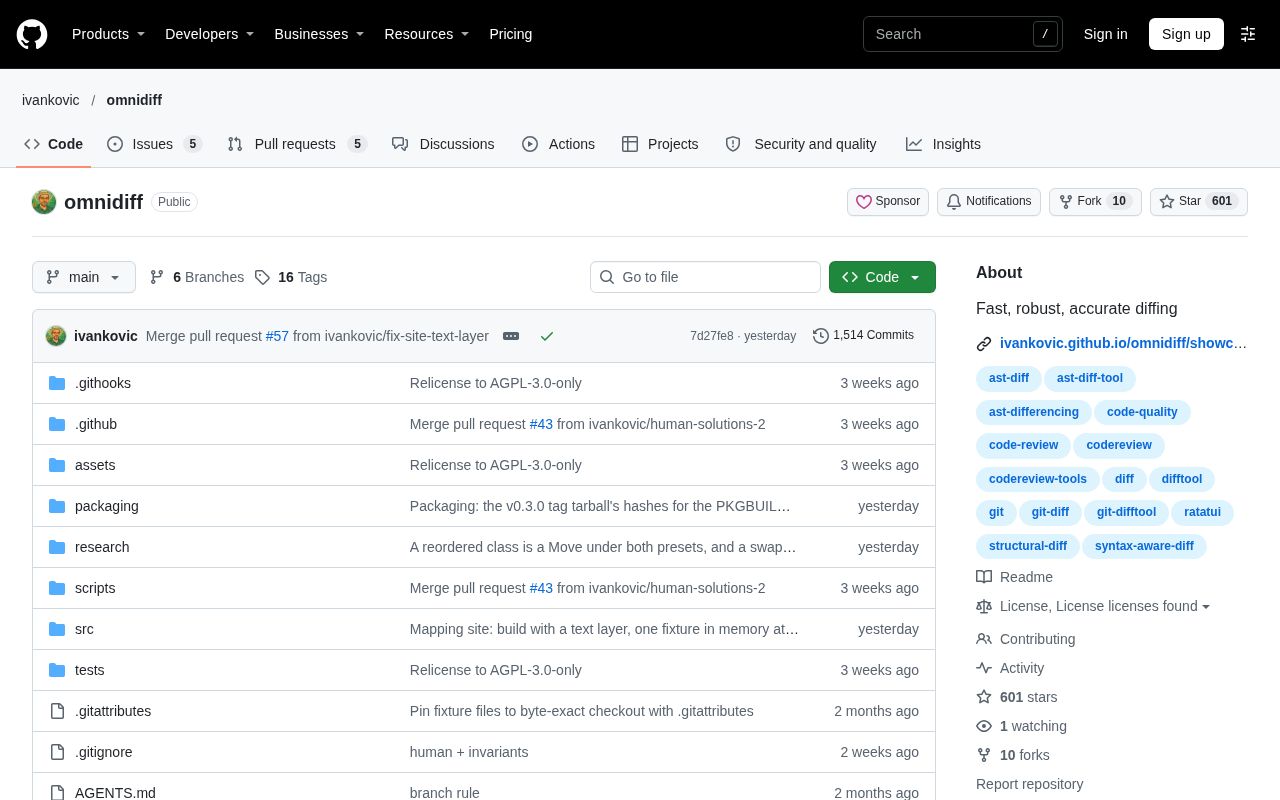
OmniDiff is an open-source, content-aware Git diff tool written in Rust, designed to overcome the limitation that traditional diff only handles plain text. It identifies code (25 languages), configuration files, images, PDFs, archives, fonts, and more, applying the corresponding diff strategy. Its design is based on manual analysis of 7,400 repositories in Gentoo packages and 2,000 real diff samples. It can compare a C++ file with tens of thousands of lines in under 100 ms. The project uses the AGPLv3 license, its current version is v0.3.0, the author has used it daily for months, and he candidly notes that he used AI-assisted development rather than full AI code generation.
Overview
In code review and version control, diff tools are something developers use every day. But traditional tools often only handle plain-text diffs, and are left helpless when faced with images, PDFs, fonts, or even binary files. OmniDiff aims to change this: it is an open-source, fast, content-aware Git diff tool written in Rust that can identify file types and apply the corresponding diff strategy.
Content-aware: beyond text
OmniDiff's core innovation is being "content-aware." According to the author's introduction on Hacker News, it supports diffing code (25 languages), configuration files, images, PDFs, archives, fonts, and many other content types. This means developers can intuitively compare changes to non-text files without leaving the terminal or their Git workflow.
This capability comes from the author's in-depth research into real-world diffs. The author analyzed 7,400 repositories listed in Gentoo packages, extracted 2,000 diff samples, and resolved them manually, in order to understand the diff pipeline that each content type truly needs. This data-driven approach ensures the tool's practicality in real-world scenarios, rather than remaining merely theoretical.
Diff strategies and pipelines: A "diff pipeline" refers to the entire processing flow for a given class of files, from reading and parsing to comparing and rendering. For plain text, the pipeline is usually a line-level or character-level Myers/Patience algorithm; for images, the pipeline may first decode pixels, compute perceptual hashes, or compare block by block, and then present the differing regions visually; for PDFs, the page structure or text streams must first be extracted before comparison. Different content types define "what counts as a diff" differently, so pipelines need to be customized per type. OmniDiff determines the pipeline each type should use by analyzing a large number of real diff samples, an approach that avoids the false positives and noise that come from forcing a single text algorithm onto every format.
Content-aware: Content-aware means the tool first identifies a file's true type (for example, via magic numbers, extensions, or content probing) before processing it, and then selects the corresponding parsing and comparison method accordingly. This contrasts with traditional diff tools that "always process by bytes or by lines." The benefit of being content-aware is that it reduces meaningless diff output—such as byte-offset changes in binary files or timestamp changes in image metadata—so that reviewers can focus on the changes that are semantically truly important.
Performance
OmniDiff also excels in performance. The author claims that on a 2023 ThinkPad T14s, it can diff a C++ file containing tens of thousands of lines of code in under 100 milliseconds. This benefits from the efficiency of the Rust language and a carefully designed diff algorithm. For large projects, this speed can significantly improve the efficiency of code review and day-to-day development.
Rust and diff algorithms: Rust's ownership model and zero-cost abstractions give it near-C/C++ performance while guaranteeing memory safety, making it particularly well suited to diff scenarios that require extensive string processing and memory operations. The choice of diff algorithm directly affects complexity: the Myers algorithm has high time complexity in the worst case, whereas Patience diff and Histogram diff first match unique lines and then recurse, which can significantly reduce computation in large files and produce more readable diff hunks. OmniDiff's claim of comparing a C++ file with tens of thousands of lines within a hundred milliseconds typically means it has applied pruning, chunking, or parallelization at the algorithmic level and avoided unnecessary full parsing.
Open source and development status
OmniDiff is open-sourced under the AGPLv3 license, and the current version is v0.3.0. The author says he has already used it as his daily Git diff tool for several months, and it runs well. Although it is still in the development stage, the tool already has a certain degree of stability. The author also mentions that a CI pipeline built on real diffs further improves the robustness of the codebase.
AGPLv3 license: The GNU Affero General Public License v3 (AGPLv3) is a strong copyleft license that adds network-service terms on top of GPLv3. Its key difference is that if a modified program provides services to users over a network, it must also provide those users with the corresponding source code. For a command-line tool, this clause mainly affects scenarios in which it is embedded in network services or SaaS products. Choosing AGPLv3 usually indicates that the author wants to ensure derivative works remain open source, and companies and individuals need to assess their compliance obligations before integrating it into closed-source products or hosted services.
v0.3.0 and the CI pipeline: A 0.x version number indicates, under semantic versioning, that the API is not yet stable and may undergo breaking changes, making it suitable for early adopters to evaluate rather than for depending on in production-critical paths. A CI pipeline built on real diff samples means solidifying diff test cases extracted from real repositories into automated tests, so that every commit regression-tests the diff results for each content type, thereby preventing parsing or rendering logic from degrading during rapid iteration.
A note on AI usage
In the post, the author specifically notes that he did use AI to assist development, but not "vibecode" (that is, relying entirely on AI-generated code without review). This candid attitude is commendable in the open-source community, and it also reflects the reasonable role of AI tools in modern software development.
Conclusion
OmniDiff brings a new approach to Git diff tools: through content awareness and efficient implementation, it frees diff comparison from being limited to text. For developers who need to handle multiple file types, this is an open-source project worth paying attention to. As subsequent versions iterate, it has the potential to become a staple in developers' toolboxes.
One-line Summary
OmniDiff is a content-aware Git diff tool written in Rust that supports non-text files such as images and PDFs.
Paragraph Summary
OmniDiff is an open-source, content-aware Git diff tool written in Rust, designed to break through the limitation that traditional diff can only handle plain text. It can identify multiple content types—code (25 languages), configuration files, images, PDFs, archives, fonts, and more—and applies the corresponding diff strategy. Its design is based on manual analysis of 7,400 repositories in Gentoo packages and 2,000 real diff samples to ensure practicality. In terms of performance, a comparison of a C++ file with tens of thousands of lines can be completed within 100 milliseconds. The project uses the AGPLv3 license, the current version is v0.3.0, the author has used it daily for several months, and he candidly states that he used AI to assist development but did not rely entirely on AI-generated code.
Related articles

9 AI Subscription Plans Compared: The Real Cost Per 100M Tokens Revealed
Bilibili creator tests 9 AI subscription plans from Volcano, Alibaba, Tencent, Baidu, Zhipu, Xiaomi, MiniMax and more, converting them all to real cost per 100M tokens, breaking down fixed-quota vs. three-tier coefficient billing and how caching, time-of-day discounts, and window limits affect actual quota.

Vibe Coding for Beginners: Expressing Intent Instead of Handwriting Code
What is Vibe Coding? A 137-episode Bilibili course defines it: the core is expressing intent, not writing code. This article analyzes Vibe Coding's productivity logic, target audience, and entry expectations to help beginners decide if it's worth learning.

LangChain Beginner's Guide: An Agent Development Roadmap from LangGraph to Deep Agents
Clarify the encapsulation relationship among LangChain, LangGraph, and Deep Agents, and master the learning path and selection logic for agent development frameworks—suitable for beginners in large model development.