One-Click Local AI Multi-Node Deployment: How Panel AI Lowers the Bar for Private Deployment

Panel AI brings Baota-style simplicity to private AI deployment with vLLM/Ollama support and multi-node management.
The video introduces Panel AI, an AI infrastructure management panel designed to standardize large model deployment, installation, and multi-node monitoring — analogous to Baota Panel and 1Panel in traditional web ops. It offers a one-click app marketplace, multi-machine cluster node management, and dual admin/user interfaces, with support for both vLLM (performance-focused) and Ollama (ease-of-use). Private deployment is handled by running a copied command on your own server with guided prompts throughout. The business model mixes subscriptions with limited-time perpetual licenses during holidays. The article cautions that the video is essentially a promotional demo lacking quantitative performance or security validation — teams with real private deployment needs should evaluate independently.
Starting from a Comment Section Debate: Do AI Management Panels Actually Matter?
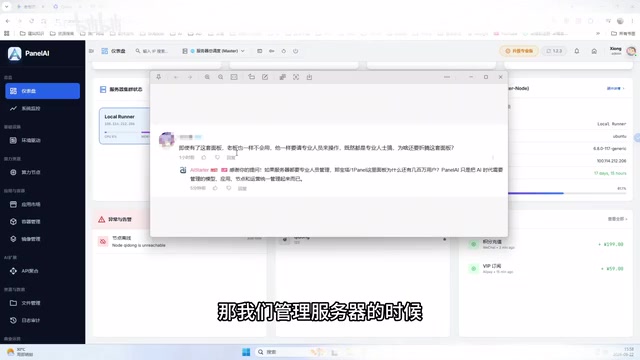
A content creator (who goes by "Xiong Ge / Qiong Ge") mentioned in a video that a viewer left a skeptical comment: even with an AI management panel like this, the boss still won't use it — you'll end up needing a professional anyway. And if a professional is already involved, why bother with the panel at all?
This question cuts right to the core value proposition of all "ops panel" products. The creator's response is worth noting: just look back at the era of server management. Tools like Baota Panel and 1Panel have accumulated tens of millions of users and hundreds of thousands of paying customers — and a large portion of those users are professional ops engineers. The reason is simple: these panels save professionals 60–80% of their operational time, while also making things accessible to beginners.
Apply that same logic to the AI era, where the management targets shift from servers to models, applications, and nodes — all while handling operations and private deployments — and the workflows become even more complex. There's an even greater need for a unified "home base" to bring everything together. That's exactly what Panel AI, as described in the video, is trying to be.
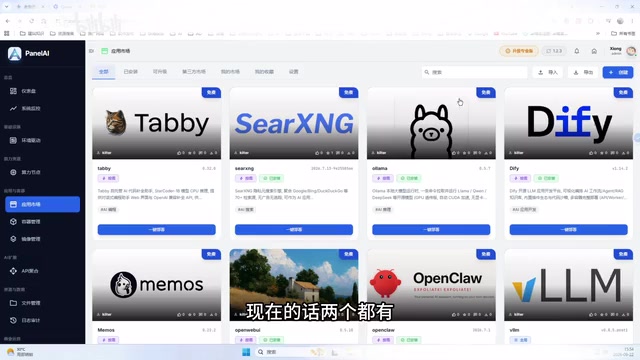
Core Features: App Marketplace and One-Click Deployment
Based on the demo, this panel looks like an "AI app store + ops console" hybrid. The creator walked through several key modules:
App Marketplace and One-Click Installation
Opening the app marketplace reveals multiple listed projects. Clicking "All" lets you browse everything, with direct one-click download and installation. Beyond the projects themselves, the marketplace is designed to include categories for models, plugins, and skills. The creator mentioned these would be gradually added before the holiday break, ready to use as soon as they're installed.
One noteworthy detail is the choice of runtime framework: the video mentions that many users want vLLM support because it runs large models faster than Ollama, while others prefer Ollama for its simplicity — especially on Windows. The current system supports both, letting users choose based on their needs. This "performance vs. ease-of-use" balancing act is exactly the kind of tradeoff that defines panel-type products.
vLLM is a high-performance large language model inference framework developed at UC Berkeley. Its core innovation is the PagedAttention memory management mechanism, which can multiply GPU VRAM utilization several times over while supporting Continuous Batching — delivering far higher throughput than traditional inference methods in high-concurrency scenarios. It's best suited for Linux server environments with NVIDIA GPUs and is primarily aimed at production-grade deployments. Ollama, on the other hand, is a lightweight local model management tool that supports macOS, Windows, and Linux. It's extremely easy to install — a few commands are all you need to run quantized open-source models (like LLaMA, Mistral, etc.) on consumer-grade hardware. The fundamental difference is this: vLLM prioritizes throughput performance at the cost of higher hardware and system requirements, while Ollama prioritizes ease of use at the cost of some performance. This is precisely why AI management platforms targeting different user groups need to support both.
Multi-Machine Clusters and Node Management
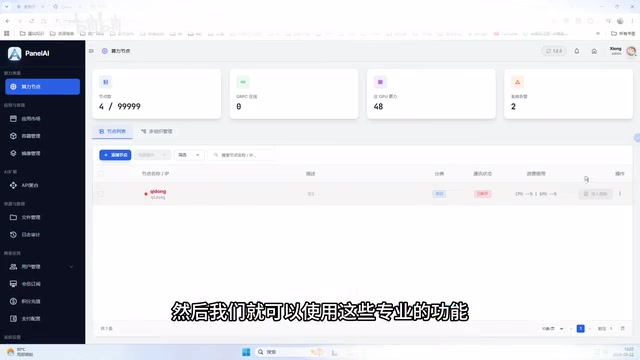
Clicking into "One-Click Deploy" lets you select nodes, with support for multi-machine cluster mode — add any server you own, install, and you're ready to go. The creator emphasized that nodes can be continuously added, theoretically allowing management of many machines, with authorization handled through binding and activation. Permanent licenses have no expiration date.
Deployment Workflow: From Backend Debugging to Frontend Use
The system distinguishes between two perspectives — the admin view and the end-user view — reflecting its design goal of serving both professionals and beginners simultaneously.
Admins can open a project in the operations module and click "Debug" to launch it; deployed projects automatically appear on the frontend. Regular users don't need to deal with complex configurations — once a project is installed, it shows up in the frontend interface. They simply click "Create Instance" or "Start" on an existing instance, then open the page from "My Instances."
For private deployment, the creator's recommended path is: bring your own server, copy the installation command provided by the system, paste and run it on your server. Once complete, it automatically generates frontend and backend addresses along with credentials, and prompts you about which ports need to be opened — all with guided instructions throughout. He also acknowledged that the demo server he used had modest specs — no dedicated GPU and only 4GB of RAM — meaning it could only run small projects for demonstration purposes. Getting real performance still requires matching hardware.
What Is "AI Infrastructure"?
The video repeatedly references a concept many people don't fully grasp: "AI infrastructure." The creator's explanation is straightforward — with a system like this, you can one-click download, install, and deploy all kinds of AI projects, while centrally monitoring the status of your entire server fleet and multiple nodes.
Compared to deployment methods that require manual step-by-step configuration with cumbersome, error-prone processes, the differentiating value of panel-type products lies in "encapsulating complexity." They don't promise to replace professionals — instead, they standardize the repetitive, error-prone work of deployment and operations, freeing up professionals' time while giving non-technical users a path to get started. This mirrors exactly the trajectory that Baota Panel and 1Panel traveled in traditional web ops.
Business Model and a Few Observations
On the commercial side, the creator mentioned the product previously used a subscription model, with a temporary "perpetual license" option (essentially buying out the current version) opened during the Mid-Autumn and National Day holiday period, with plans to build automated workflows post-holiday so new projects can be automatically listed and go live once approved.
Based on the content, this video is fundamentally a product demo tied to a holiday promotion. A few things worth keeping in mind:
- The video is primarily a narrated walkthrough demo, with no quantitative validation of performance, stability, or security;
- The vLLM vs. Ollama tradeoff is a real industry decision, but the video provides no concrete comparative data;
- A demo on low-spec hardware only proves "it can run" — it says nothing about production environment performance.
For teams with genuine local or private AI deployment needs, the core value proposition of this type of panel — lowering the barrier to entry, centralized multi-node management, one-click deployment — is directionally sound. But whether it's worth investing in still requires independent evaluation based on your own hardware capabilities, model scale, and data compliance requirements. Don't base a decision solely on a single demo.
Background Context
From a broader perspective, the concept of "AI infrastructure" has surged in recent years alongside the explosion of demand for private large model deployments. For reasons of data security, regulatory compliance, and cost control, enterprises are increasingly inclined to deploy models on their own servers or private clouds rather than relying entirely on API interfaces from providers like OpenAI and Anthropic. This has created demand for an entire toolchain around model hosting, inference acceleration, access control, monitoring, and alerting. The success of Baota Panel and 1Panel in web service operations proved there is a massive market for "wrapping ops complexity into a visual interface" — and the AI side has analogous needs: model version management, multi-node compute scheduling, app listing and review workflows — all involve repetitive, error-prone operations that panel-type products aim to standardize.
Related articles

Gaussian Process Bandit Optimization: Exploration Strategies and Inference Regret Guarantees
Cumulative regret guarantees in Bayesian optimization fail to reflect final recommendation quality. This article examines a new study that provides inference regret guarantees for Gaussian process bandit optimization through exploration query strategies and fill distance analysis, validated on hyperparameter optimization and control tasks.

The Most Detailed Codex Guide on Bilibili: From Installation to Real-World Practice
The most detailed Codex guide on Bilibili: from app store installation to daily work mode configuration, with a real coffee shop project demonstrating file organization, data extraction, dashboard creation, and other practical tasks. Learn to use Plan Mode and desktop pets to leverage Codex efficiently.

Appearance Compensation in Volume Rendering: Why RGB Accuracy Cannot Guarantee Density Correctness
Volume rendering research reveals that volumetric data perfectly reproducing external RGB views may still contain density errors: appearance compensation can double central density and keep external rays unchanged even when L2 error exceeds 14.52%. Density recovery depends on appearance capacity, spatial resolution, and measurement design.