One Developer Used LLMs Solo to Build C Compiler Kcc — and It Can Boot the Linux Kernel

One developer used LLMs at $100/month to solo-build a C compiler that boots the Linux kernel.
A developer shared Kcc on Hacker News — a C compiler built solo with LLM assistance at roughly $100/month — that reportedly can compile and boot the Linux kernel, a demanding correctness benchmark. The case highlights how projects with well-defined specs and automated validation are natural fits for LLM collaboration, with humans handling architecture while models accelerate implementation. The real significance isn't that Kcc rivals GCC, but that AI-assisted development is making system-level software increasingly accessible to individual developers.
One Person, $100/Month, a C Compiler That Runs Linux
A post on Hacker News sparked a modest but noteworthy discussion: a developer used large language models (LLMs) to independently build a C compiler called Kcc — and it reportedly can compile and boot the Linux kernel. Two key details stood out in the project description: solo development and roughly $100/month in LLM costs.
Those two numbers reveal something real about where AI-assisted programming stands today. What once required a team and years of effort — building system-level software — is now something individual developers can attempt at a manageable cost. The post itself didn't go viral (7 points, 4 comments), but the question it raises — whether LLMs can handle something as correctness-critical as a compiler — is well worth exploring.
Why "Compiler + Boot the Kernel" Is a Meaningful Bar
A C compiler is never a toy project. It requires fully implementing lexical analysis, parsing, semantic checking, intermediate representation, optimization, and code generation — while correctly handling the many edge cases and undefined behaviors that C is infamous for.
And "can boot the Linux kernel" is an exceptionally rigorous acceptance test for compiler correctness. The Linux kernel heavily depends on GCC-specific behaviors, inline assembly, various compiler extensions, and precise control over code generation details. A compiler that can build the kernel and successfully boot it has demonstrated substantial language coverage and code correctness — something that's in an entirely different league from "can compile Hello World."
That's why Kcc uses "boot Linux kernel" as its headline claim: it's invoking a widely recognized, high-difficulty benchmark to prove the project's legitimacy.
The Cost Math of LLM-Assisted Development
The "$100/month" figure is worth pausing on. It suggests the developer wasn't burning through the most expensive models indiscriminately — this work was done within a relatively modest budget.
That gives independent developers a useful reference point:
- Projects with well-defined specs and automated verification — like compilers — are particularly well-suited for LLM collaboration. Every step has a ground truth: the C standard, test suites, whether the kernel boots. Code generated by the model can be quickly validated and iterated on.
- Controllable costs mean replicability. A monthly spend in the low hundreds makes "AI-assisted system software development" something individuals can actually experiment with, not just large organizations.
Of course, the $100/month refers to LLM API or subscription fees — it doesn't account for the significant time and expertise the developer themselves invested. The LLM here functions more like a tireless pair programming partner than a full replacement for human judgment.
It's worth noting that pair programming as a collaborative model is already well-supported by software engineering research. In traditional pair programming, two developers share a workstation — one writes code while the other reviews in real time — and studies consistently show this reduces bugs and accelerates knowledge transfer. An LLM as an "AI pair partner" brings a distinctive advantage: it never gets tired of repetitive tasks, can synthesize vast technical documentation in milliseconds, and can simultaneously play the roles of questioner, code reviewer, and implementer within the same session. Compiler development involves a lot of pattern-driven work — generating parser scaffolding from grammar specs, extending code generation backends for new instruction sets — which maps naturally onto what this kind of collaboration does best. This explains why system-level projects with clearly defined specs and automated verification are seeing deep LLM involvement earlier than more open-ended product software.
How to Think About This Kind of Project
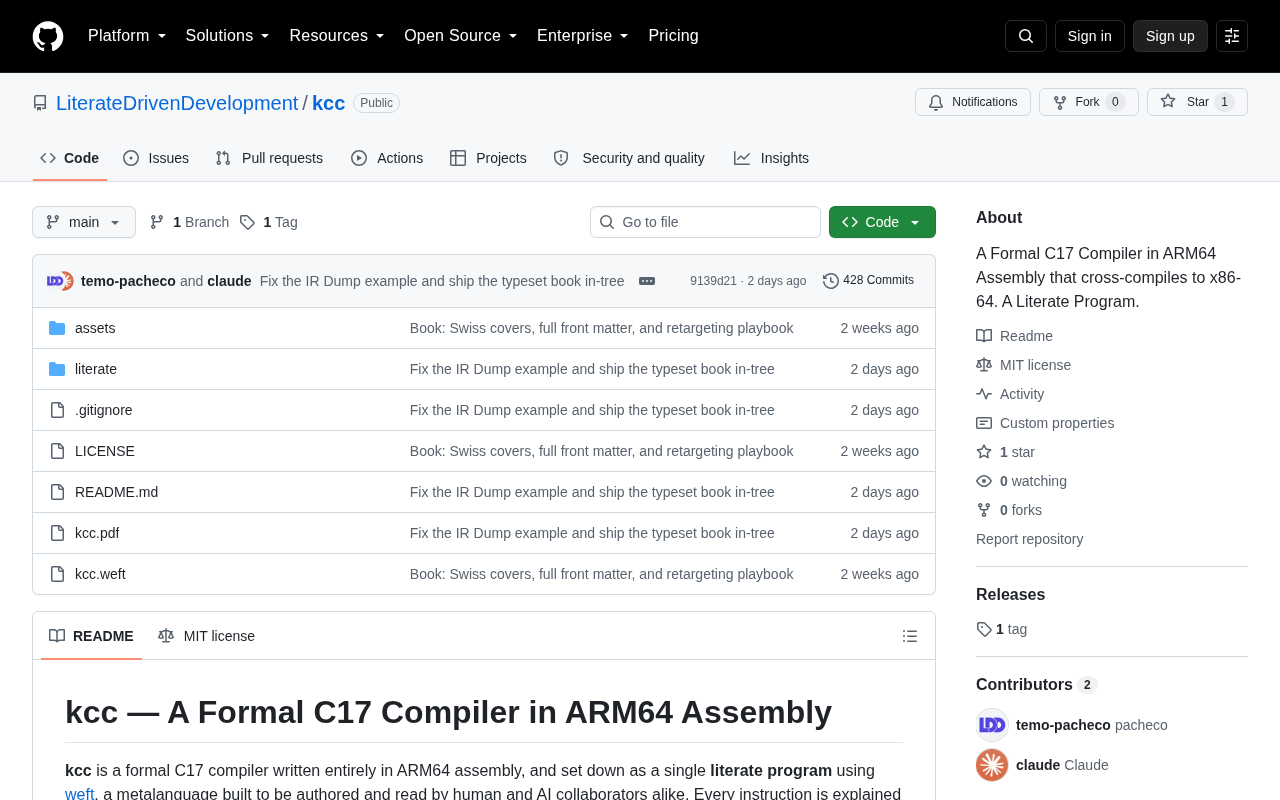
Some healthy skepticism is warranted: the original post is light on detail — just a title, minimal engagement, and a screenshot. There's no public performance comparison, test coverage data, or code quality assessment. The following should be read as commentary on the broader phenomenon, not an authoritative evaluation of Kcc itself.
What's Promising
Kcc represents a worthwhile attempt at LLM-assisted development in a high-complexity, high-constraint domain. Compiler development has clear right-and-wrong standards, which is precisely where LLMs can contribute most effectively — humans handle architecture and hard decisions, the model fills in implementation details and accelerates iteration.
What to Be Cautious About
"Can boot the kernel" doesn't mean "production-ready." A compiler's maturity also depends on optimization quality, the performance of generated code, support for various architectures and edge cases, and long-term maintainability. A solo project will almost inevitably fall short of GCC or Clang, which have decades of accumulated engineering behind them.
There's also the question of maintainability and subtle bugs in heavily LLM-generated code. Errors in a compiler can silently propagate into every program it compiles — a particularly insidious failure mode.
Closing Thoughts
Kcc is a case study with limited information but plenty of talking points. It offers a concrete data point — one person, low cost, LLMs, a C compiler that boots Linux — to the ongoing question of how far AI can take a developer.
For those tracking the frontier of AI-assisted programming, the real thing to watch isn't this one project, but the trend it represents: as LLM capabilities combine with developer expertise, the once-forbidding barrier to entry for system-level software is coming down, bit by bit.
Background Context
The traditional reference points for compiler development are GCC and LLVM/Clang. GCC has been around since 1987, its codebase spans over 15 million lines, and it's maintained by hundreds of full-time engineers. LLVM has evolved over more than two decades into a modular, industrial-grade compiler framework. For these reasons, the industry has long viewed "independently building a C compiler that runs Linux" as a goal achievable only with organizational-scale resources.
Historically notable small-team or solo compiler efforts — like TCC (Tiny C Compiler) — have been lightweight and fast, but have always lagged behind mainstream compilers in GCC extension compatibility and code generation quality, and never targeted "boot the Linux kernel" as a design goal.
Kcc puts this bar back on the table for discussion. Its significance lies less in challenging GCC's production dominance and more in resetting expectations about what individual developers can achieve — and at what cost.
Related articles

Bilibili's Hit Dify Tutorial: A Practical Guide to Building 20+ AI Apps from Scratch
A distilled guide to Bilibili's top-rated Dify tutorial: Windows + Docker deployment, MySQL connection, five app types, model integration strategy, and publishing.

Agent Skills Beginner's Guide: From Concepts to Multi-Agent Collaboration in Practice
A comprehensive guide to Agent Skills: core concepts, components, the importance of Description, standardization, beginner learning paths, and multi-agent collaboration.

One Neuron Detects Both Cats and Cars? We Reproduced It and Found a New Explanation
The cat-car neuron reinterpreted: researcher Cammarata argues it distinguishes pointy from round, not cats from cars. We reproduced the experiment and found the new explanation holds on most inputs—but cars are the exception. The interpretability debate continues on language models.