One Flock License Plate Match Put an Innocent Woman Behind Bars for 13 Days
A single Flock license plate match wrongfully jailed an innocent woman for 13 days, revealing structural risks in AI-powered policing.
A real-world case is putting U.S. law enforcement's reliance on Flock Safety's ALPR technology under scrutiny: an innocent woman was detained for 13 days based solely on a single camera "hit." The article traces both the technical roots — OCR misreads, stale hotlist data, and cross-state plate duplication — and the systemic judicial failure of treating automated alerts as unquestionable proof rather than leads requiring independent verification. Deeper still, private surveillance companies are deeply embedded in law enforcement while operating outside clear legal oversight, blurring accountability and making victim redress nearly impossible. The article calls for mandatory human review, auditable decision records, and clear accountability mechanisms before any AI recognition system is deployed in law enforcement.
A Case of Wrongful Imprisonment Triggered by a Single Data Match
Automatic License Plate Recognition (ALPR) technology has spread rapidly through U.S. law enforcement in recent years, with Flock Safety being one of the most prominent players in the field. The company has deployed tens of thousands of cameras across the country, scanning and logging passing vehicles' license plates in real time — claiming to help police quickly track suspect vehicles and recover stolen cars. But a real-world case has exposed the serious consequences this system can produce when human verification is absent: an innocent woman was held for 13 days based solely on a match from a single Flock camera.
The incident sparked discussion on Hacker News, pointing directly at the problem of over-trusting automated surveillance technology within the judicial chain. When an algorithm produces a "hit" and neither law enforcement nor the courts independently verify that result, a technical error translates directly into the loss of an ordinary person's freedom.
How Automatic License Plate Recognition Works — and Where It Fails
The core logic behind systems like Flock is straightforward: cameras capture vehicle images, optical character recognition (OCR) converts the plate into text, and that text is compared against a police "hotlist." Any match triggers an alert to law enforcement.
The problem is that this seemingly objective data pipeline has multiple failure points. OCR itself can misread characters — confusing similar ones like 0 and O, or 1 and I — and poor lighting or camera angles compound these errors. Hotlist data can also be outdated, incorrectly entered, or involve license plate numbers that exist in multiple states. When these errors stack up, a false "hit" can point to a completely unrelated vehicle and driver.
More critically, officers often treat system alerts as high-confidence direct evidence rather than leads that require further verification. This blind trust in automated results is precisely what drives wrongful arrests and detentions.
It's worth noting that cross-state plate duplication is a particularly acute problem in the United States. Each state manages its own license plate numbering independently, meaning the same alphanumeric combination can legally exist on two entirely unrelated vehicles in different states. When an out-of-state vehicle enters an area covered by cameras and a hotlist happens to contain the same number associated with a stolen or suspect in-state plate, the system fires a false alert. ALPR systems generally cannot reliably distinguish a plate's state of origin from the image alone — state identifiers are usually located at the plate's edges, in small fonts with varying designs, and are easily missed or misread by OCR in low-light or high-speed situations. This means false positives aren't occasional technical glitches — they're an architectural flaw baked into the system, one whose potential impact only grows as nationwide hotlist-sharing becomes more widespread.
How a Technical Error Becomes a Judicial Injury
In this case, the fact that a single data match could spiral into 13 days of imprisonment reveals that the problem goes far beyond camera accuracy. It reflects a broader failure of the judicial process to check automated evidence.
Once an alert triggers an arrest, there should be an independent human verification step to confirm whether the vehicle, owner, time, and location actually match. But if officers assume the system "can't be wrong," that verification becomes perfunctory — and the wrongly identified person's objections are powerless against what appears to be objective, technical evidence. Thirteen days of detention means not just lost freedom, but potentially cascading harm to employment, reputation, and mental health. And nearly all of those costs are borne by the individual who was misidentified.
The Accountability Problem Behind Mass Surveillance Deployment
Flock's camera network has drawn sustained controversy for two reasons: its coverage is now broad enough to constitute near-blanket surveillance of public roads, and the accuracy of its data, retention periods, and access controls lack transparent external oversight.
When a private company's technology becomes deeply embedded in law enforcement and the courts, accountability becomes murky. Is a misidentification the fault of the camera manufacturer, or of the police who acted on the data? And who does the wrongly arrested person even file a complaint against? Without clear legal frameworks and technical audit standards, individual redress is extremely difficult. That's exactly why cases like this deserve attention from both the tech and legal communities — improvements in technical efficiency shouldn't come at the cost of procedural justice.
Flock Safety's business model makes the oversight gap even worse. The company sells not only to police departments, but also to residential communities, property management firms, and private homeowners — feeding all of those private nodes into a unified data-sharing network. This means large volumes of surveillance data are collected by private parties yet flow seamlessly into law enforcement systems, sidestepping the legislative approvals or public hearings that public procurement and data use would normally require. Investigations by organizations like the ACLU have found that many residents don't even know cameras have been installed in their neighborhoods, let alone understand how long the data is retained or who can access it. This gray zone of "privately deployed, publicly used" surveillance makes it extremely difficult for existing privacy laws to intervene effectively.
Lessons for AI Surveillance Deployment
This wrongful detention is a textbook example of "human-machine collaboration" gone out of balance. Any probabilistic recognition technology will have a false positive rate. The question has never been how to eliminate errors — it's how to design robust enough verification and correction mechanisms so that algorithmic output is the starting point of a decision, not the conclusion.
For public sector agencies rapidly deploying AI recognition and prediction systems, several lessons are clear. First, automated results must be paired with mandatory human review. Second, algorithmic decisions affecting citizens' rights should generate traceable, auditable records. Third, clear accountability and redress channels are essential. Technology can be a tool for law enforcement, but the moment it becomes unquestionable "digital proof," the risk has already been quietly embedded.
Note: This article is based on discussion threads from Hacker News. Source reporting details are limited; for specific case information, refer to authoritative media and official statements.
On the technical side, the false positive rate is the core metric for evaluating the reliability of systems like these — yet its real-world harm is routinely underestimated in enforcement contexts. Suppose an ALPR system has a false positive rate of just 0.1%. That sounds negligible. But at the scale of millions of vehicles scanned per day, it still generates thousands of erroneous alerts daily. When those false positives enter the enforcement pipeline without adequate filtering, what is statistically a low-probability event becomes, for the individual wrongly flagged, a one-hundred-percent harm. That's precisely why aggregate accuracy figures cited by technology vendors cannot serve as a shield against scrutiny in individual cases — system-level high precision and individual-level zero tolerance for error are two entirely separate problems that must be evaluated independently.
Related articles

M&M's Spent Millions Replacing Artificial Blue Dye — Why Is It So Hard?
Mars spent millions trying to replace artificial blue dye in M&M's with spirulina, but thick material clogs pipes and residue risks mold, forcing a full production-line rebuild. Here's the engineering behind the reformulation.

Teammate Wanted for Meta Global AI Developer Hackathon: Computer Vision & Medical AI
A Reddit developer seeks teammates for the Meta Global AI Developer Hackathon, focusing on computer vision and medical AI. This article analyzes the track logic, skills-complementarity needs, and topic selection strategy behind this teaming signal.
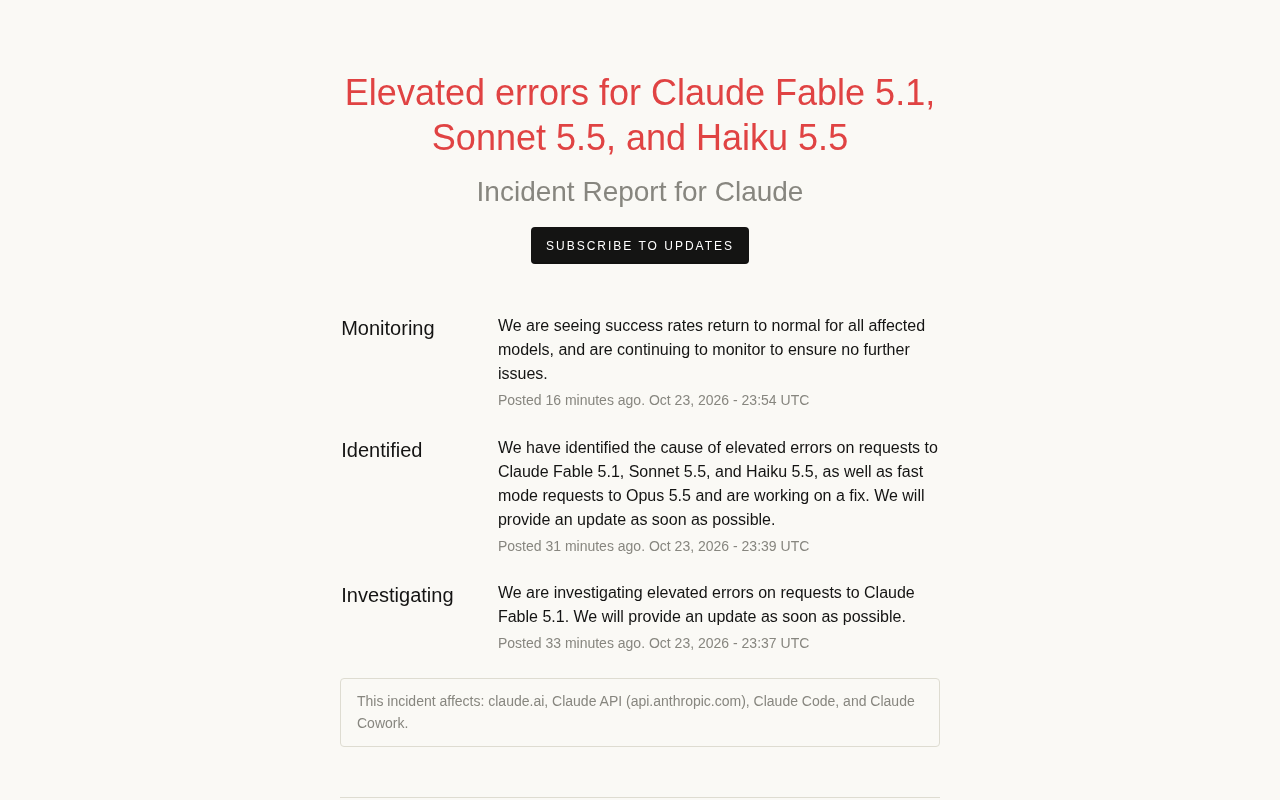
Multiple Claude Models Hit by Errors: A Postmortem of Fable 5.1, Sonnet 5.5, and Haiku 5.5
Claude Fable 5.1, Sonnet 5.5, Haiku 5.5, and Opus 5.5 fast mode saw elevated errors; Anthropic identified and resolved the issue in 17 minutes. This postmortem covers the timeline, the technical reasons for the multi-model cascading failure, and practical lessons for retry and degradation strategies.