One Person, One AI Toolchain, One Bank Breach: The Security Wake-Up Call Behind ARTEX

An AI toolchain may have let one person breach major South Korean banks, reshaping the cybersecurity threat landscape.
Several major South Korean banks were recently hit by a cyberattack that CrowdStrike believes may have been carried out by a single attacker, using the ARTEX open-source AI penetration framework as an orchestration layer alongside DeepSeek, GLM, Grok, and Claude Code. The incident's significance lies not in its scale, but in how it reveals AI systematically lowering the barrier to APT-level attacks — capabilities that once required specialized teams are now within reach of a single operator wielding an automated toolchain. The security community remains divided on where "AI-assisted" ends and "AI-autonomous" begins, but the message for financial institutions is clear: traditional perimeter-based defenses and manual response are no longer enough.
A Bank Cyberattack Possibly Launched by a Single Person
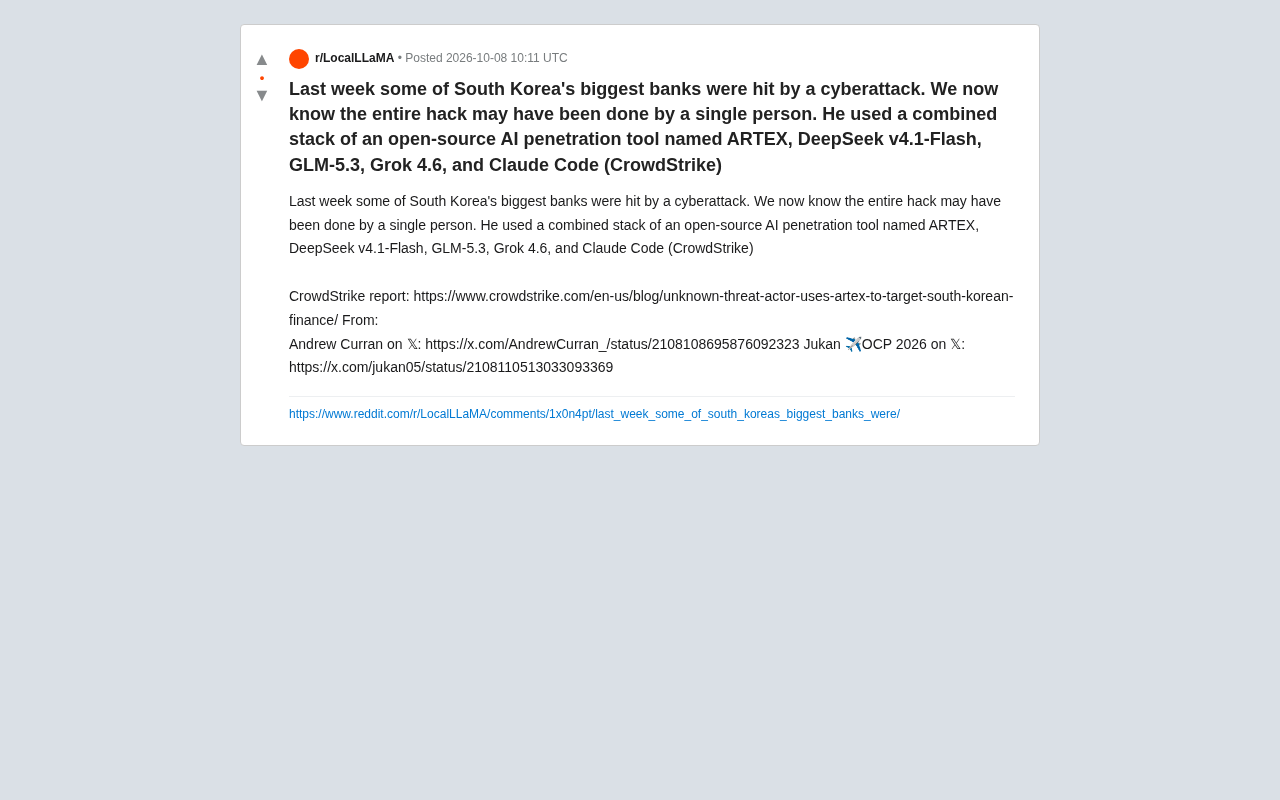
Several major South Korean banks were recently hit by a cyberattack. According to a report from security vendor CrowdStrike, what appeared to require an organized team may have been the work of a single attacker. What's sparked widespread discussion in the security community isn't the scale of the attack itself, but the toolset involved — a fully AI-driven penetration stack.
CrowdStrike disclosed that the attacker used an open-source AI penetration testing tool called ARTEX, chaining it together with multiple mainstream large language models — including DeepSeekAd v4.1-Flash, GLM-5.3, Grok 4.6, and Claude Code. This approach of assembling an open-source attack framework with a mix of commercial and open-source LLMs marks a turning point: AI-driven cyberattacks are moving from theoretical concept to operational reality.
A New Attack Paradigm, Seen Through the Toolchain
What makes this incident alarming is what it reveals about the democratization of attack capabilities. Historically, advanced persistent threats (APTs) targeting major financial institutions required large teams with distinct roles — someone for reconnaissance, someone writing exploits, someone maintaining infrastructure. AI toolchains are compressing all of that into what a single operator can manage.
The Role of ARTEX
As an open-source AI penetration tool, ARTEX handles the orchestration of automated attack workflows. It lowers the technical bar for attackers across phases like information gathering, vulnerability probing, and lateral movement. Its open-source nature means anyone can obtain, modify, and deploy it — which is standard practice in the security research community, but inevitably carries the risk of misuse.
The rise of AI-driven penetration testing frameworks stems from the security research community's demand for automated red team exercises. Tools like these typically operate as an "attack orchestration layer" — they don't directly carry out attacks, but coordinate multiple sub-modules or external tools to execute tasks in a predefined logical sequence. Similar open-source frameworks include the early Metasploit (focused on exploit execution) and the various agent frameworks derived from AutoGPT. ARTEX's differentiator is its integration of large language models into the decision-making loop — when presented with reconnaissance results, the model can dynamically adjust the next attack path without requiring human intervention at every step. This automated "perceive-decide-act" feedback loop is the most fundamental distinction from traditional script-based attack tools. For defenders, detection logic based on attack signature databases faces a greater challenge, because AI-generated attack variants are difficult to cover with fixed rule sets.
The Significance of Multi-Model Coordination
Rather than relying on a single model, the attacker combined DeepSeek, GLM, Grok, and Claude Code. There's a practical logic behind this multi-model strategy: different models excel at different tasks — code generation, reasoning and analysis, bypassing safety restrictions, and so on. Claude Code handles code-heavy tasks, while Grok, DeepSeek, and GLM were likely used for content generation and decision support at different stages. By distributing the workload, the attacker both circumvented the content safety filters of any single model and improved overall attack efficiency.
This multi-model coordination strategy is technically referred to as "model routing" or "LLM orchestration" — the core idea is to select the optimal model for each sub-task, analogous to a microservices architecture in enterprise software. In the context of security offense and defense, this strategy has an even more concrete motivation: evading the content safety review of any single model. Different model vendors place different emphasis on refusal training, so a request that one model rejects may go through without issue on another. By splitting sensitive tasks and distributing them across different models, an attacker can systematically bypass single-point interception. This also explains why the combination spans Chinese open-source models (DeepSeek, GLM) alongside Western commercial models (Grok, Claude Code) — this isn't a matter of technical preference, but a deliberate strategy to circumvent safety barriers by diversifying across systems.
Disagreements and Concerns in Community Discussion
The news triggered extensive discussion on Reddit and X. Security researchers including Andrew Curran and Jukan shared and analyzed the CrowdStrike report on X, amplifying the conversation further.
There's a clear divide in perspectives. Some argue that this represents a genuine inflection point — AI has materially changed the rules of the game, enabling a single person to launch attacks that previously required a team, forcing defenders to fundamentally reassess their threat models. Others are more measured, pointing out that there remains a significant gap between "AI-assisted" and "AI-autonomous" — no matter how powerful the toolchain, it still requires a person with domain expertise to operate and make decisions, and the threat should not be overblown.
It's worth noting that the claim that "the entire attack may have been carried out by a single person" remains an inference based on the CrowdStrike report, not a fully confirmed conclusion. The original language preserves this uncertainty with the phrasing "may have been."
Practical Implications for Financial Sector Security
Whether the attacker was one person or a small team, this incident raises sharp questions for financial sector defense.
Traditional defense frameworks largely assume there is an upper bound on attacker resources and skills. AI toolchains are raising that ceiling for individual attackers. This means:
- Attack frequency and volume may increase, as a lower barrier to entry attracts more participants;
- Attacks evolve faster — AI-generated attack code and strategies can iterate rapidly, undermining signature-based defenses;
- Defenders must use AI to fight AI — automated detection and response is shifting from an option to a necessity.
For high-value targets like banks, perimeter defense alone is no longer sufficient. Continuous behavioral monitoring, anomaly detection, and the ability to recognize patterns of AI misuse are becoming the new priorities for security infrastructure.
The threat escalation facing the financial industry has a specific backdrop. Banking systems typically rely on a "defense in depth" model, with detection checkpoints at multiple layers — network perimeter, identity verification, transaction monitoring, and more. However, AI-assisted attacks can accelerate the compression of "dwell time" — the window between initial intrusion and the completion of lateral movement. Traditionally, attackers spent weeks or even months moving through internal networks before completing reconnaissance; an AI toolchain can compress that process to a matter of hours, leaving security operations centers (SOCs) that rely on manual log analysis unable to respond in time. The MITRE ATT&CK framework has in recent years added dedicated classification entries for AI-assisted attack techniques, reflecting the industry's formal acknowledgment of this trend. This is precisely where the core value of AI for defenders lies: matching machine speed with machine speed.
The Double-Edged Sword of Open-Source AI Tools
The ARTEX incident once again puts the governance challenge of open-source AI tools front and center. Open source has advanced security research, allowing defenders to study attack techniques and prepare accordingly. But the same tools in the hands of malicious actors become ready-made weapons.
This isn't a problem that can be solved by simply "banning open source." More realistic directions include: model vendors strengthening detection and blocking of high-risk use cases; the security community establishing rapid intelligence-sharing mechanisms around AI-driven attacks; and regulators drawing clearer boundaries around the use of AI penetration tools.
This attack on South Korean banks may just be the beginning. As AI becomes a standard component of the attack stack, the entire security industry needs to upgrade its defensive paradigm — and fast.
The governance challenge of open-source security tools is known in academic circles as the "Dual-Use Research of Concern" (DURC) dilemma, first systematically discussed in the context of biosecurity before extending to cybersecurity and AI in recent years. The mainstream mitigation approaches currently operate at three levels: first, the tooling layer — introducing behavioral detection in open-source code repositories to identify obvious malicious usage patterns; second, the model layer — using RLHF (reinforcement learning from human feedback) and red-team testing to reduce the likelihood of models being exploited for offensive tasks, though as this incident demonstrates, multi-model coordination can circumvent this mechanism; third, the legal and regulatory layer — some countries have already criminalized the unauthorized use of penetration testing tools, but cross-border enforcement remains difficult. How to establish effective guardrails without stifling security research innovation remains an open question with no settled answer.
Related articles

REA: Reverse Engineer Any App with AI, No Coding Required
REA is a viral open-source AI reverse-engineering tool that lets Claude, Codex, and other AI agents analyze any app and generate functional clones—no coding required. This article covers how it works, installation, a hands-on test, and legal risks.
2026 AI Coding Tools Comparison: Claude, ChatGPT, Gemini — Which Is the Best?
A 2026 comparison of five mainstream AI coding tools — Claude Code, ChatGPT Codex, Gemini, DeepSeek, and GitHub Copilot — on real projects, pricing, and code quality, to help you decide where that $20/month should go.

ChatGPT Codex Can Clone Any Software? Testing the Risks and the Truth
YouTube shorts claim ChatGPT Codex or Claude Code can clone Adobe, Excel, and Figma for lifelong free use. We break down the feasibility, legal risks, and DM-funnel tactics—and explain what AI coding tools are truly good for.