OnePlus 16 Launches: Why This Flagship Is the Most Interesting After the Brand's Exit from the US and Europe
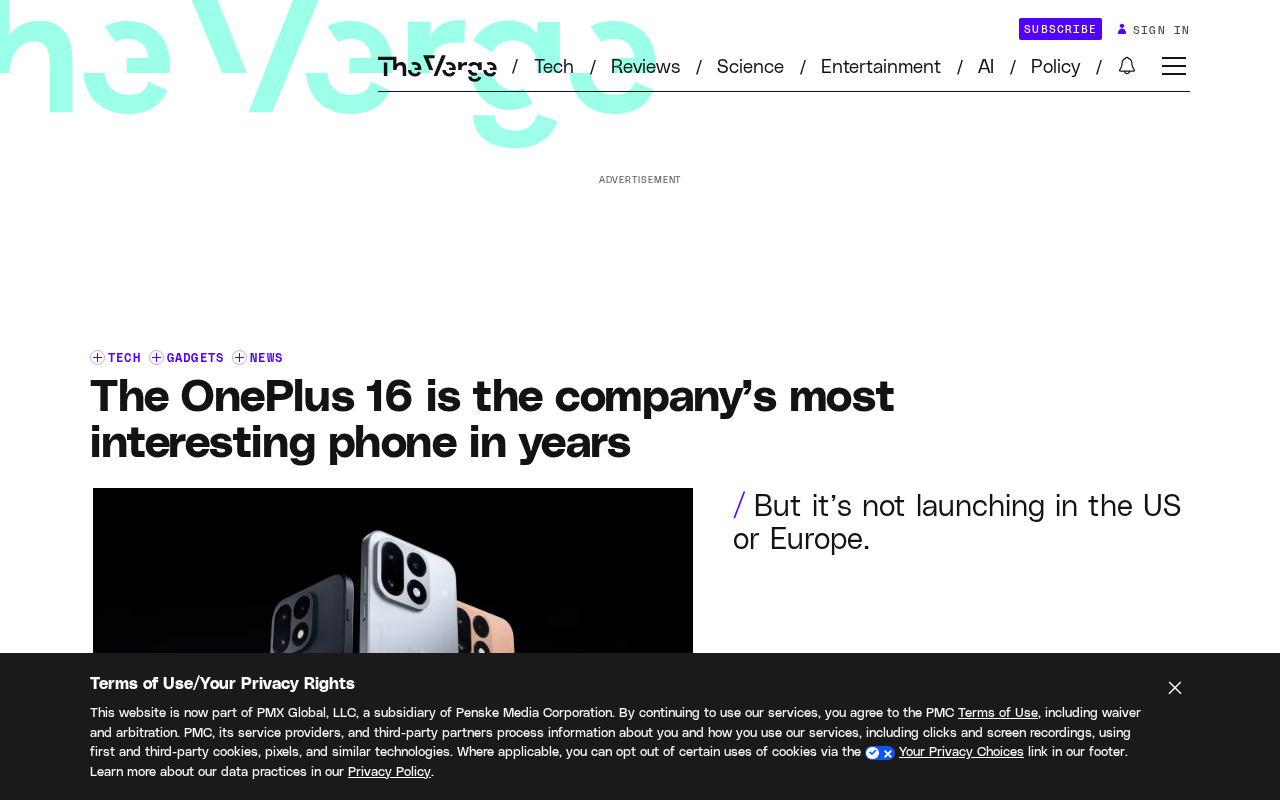
OnePlus 16 launches in China as its first flagship after exiting the US and European markets, focusing on performance and experience.
The OnePlus 16 has officially launched in China as OnePlus's first flagship after exiting the US and European markets. It features the Snapdragon 8 Elite Extreme Gen series chip and continues the brand's performance-first positioning. Withdrawal from the US and Europe lets OnePlus avoid balancing carrier partnerships, band compatibility, and pricing across regions, allowing more focused resources and a purer product definition. But the performance flagship segment is highly homogenized, so real differentiation must come from system scheduling, high-load stability, and charging-battery balance. For domestic users, the brand will focus more on the local market, though the single-market sales ceiling also brings risk. The OnePlus 16's market performance will test whether this strategic contraction holds up.
The OnePlus 16 has officially launched in the Chinese market. It is the first flagship model released by OnePlus after the brand withdrew from the US and European markets this summer, and it is also the most noteworthy OnePlus phone in recent years.
A Flagship That "Returns to Its Roots"
According to the original report, the OnePlus 16 continues the brand's long-standing product positioning—performance as its core selling point. It is equipped with the Snapdragon 8 Elite Extreme Gen series chip and is positioned in the performance flagship segment. For users familiar with OnePlus, this approach is not unfamiliar: from the early "Never Settle" geek flagship to its gradual move toward the mass market later on, OnePlus's product line has undergone clear expansion and oscillation.
What is different this time is the market context. OnePlus has already exited the US and European markets, meaning this model no longer needs to simultaneously accommodate carrier partnerships, band compatibility, and pricing strategies across multiple regions. Resources can be more concentrated on a single market, and the product definition may actually become more pure.
Snapdragon 8 Elite Extreme Gen is an enhanced version launched by Qualcomm after the Snapdragon 8 Elite (that is, the fourth-generation Snapdragon 8).
Snapdragon 8 Elite itself is Qualcomm's first mobile flagship chip to adopt its self-developed Oryon CPU architecture, abandoning the previous design based on Arm's reference Cortex cores, and it delivers clear improvements in single-core performance and multi-core efficiency. Elite Extreme Gen belongs to the high-frequency enhanced version within the same generation, usually widening the gap from the standard version by raising CPU and GPU clock speeds and optimizing NPU computing power, positioning it at the top of the Android camp's performance tier for that year.
For flagship phone makers, choosing this tier of chip means they can achieve first-tier performance in benchmark scores, game frame rates, and on-device AI tasks, but it also places higher demands on thermal design and power scheduling. The OnePlus 16 uses it as a core configuration, which fits the logic of its performance flagship positioning.
Exiting the US and Europe: Strategic Contraction or Refocusing?
OnePlus's decision to exit the US and European markets is itself worth pondering. The US and Europe are the traditional main battlegrounds for Qualcomm flagship chips, and also the regions where Apple and Samsung compete most fiercely. Giving up a presence in such a market will hurt sales in the short term, but in the long run it may be a pragmatic trade-off.
After losing US and European channels, OnePlus no longer has to make differentiated compromises for different markets. Flagship models often need to balance imaging modules, charging power, and body materials, and running multiple markets in parallel amplifies the complexity of such trade-offs. After focusing on a single market, the product team can concentrate resources on a few points that truly affect the experience.
From the results, this focus has produced a phone that is "more like OnePlus"—at least in terms of performance positioning, it has returned to the path on which the brand was initially recognized.
How Much Room Is Left on the Performance Flagship Path?
A performance flagship centered on the Snapdragon 8 Elite Extreme Gen is already a standard approach in today's Android camp. Almost every manufacturer emphasizes benchmark scores, cooling, and gaming frame rates. For OnePlus to differentiate itself on this path, simply stacking hardware is no longer enough.
The real gap is often created by system scheduling strategies, stability under prolonged high load, and the balance between charging and battery life. OnePlus has built considerable reputation in fast charging in the past. If it continues to invest in these "experience details," that will be more persuasive than chip specifications alone.
The report uses "some time" to describe the level of this product. The wording is cautious, which also suggests it may not be revolutionary, but at least it is a clear rebound.
System scheduling strategy refers to the way a phone dynamically manages chip frequency, core allocation, and task priority at the software level.
The same chip can deliver very different real-world experiences in the hands of different manufacturers: aggressive scheduling prioritizes high frame rates and responsiveness but tends to generate heat and throttle; conservative scheduling focuses more on temperature and battery life but may suffer frame drops in games. Manufacturers usually rely on self-developed scheduling algorithms, combined with cooling structures, battery capacity, and charging power, to make comprehensive trade-offs.
For performance flagships, chip specifications are only the starting point. Whether they can maintain stable output under prolonged high load is what truly distinguishes product capability. This is also why, if OnePlus wants to differentiate itself in the performance segment, polishing system scheduling and experience details is more valuable than simply stacking hardware.
What It Means for Domestic Users
For domestic consumers, the direct impact of OnePlus's exit from the US and European markets is that the brand will focus more intently on serving the local market. This usually means more targeted system localization, after-sales networks, and pricing strategies.
But focus also means risk. The sales ceiling of a single market is lower. If the product's appeal is insufficient, the advantage of concentrated resources brought by contraction may not translate into sales. The market performance of the OnePlus 16 will become a key indicator of whether this strategic adjustment holds up.
Overall, the OnePlus 16 is OnePlus's first flagship answer sheet after shrinking its front lines. It may not be stunning, but the direction is clear—returning to performance and experience itself. For those watching the Android flagship landscape, this model is worth noting.
The so-called "single-market ceiling" refers to the fact that when a brand focuses on only one regional market, its potential user scale and sales upper limit will be constrained by that market's population, replacement cycle, and competitive landscape.
Although the US and European markets are highly competitive, their overall capacity and average selling price are relatively high. Giving them up directly compresses the brand's global shipment base. After focusing on the Chinese domestic market, OnePlus can concentrate resources on localized systems, channels, and after-sales service, but at the same time it loses the ability to spread R&D and marketing costs across multiple markets.
Therefore, whether the strategic contraction can hold depends on whether, within a limited market space, the product can leverage reputation and differentiation to generate sufficient demand and turn the advantage of concentrated resources into actual sales.
One-line Summary
OnePlus 16 launches in China as its first flagship after exiting the US and European markets, focusing on performance and experience.
Paragraph Summary
The OnePlus 16 has officially launched in the Chinese market. It is OnePlus's first flagship model after exiting the US and European markets, equipped with the Snapdragon 8 Elite Extreme Gen series chip and continuing the brand's performance-centered positioning. Exiting the US and European markets frees OnePlus from having to balance carrier partnerships, band compatibility, and pricing strategies across multiple regions, allowing resources to be more concentrated on a single market and making the product definition purer. However, the performance flagship segment is highly homogenized, with almost every manufacturer emphasizing benchmark scores and gaming frame rates; real differentiation depends on experience details such as system scheduling, high-load stability, and the balance between charging and battery life. For domestic users, the brand will focus more on the local market, but the sales ceiling of a single market also implies risk. The market performance of the OnePlus 16 will test whether this strategic contraction holds up.
Related articles

The Chaotic Aesthetics of Apple's HomeView Ad: A Marketing Code Only Parents Can Read
Apple's HomeView smart display ad ditches minimalist style for chaotic family mornings to win over parents. We analyze why it confuses most viewers but resonates instantly with families — and the trade-offs and risks of Apple's targeted marketing.

Cerebras CEO Pushes Back on AI Doomerism: Stop Spreading Panic
Cerebras CEO Andrew Feldman publicly pushes back on AI doomerism at TechCrunch Disrupt, arguing excessive risk focus drowns out AI's real opportunities.

Retooling in Minutes: Industrial Next Redefines Factory Robot Flexibility
Industrial Next aims to let factory robots retool in minutes instead of weeks, automating complex delicate tasks and advancing flexible manufacturing and small-batch production.