Open Executive: How Developers Fight Back by Replacing CEOs with Open-Source AI
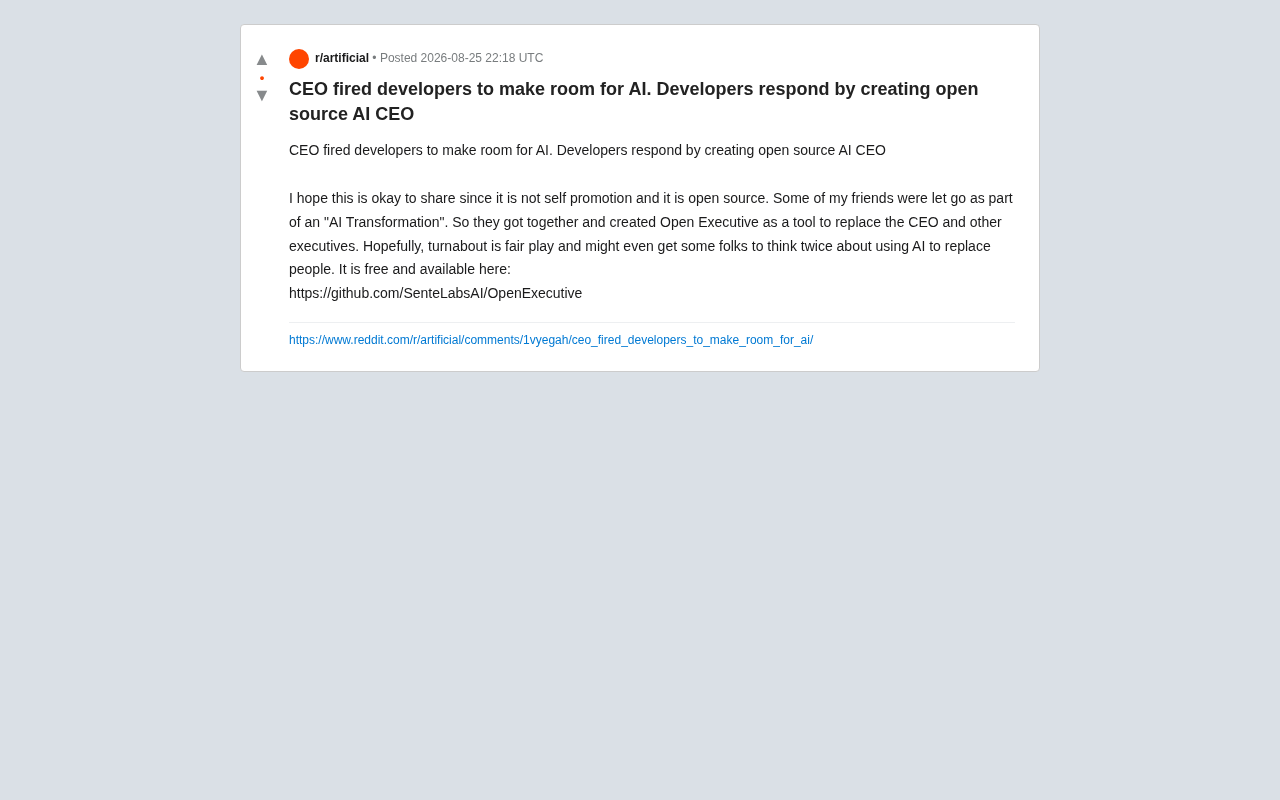
Laid-off devs built an open-source AI to replace CEOs, exposing the power asymmetry behind AI-driven layoffs.
After being laid off under the banner of "AI transformation," a group of developers created Open Executive — a free, open-source project designed to replace CEOs and executives with AI. While satirical in nature, the project exposes a serious issue: automation decisions flow top-down, always targeting front-line workers while leaving executive roles untouched. The project challenges companies to ask whether AI replacement should be based on job nature rather than hierarchy, and highlights the political and financial forces that shape who gets automated.
A Dark Comedy About "Who Should AI Replace"
Recently, a story dripping with irony has been circulating on Reddit: a company CEO laid off a group of developers in the name of "AI transformation," claiming the need to "make room for AI." But instead of leaving quietly, these developers chose a distinctly programmer-style form of retaliation — they banded together to build an open-source project called Open Executive, aimed squarely at the C-suite: replacing CEOs and other executives with AI.
The project creator wrote in their post: "Some of my friends were laid off as part of an 'AI transformation.' So they got together and built Open Executive, designed to replace CEOs and other executives. Since turnabout is fair play, maybe it'll make some people think twice before replacing employees with AI."
The project is completely free and open source, hosted on GitHub (SenteLabsAI/OpenExecutive). While laced with heavy satire, it strikes at one of the most sensitive nerves in the tech industry today: Who exactly should AI be replacing?
The Layoff Logic Behind AI Transformation
Why Is It Always the Rank and File Getting Cut?
Over the past year or two, "AI transformation" has become the go-to corporate euphemism for layoffs. From customer service agents and copywriters to junior developers, the people placed on the "replaceable by AI" list are almost always front-line workers. The reasoning seems sound enough: their work has clear inputs and outputs, making it easy for large language models or automation tools to take over.
Large language models (LLMs) can handle these tasks thanks to their core capability built on the Transformer architecture: by training on massive volumes of text data, models learn the statistical patterns and knowledge representations of language, enabling them to perform text generation, code writing, information extraction, and more. The latest generation of models, represented by GPT-4, Claude, and others, have reached or even surpassed junior practitioners' proficiency in standardized writing, coding, and data analysis tasks. Combined with tools like RPA (Robotic Process Automation), companies can fully automate large volumes of structured, repetitive workflows. This is precisely why customer service conversations, templated copy, and basic code writing are the first jobs on the chopping block — their task boundaries are clear, output quality is measurable, and they fall squarely within the "sweet spot" of current AI capabilities.
Yet the Open Executive project poses a sharp counter-question: if AI excels at handling tasks with clear rules and quantifiable outputs, then much of what executives do — setting strategy, running meetings, approving budgets, sending motivational emails — can similarly be structured and automated. So why does the axe always fall on those at the bottom, never swinging upward?
Is Management's Decision-Making Really More "Irreplaceable"?
This is the core assumption Open Executive sets out to challenge. Managers are often perceived as having "irreplaceable judgment," but in reality, a large portion of management work is essentially information aggregation, pattern matching, and risk trade-off analysis — capabilities that modern AI systems are rapidly approaching.
In fact, AI has already seen real-world experiments in assisting high-level decision-making. As early as 2014, Hong Kong venture capital firm Deep Knowledge Ventures appointed an AI algorithm called VITAL as a board member, granting it voting rights on investment decisions. In recent years, research from consulting firms like McKinsey has shown that about 25% of a CEO's daily time is spent on activities that could be automated, including data analysis, report reviews, and calendar coordination. Some companies are already using AI tools to support strategic planning — for example, using large models to analyze market data, competitive intelligence, and internal operational metrics to generate strategic recommendations for management review. However, these efforts largely remain at the "assistance" level; very few companies are willing to let AI truly replace executive decision-making authority. This phenomenon is telling in itself: if AI assistance can genuinely improve decision quality, why don't companies go further?
Through the performance art of "AI-ifying the CEO role," Open Executive is effectively asking a sardonic question: when companies talk about using AI to boost efficiency and cut costs, why do the decision-makers never include themselves in the equation?
The Open-Source Community's Unique Form of Pushback
Code as Attitude
What makes this incident most noteworthy is the way the developer community chose to express its discontent. They didn't opt for public condemnation or social media pile-ons — instead, they responded in the language they know best: code. This "let the product speak" form of protest embodies a core trait of engineering culture: Don't complain — build.
This tradition of "code as expression" has deep historical roots in the open-source community. Starting in 1983 when Richard Stallman launched the GNU Project to combat the closed nature of commercial software with free software, programmers developed a cultural DNA of replacing verbal protest with technical action. In the 2010s, developers expressed their stances by adding license clauses to GitHub projects that prohibited certain uses (such as the "Anti-996 License" restricting companies that enforced excessive overtime from using the code). More recent examples include open-source maintainers who withdrew or sabotaged their own packages for political reasons (such as the 2022 "colors.js" and "faker.js" incidents), protesting the unfair exploitation of free labor by commercial companies within the open-source ecosystem. Open Executive carries on this tradition — it's not a petition; it's a runnable software system. This form of protest cuts deeper than any open letter because it directly creates a verifiable "alternative."
Making the project open source and freely available further amplifies its reach. Anyone can view, fork, contribute code, or even actually "deploy an AI CEO" in their own organization. This transforms it from an inside joke among programmers into a public issue that can be debated and expanded upon.
Real Value Beyond the Satire
Although Open Executive was born from emotion, it inadvertently exposed a topic worthy of serious discussion: the power asymmetry in AI adoption.
This asymmetry is well-documented in organizational behavior and the sociology of technology. Scholars call it "automation class bias" — the power to decide what gets automated rests with the top of the organization, and those at the top naturally tend to direct automation downward. MIT economist Daron Acemoglu's research points out that when adopting automation technologies, companies tend to over-emphasize labor displacement while overlooking the more valuable productivity augmentation — and this bias is closely tied to organizational power structures. Those who hold decision-making power don't voluntarily put their own positions on the automation list. This isn't a matter of technical limitations; it's a political economy problem. As sociologist Langdon Winner argued in his classic paper "Do Artifacts Have Politics?": the way technology is applied is never neutral — it reflects and reinforces existing power relations.
When companies push automation, they tend to replace human labor from the bottom of the organizational hierarchy upward, rather than making decisions based on the objective criterion of "which jobs are best suited for automation." Open Executive puts this asymmetry on full display in an exaggerated way.
Industry Lessons Behind the Story
What Should Determine the Boundaries of AI Replacement
The truly important question for companies and professionals to consider is this: should the decision to replace humans with AI be based on the nature of the role rather than its position in the hierarchy? If a company genuinely believes AI can improve decision quality, then having AI participate in or assist with high-level decisions should theoretically yield even greater value. The fact that very few companies actually do this reveals that much of what's called "AI transformation" is more cost-driven than capability-driven.
This cost-driven nature is worth examining closely. According to the World Economic Forum's 2024 Future of Jobs Report, approximately 83% of global companies list AI and big data as their top transformation technologies over the next five years, but more than half of those prioritize "reducing labor costs" over "improving decision quality" in their implementation. This means AI transformation is often reduced to a financial optimization exercise — laying off lower-paid but numerous front-line employees delivers immediate, visible reductions in operating costs on financial statements, while replacing highly-paid but few executives faces complex obstacles around governance structures, shareholder relations, and legal liability. In other words, the answer to "who does AI replace" is determined less by technological capability than by organizational politics and financial incentives.
Survival Strategies for Developers and Knowledge Workers
For developers and knowledge workers, this story is also a wake-up call: purely execution-oriented, rule-based work does face a real risk of automation. The true moat lies in capabilities that resist structuring — cross-domain integration, judgment in complex situations, and the ability to create tools themselves.
From a cognitive science perspective, this relates to what's known as "Polanyi's Paradox": humans know far more than they can articulate. "Explicit knowledge" that can be clearly described and codified is easy for AI to learn and reproduce, while "tacit knowledge" deeply embedded in practical experience — such as intuitive judgment when facing entirely novel problems, the ability to discern real intent from ambiguous requirements, and creative combinations of cross-domain concepts — remains a uniquely human advantage. For developers, this means career security doesn't come from mastering any particular programming language or framework (these are classic forms of explicit knowledge), but from cultivating systems thinking, product intuition, and the ability to make judgments under uncertainty.
Interestingly, these laid-off developers demonstrated precisely the kind of value AI cannot yet replicate by creating Open Executive: identifying a problem, defining a solution, and implementing it as a complete product.
Conclusion
Open Executive may never actually replace a single CEO, but through dark humor, it forces a reexamination of the logic and fairness behind "AI transformation." As companies wield AI as a blunt instrument to cut front-line workers, these developers used code to pose an unavoidable question:
If AI is really that powerful, why isn't the first person replaced the one giving the orders?
This counterattack on GitHub is less an act of revenge than a mirror — reflecting the issues of power and responsibility being deliberately ignored in today's AI wave. Before this mirror, every corporate decision-maker should honestly ask themselves: is the AI transformation I'm driving actually using technology to solve real problems, or is it using technological rhetoric to protect my own position of power?
Related articles

Uber Deploys ChatGPT Work Company-Wide: AI in the Workplace Enters the Scaled Implementation Phase
Uber deploys ChatGPT Work to 30,000+ employees, extending it from engineering to all roles. We analyze its expert-engineer pairing, end-to-end automation, and questions of AI control and power concentration—insights for scaling AI in the workplace.

Shift at Midnight Hands-On: When "ID Verification" Becomes Alien Hunting
Shift at Midnight blends ID verification with horror survival in a four-player co-op game. We break down its inspection mechanics and chaotic humor.

Zelensky Recounts the Outbreak of War: I Need Ammunition, Not a Ride
Zelensky recalls the first day of war in a YouTube interview: farewell to family, rejecting Biden's evacuation offer with "I need ammunition, not a ride," and how Bucha shaped his stance on compromise and peace talks.