Open-Source AI Challenge Entry: Building a Bird Identification Assistant with SmolVLM

Bird Buddy AI uses a 500M-parameter open-weight vision-language model to bring bird photo identification to outdoor birdwatching.
Bird Buddy AI is a project under the "Side Project" theme of the second week of the Hacktoberfest Open-Source AI Challenge. Rather than following the chatbot trend, it applies an open-weight vision-language model to outdoor birdwatching: users upload bird photos, the app provides identification suggestions and describes visible features, and it includes a daily nature challenge. Technically, it chose the 500M-parameter SmolVLM-500M-Instruct with Python, Streamlit, PyTorch, and Transformers, enabling local offline inference on a laptop without paid APIs. During testing, the author found the model gave confident but incorrect identifications, so bird identification was positioned as "suggestions" rather than scientific certainty, with improving species-level accuracy as the next goal.
In the second week of the Hacktoberfest Open-Source AI Challenge, themed "Side Project," a project called Bird Buddy AI drew considerable attention. Rather than chasing the chatbot hype, it brought an open-weight vision-language model outdoors—snap a photo of a bird and let AI help you identify it.
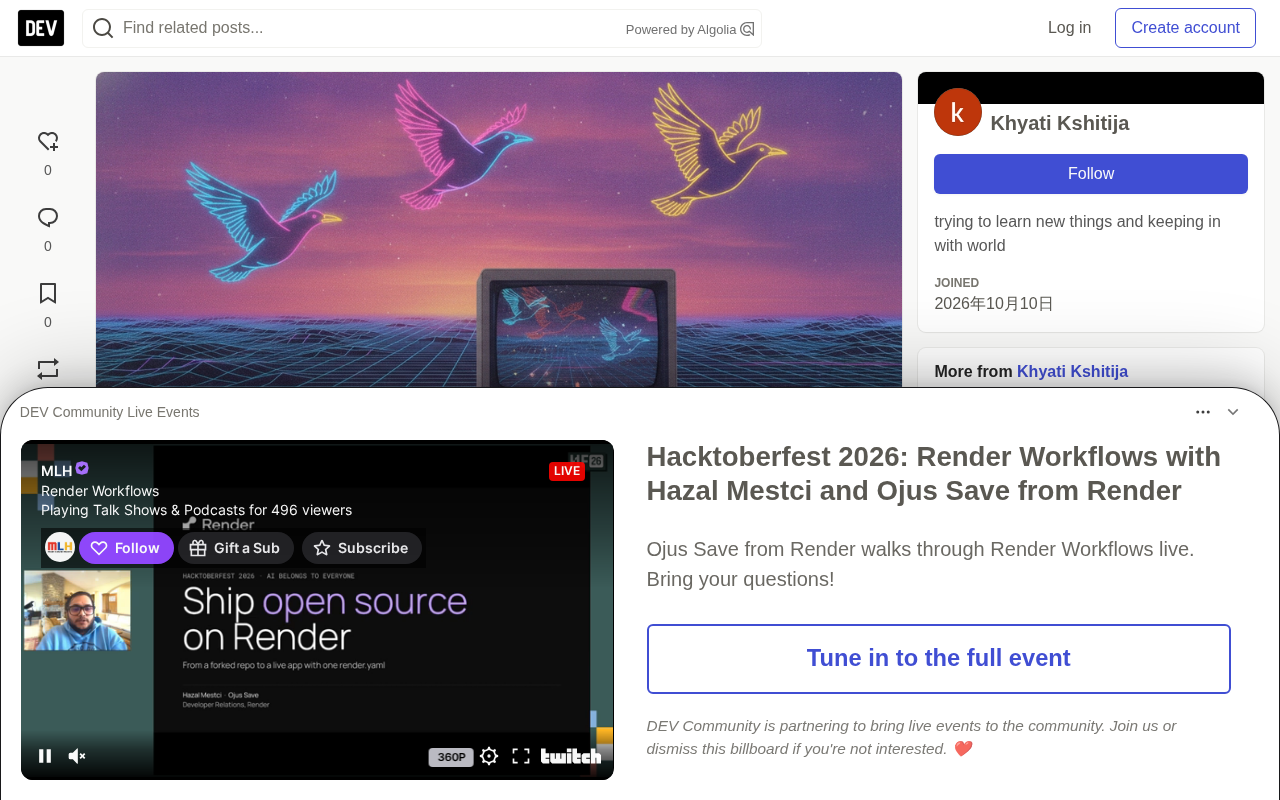
An AI Application Rooted in Birdwatching
The core logic of Bird Buddy AI is straightforward: users upload a bird photo, the app calls an AI model to generate identification suggestions and describe the visible features of the bird in the image. It also includes a built-in daily nature challenge feature that encourages users to go outside and observe the ecology around them.
According to the project author's description on the Hugging Face challenge page, the tool is currently positioned as a prototype for beginner birdwatchers, students, and nature enthusiasts. The author explicitly states that they may explore a freemium model in the future, offering more advanced birdwatchers richer species guides, regional information, and more precise identification tools.
This "AI + outdoor activity" positioning stands out somewhat against the current backdrop of numerous AI projects focused on text generation and coding assistance. The author themselves emphasized in the project description: "What I wanted to build wasn't yet another chatbot, but a connection between digital tools and activities happening in the real world."
Tech Stack: Small Model + Lightweight Framework
The project's technology choices are worth noting. Bird Buddy AI is built with Python and Streamlit, with the image analysis component calling SmolVLM-500M-Instruct on Hugging Face—an open-weight vision-language model with only 500 million parameters, running through PyTorch and Transformers.
At 500M parameters, this is a fairly lightweight scale for a vision-language model. This choice allows the model to run inference locally on the author's laptop without sending photos to an external inference API. The local test version runs completely offline after downloading the model, while the hosted demo is deployed on Streamlit Cloud.
For individual developers and small projects, this "small model + local inference" combination lowers the barrier to experimentation. You don't need a GPU cluster or to pay for every API call to validate whether an idea is viable.
What is SmolVLM-500M-Instruct: SmolVLM is a series of compact vision-language models from Hugging Face, with the name derived from "Small" and "VLM" (Vision-Language Model). It accepts both image and text inputs: a vision encoder first splits the image into visual tokens, which are then fed alongside text tokens into the language model to decode an answer. The 500M version refers to a total parameter count of roughly 500 million, making it one of the smallest specifications in the series—so it can run directly on an ordinary laptop's CPU or a low-VRAM GPU. The "Instruct" suffix indicates it has been instruction-tuned to respond according to the user's question format rather than simply continuing text. Compared to multimodal large models with billions of parameters, it has limited accuracy on specialized tasks like fine-grained species identification, but its advantages lie in being small, offline-capable, and extremely cheap to deploy—making it very well-suited for prototyping and learning purposes.
The division of labor between PyTorch and Transformers: PyTorch is the underlying deep learning framework responsible for tensor computation, automatic differentiation, and model inference; Transformers is Hugging Face's high-level library built on top of PyTorch, encapsulating model loading, tokenization, image preprocessing, and generation interfaces. Developers can pull down SmolVLM for inference with just a few lines of from_pretrained code, without implementing the network architecture themselves. It's precisely this combination that has pushed the engineering barrier to "running a vision-language model" extremely low, making it possible for individual developers to quickly turn an idea into a working demo within a side project.
Model Limitations Exposed During Testing
The author shared a key learning moment: during testing, the model sometimes gave identification results that sounded confident but were actually wrong.
This finding reveals an important issue—the model generating persuasive explanations and it truly identifying species accurately are two different things. Vision-language models can fluently describe a bird's color, posture, and beak shape in an image, but the species judgment those descriptions collectively point to may be wrong.
Therefore, the author positioned bird identification as a "suggestion" rather than "scientific certainty," and listed improving species-level identification accuracy as the next-stage goal. This clear awareness of the model's capability boundaries is uncommon in AI application development.
The "hallucination" problem in vision-language models: The phenomenon described in the article—"sounding confident but actually wrong"—is known in the industry as hallucination. For vision-language models, hallucination can manifest either as describing objects that don't exist or as identification results that don't match the real species. The reason is that the model is essentially predicting a probability distribution over the next token; it optimizes for "output that looks reasonable," not "output that is consistent with facts." When bird image features are blurry, the angle is awkward, or species are similar, the model will still give a fluent answer following common patterns in its training corpus. Mitigation approaches typically include: providing more reference images or a candidate species list for comparison, supplementing with authoritative species databases through retrieval-augmented methods, explicitly providing confidence levels in the output, and involving users in the final confirmation step. This also explains why the author positioned identification results as "suggestions"—returning uncertainty to human judgment is a key design principle for reliably using such models today.
The Practical Value of Open-Weight AI
The author devoted considerable space in the project retrospective to discussing the significance of open innovation. For those learning by building hands-on, open-weight models make the entire experimentation process feasible: you can run the model, observe its performance on real photos, build an interface around it, and learn from its mistakes—all without relying on paid hosted inference services.
Openness also means the project can be reviewed, modified, and improved by other developers. The author envisions future contributors helping to optimize the identification pipeline, test different models, or add support for more bird species.
What this project truly demonstrates isn't just that an AI model can identify images, but how open technology gives more people the opportunity to learn, experiment, and build useful things. For developers participating in open-source challenges, this may be more valuable than the technology itself.
Project Resources
- Live demo: https://bird-ai-o.streamlit.app/
- Source code: https://github.com/khyatikshitija/bird-ai
One-line Summary
Bird Buddy AI uses a 500M-parameter open-weight vision-language model to bring bird photo identification to outdoor birdwatching.
Paragraph Summary
Bird Buddy AI is a project under the "Side Project" theme of the second week of the Hacktoberfest Open-Source AI Challenge. Rather than following the chatbot trend, it applies an open-weight vision-language model to outdoor birdwatching: users upload bird photos, the app provides identification suggestions and describes visible features, and it includes a daily nature challenge to encourage users to get outside. Technically, it chose the 500M-parameter SmolVLM-500M-Instruct, combined with Python, Streamlit, PyTorch, and Transformers, enabling local offline inference on a laptop without paid APIs. During testing, the author found the model gave confident but incorrect identifications, so bird identification was positioned as "suggestions" rather than scientific certainty, with improving species-level accuracy as the next goal. The project also demonstrates the value of open-weight models for individual developers.
Related articles

Bilibili's Hit Dify Tutorial: A Practical Guide to Building 20+ AI Apps from Scratch
A distilled guide to Bilibili's top-rated Dify tutorial: Windows + Docker deployment, MySQL connection, five app types, model integration strategy, and publishing.

Agent Skills Beginner's Guide: From Concepts to Multi-Agent Collaboration in Practice
A comprehensive guide to Agent Skills: core concepts, components, the importance of Description, standardization, beginner learning paths, and multi-agent collaboration.

One Neuron Detects Both Cats and Cars? We Reproduced It and Found a New Explanation
The cat-car neuron reinterpreted: researcher Cammarata argues it distinguishes pointy from round, not cats from cars. We reproduced the experiment and found the new explanation holds on most inputs—but cars are the exception. The interpretability debate continues on language models.