Open Source AI Closes the Gap: How Chinese Models Are Challenging America's AI Dominance

Chinese open source models are nearly matching closed source frontier AI, threatening OpenAI and Anthropic's IPO valuations.
The gap between open source and closed source AI has compressed from 18 months to just weeks, driven largely by Chinese models like DeepSeek, Kimi K3, and Qwen 3. This threatens the IPO narratives of OpenAI and Anthropic, sparks debate over whether open source is "decelerationist," and positions Google — with its full-stack infrastructure advantage — as the quiet winner of the entire shift.
Six Years in the Making: The Gap Between Open Source and Closed Source Is Vanishing
The AI arms race between open source and closed source models began well before ChatGPT launched in 2022 — it's been playing out for over six years. The central tension is sharp and clear: open source models let anyone freely download and deploy them locally or on dedicated servers, while closed source labs tend to lock their most capable models behind proprietary walls, charging per API call.
Background: A Brief History of Open Source AI Open source AI traces its roots to the early days of deep learning. Around 2016, Meta's (then Facebook's) FAIR lab and Google's TensorFlow project began releasing research as open source, establishing a culture of openness. The real turning point came in February 2023 when Meta released the LLaMA series — originally restricted to researchers, but the weights quickly leaked online, spawning a wave of community derivatives like Alpaca and Vicuna. That moment marked the shift of open source LLMs from academic niche to mainstream, and was the first sign to closed source labs that community forces could be unpredictable. Since then, Mistral AI, Alibaba's Qwen, DeepSeekAd, and others have proactively released open weights, creating a dual-track ecosystem that now rivals OpenAI, Anthropic, and other closed source players.
Since 2022, the closed source camp has held a firm lead in both frontier capabilities and user scale. But what's truly alarming is the speed at which that gap is closing — from roughly 18 months behind, to a year, to a few months. Now, with the release of models like Kimi K3 and Qwen 3 Max, the gap has nearly disappeared relative to any frontier model.
This pace of catch-up has been so rapid that some industry leaders have called it "dangerous," arguing that "open source models are inherently decelerationist" — a provocative claim we'll unpack shortly.
After DeepSeek: What Kimi K3 Actually Changes
We first noticed open source might be catching up during the "DeepSeek moment" in January 2025. DeepSeek matched OpenAI's o1 reasoning model at a fraction of the cost — a shock that wiped nearly $1 trillion in market cap from U.S. tech stocks.
Even then, there was still a roughly 4–5 month gap between OpenAI's o1 and DeepSeek — a meaningful lead. This time is different: Kimi K3 not only caught up on benchmarks, it arrived just about one month after Anthropic released its own frontier model.
A Closer Look: What Benchmarks Actually Mean The article repeatedly references "benchmark catch-up" — worth examining in depth. AI benchmarks are standardized test sets used to evaluate model capabilities. Common ones include MMLU (Massive Multitask Language Understanding), HumanEval (code generation), MATH (mathematical reasoning), and GPQA (graduate-level science Q&A). They provide quantifiable, cross-model comparisons. However, benchmarks have clear limitations: first, "benchmark gaming" — some models achieve high scores through targeted training on specific test sets without matching real-world performance; second, they struggle to capture complex real-world reasoning, long-term memory, or tool use; third, there's the data contamination problem, where test questions may already appear in training data. So when industry observers talk about "open source catching up to closed source," the benchmark numbers matter — but so does actual user experience.
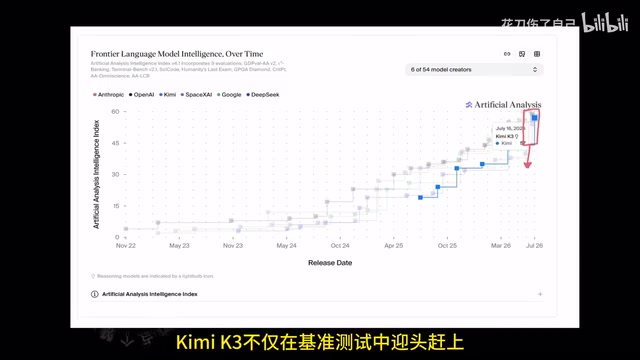
From 18 months down to one month — that compression curve alone is the most direct challenge to the moat narrative of closed source labs.
IPO Season: Why the Timing Is So Damaging
This moment is especially critical because both OpenAI and Anthropic are in the middle of IPO sprints. OpenAI is targeting a $1 trillion valuation by 2027, while Anthropic recently surpassed OpenAI with an implied valuation of roughly $965 billion and is planning to go public as early as this fall.
A Closer Look: AI Valuation Logic and Its Risks Understanding the IPO pressure on OpenAI and Anthropic requires going back to the fundamentals of tech company valuation. Traditional tech unicorns are valued on "moat narratives": user lock-in, network effects, proprietary data, or proprietary technology. What makes large AI model companies unique is that their core product — the model weights themselves — can theoretically be replicated and replaced. As open source models continue to approach the frontier, the "model as moat" narrative faces fundamental scrutiny. The investor support for OpenAI's ~$300 billion implied valuation (from its early 2025 funding round) and Anthropic's near-$100 billion figure rests heavily on belief in their ability to "sustain the lead." If that lead is disproven, repricing risk becomes very real. The historical parallel is the early 2000s dot-com bust — when "bandwidth" and "server capacity" shifted from scarce resources to commodities, valuations of early internet infrastructure companies collapsed rapidly. Whether commoditization of AI compute and model capability will replay this history is the central question markets are watching.
Investors scrutinizing these valuations need to believe these models have durability and defensibility against free open source alternatives. But the rapid catch-up of open source models makes that defensive narrative increasingly hard to sustain.
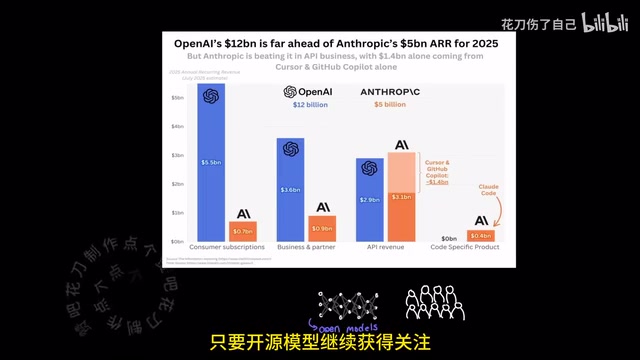
The revenue structure adds further complications. OpenAI relies heavily on subscriptions; Anthropic is tightly tied to API pricing and enterprise clients. As long as open source models keep gaining traction, they pose a real threat to retention and revenue — especially on the API and enterprise side, where early tech adopters are fully capable of switching platforms for lower costs.
To counter pressure from the GPT-5 series and Kimi, Anthropic has been continuously raising token quota limits to retain users and prevent them from migrating to smarter, cheaper alternatives.
The Chinese AI Paradox: Beating Constraints With Innovation
Interestingly, Chinese labs are dealing with the opposite problem. After Kimi K3 launched, usage surged so dramatically that Moonshot AI ultimately had to restrict new user registrations — their infrastructure simply couldn't handle the demand.
The compute constraints here are well understood. Due to chip export controls, most Chinese models are still being trained on chips that are three to five years behind technologically. Although the NVIDIA H200 was recently cleared for sale to China, the overall gap remains significant.
Background: The Story Behind Chip Export Controls Starting in October 2022, the U.S. Commerce Department's Bureau of Industry and Security (BIS) implemented multiple rounds of export controls on high-performance AI chips bound for China. The primary targets were NVIDIA's A100 and H100 data center GPUs — chips featuring high-bandwidth memory (HBM) and high-speed NVLink interconnects critical for training large-scale models. To work around restrictions, NVIDIA released downgraded A800 and H800 variants, but the October 2023 update brought those into the restricted list as well. As a result, Chinese labs have had to rely heavily on domestic alternative chips (like Huawei's Ascend 910B) or stockpiled older GPUs for training, with meaningful efficiency losses. That Kimi K3 and DeepSeek can still approach the frontier under these constraints is partly due to algorithmic innovation — such as Mixture of Experts (MoE) architectures and efficient distributed training strategies — making "algorithm for compute" substitution possible.
Technical Deep Dive: MoE Architecture — The Secret Behind the Catch-Up A key technical lever enabling Chinese open source models to approach closed source frontiers under constrained compute is the Mixture of Experts (MoE) architecture. Traditional dense Transformer models activate all parameters during inference, while MoE models divide parameters into groups of "expert" sub-networks, routing each input to activate only a small subset of experts (typically 2–8) while the rest remain idle. This means MoE models can run at a far larger total parameter scale than a dense model of equivalent compute (FLOPs). Both Qwen 3 Max and DeepSeek-V3 use MoE architectures, with total parameter counts in the hundreds of billions — but only a fraction of those parameters are activated during any given inference. This design preserves the knowledge capacity of a large model while dramatically reducing inference costs, making it the core engineering strategy for "doing more with less" under compute constraints.
Yet under exactly these hardware constraints, Kimi and other Chinese open source models have once again demonstrated that limited resources don't necessarily prevent reaching the frontier. Matching top-tier models while operating with older chips — that's what truly has the U.S. on alert.
"Open Source Is Decelerationism": A Philosophical Fight Over AI's Future
The impact of Chinese open source models was significant enough to prompt OpenAI's head of strategy to write a lengthy response specifically addressing Kimi K3. The core argument: open source models are inherently decelerationist.
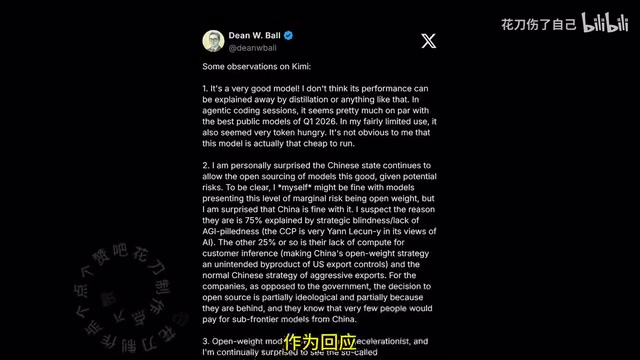
The logic works like this: as more frontier-capable models become freely available for download and modification, AI capability becomes "abundant." Abundance creates deflationary pressure in the ecosystem — it draws users away from the expensive frontier models offered by OpenAI, Anthropic, xAI, and Google.
If users have plenty of free alternatives, why pay for expensive models? Companies face lower expected profits, which weakens investor incentives to keep pouring money into top talent, large data centers, and high-end GPUs. That creates a downward spiral — and ultimately, as capital retreats, the pace of overall AI innovation slows.
Interestingly, the post also criticizes "accelerationists" — because a large portion of AI innovation is commercially driven. Trading commercialization for open source may, after losing the commercial engine, paradoxically slow the pace of innovation across the entire industry.
Meanwhile, a 2023 clip of Anthropic CEO Dario Amodei resurfaced in which he warned that open source was heading in a dangerous direction, citing risks of misuse from highly capable open models. Anthropic has also been actively lobbying governments for increased AI regulation.

Open Source vs. Closed Source: Balance, Not Zero-Sum
While current sentiment seems to favor open source dominance — which is undeniably good for consumers — we have to acknowledge that training frontier models requires enormous investment: collecting trillions of high-quality tokens, building data centers stocked with top-tier GPUs, and recruiting the very best AI researchers in the world. For now, this is still primarily driven by closed source frontier labs.
A healthy AI ecosystem therefore requires a dynamic balance between open and closed source. The competitive pressure from closed source pushes labs to keep innovating and prevents price gouging; open source expands the overall adoption of AI and lowers the barrier to access. Each keeps the other in check — and that tension is what keeps the industry alive.
Google: Why It's the Biggest Winner of This Whole Game
In this open-versus-closed tug of war, Google sits in a uniquely advantageous position. It doesn't need to fight hard against open source models, because its core value isn't bet on any single model — it's in control of the entire technology stack: custom ASICs (TPUs), world-class researchers, infrastructure, and a powerful product ecosystem.
Technical Background: TPU and Google's Vertical Integration Strategy TPUs (Tensor Processing Units) are custom ASICs Google has designed in-house since 2016, optimized for matrix multiplication operations. Compared to general-purpose GPUs, they offer superior energy efficiency and cost advantages for specific AI workloads. Now on the fifth generation (TPU v5e/v5p), they form the backbone of Google Cloud's AI infrastructure. More importantly, Google has built a complete hardware-software loop through TPUs, the JAX framework (its in-house ML programming framework), GKE (Google Kubernetes Engine), and the Vertex AI platform. This means that even if the model layer becomes commoditized, enterprise customers still need Google's compute infrastructure to deploy and run those models. The strategy closely mirrors Intel's "Wintel" architecture during the PC era — even as operating systems and applications competed fiercely, the chip and underlying architecture layer consistently commanded a premium.
If the model layer truly becomes a commodity, Google faces far less disruption than pure-play model labs. In fact, Google may actually benefit from commoditization. When models themselves are no longer the scarce resource, the player who controls chips, compute, and distribution channels is the one who ends up winning.
Key Takeaways
Related articles
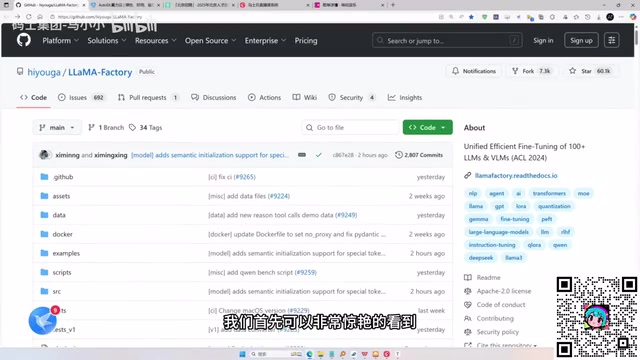
LLaMA-Factory in Practice: A Complete No-Code Guide to Fine-Tuning Large Models
An introduction to LLaMA-Factory, the open-source fine-tuning tool: its 60.1K-star background, supported models and algorithms, local vs. cloud deployment, and CUDA setup steps.

Zeng Ming's Deep Retrospective: Why OpenAI May Not Be the Ultimate Winner — and Why the Corporate System Will Disappear
Zeng Ming's deep retrospective on the AI endgame: model companies are just infrastructure, OpenAI and Anthropic won't be the final winners; the next battle is the Agent entry point standard; the corporate system will disappear as AI restructures collaboration, and only mission-driven companies can survive the cycle.
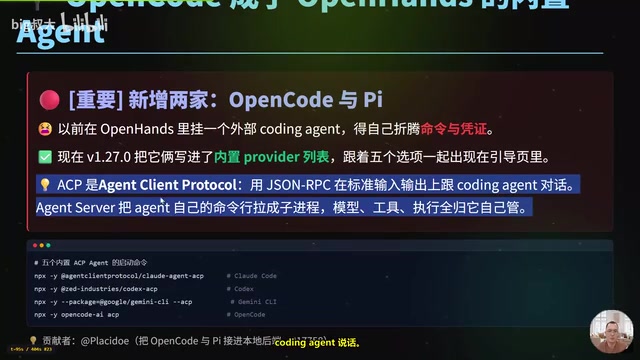
OpenHands v1.28.0: OpenCode and PI Added as Built-in Agents, API Keys Requestable In-Conversation
OpenHands ships 5 releases in 21 days: v1.27.0 adds OpenCode and PI as built-in agents, v1.28.0 enables in-chat key requests. ACP integration, credential reuse, model list changes, and upgrade advice.