Open-Source AI Desktop Pet Coopanion: DeepSeek's Big Fat Fish Moves Into Your Taskbar
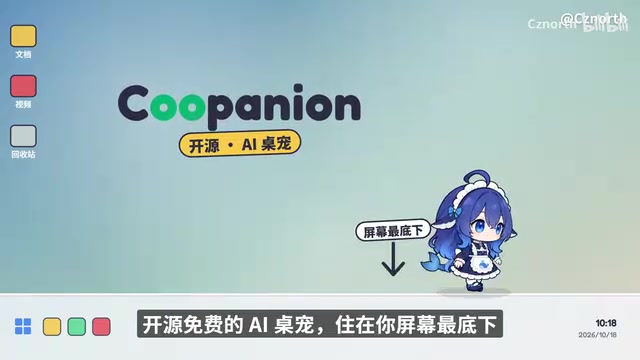
Open-source AI desktop pet Coopanion lives in the taskbar, with memory, personality, and computer operation—350+ stars in four weeks.
Coopanion is a free, open-source AI desktop pet that embeds large models into the taskbar, emphasizing companionship over model capability. It offers avatar changes and five personalities, writes memory to versioned local files, and asks before operating your computer, stopping the moment you touch the mouse. It supports 13 models including DeepSeek, Qwen, Kimi, and Claude, and can even play Plants vs. Zombies via an extension. It gained 350+ GitHub stars in under four weeks with 20+ derivative projects.
When AI Is No Longer Just a Chat Box, but Lives in Your Taskbar
Most AI tools are still stuck in browser tabs, but Coopanion has chosen a more "intimate" approach: it stuffs large models into the taskbar at the very bottom of your screen, turning them into a desktop pet you can poke, pet, and fling away. After being introduced by a creator on Bilibili, this open-source project racked up over 350 GitHub stars in under four weeks, and netizens have spun off around twenty derivative projects—even "Cloud-chan" got her own dedicated avatar.
Its core selling point isn't model capability but the engineering of "companionship": swappable avatars, selectable personalities, persistent memory, and the ability to pick it up and fling it away. The software itself is free and open source, the models run on pay-per-use APIs, and users can swap brains by pasting in their own key.
It Remembers You: Local Memory Files and Versioned Design
Coopanion's most underrated design is how memory is implemented. The name you tell it and the things you've chatted about are all written to a local file on your computer, and every change leaves a version behind. This means two things: your memory belongs to you and never passes through the cloud; and history is traceable, so if you mess it up you can dig up the old records.
For products like desktop pets, memory is the source of stickiness. A pet that can't remember your name is just an animation; a pet that remembers you complaining about overtime last week feels like a "companion." Versioning turns that memory into a manageable asset rather than implicit state in a black box.
Local memory files and versioning refers to saving user information extracted from conversations (such as names, preferences, and historical events) in a structured format (like JSON or Markdown) in a designated directory on the user's device, rather than uploading it to a cloud server. Versioning borrows the idea from version control systems like Git: each time the memory file is modified, a timestamped copy or diff record is automatically generated, forming a traceable chain of history. This design is gradually gaining popularity in desktop AI applications because it simultaneously addresses privacy concerns (data never leaves the local machine) and maintainability (rollback after accidental edits). Compared with traditional implicit memory (such as the conversation context cache inside the model), explicit local files let users directly view, edit, and even migrate their memory data, turning "memory" from a black-box state into an asset users can control.
Five Personalities: Pick a Personality on First Launch
On first launch, Coopanion asks users to choose a personality, currently offering five orientations: curious, clingy, efficient, lively, and quiet. This design looks lightweight but actually determines the rhythm of interaction: the efficient type may cut the small talk and get things done, the clingy type initiates conversation, and the quiet type is more like an unobtrusive accessory.
Making personality a configurable option is an admission that there's no standard answer to "companionship." Some people want an efficiency assistant, others want an electronic pet that acts cute—the same underlying capabilities can grow into completely different product experiences.
It Can Operate Your Computer, but Asks Before the First Move
Coopanion has the ability to operate your computer: clicking buttons, typing, switching windows. Such capabilities are nothing new among Agent-type products, but its safety strategy is worth noting—it asks for your consent before executing an action for the first time, and it stops immediately the moment you touch the mouse. Login and payment steps are left entirely for you to handle.

This "ask before acting, stop when the human moves" mechanism essentially hands control back to the user. The desktop pet form naturally lowers people's vigilance toward automated operations, which is precisely why explicit confirmation steps and an always-interruptible design matter more. It also draws boundaries: for anything involving accounts and funds, the AI does not act on your behalf.
Operation permissions and safety boundaries of Agent-type products are a core issue in today's AI desktop automation space. "Operating the computer" usually means executing tasks on the user's behalf by simulating mouse clicks, keyboard input, window switching, and other system-level APIs (such as Windows UI Automation or macOS Accessibility API). Such capabilities have been practiced for years in RPA (robotic process automation), but LLM-driven Agents make them more flexible, requiring no pre-written scripts. However, the desktop pet form naturally carries a visual implication of "harmlessness," making users prone to lowering their guard around automated operations. As a result, the industry is gradually reaching consensus: sensitive operations (login, payment, file deletion) should require mandatory human confirmation, and a mechanism to interrupt at any time (such as pausing when the mouse moves) should be provided. Coopanion's "ask before acting, stop when the human moves" is a concrete implementation of this principle, in line with the safety approach of solutions like Anthropic's Computer Use.
Not Picky About Brains: Swap Among 13 Models, and It Can Even Play Games Itself
At the model level, Coopanion supports 13 models including DeepSeekAd, Qwen, Kimi, and Claude—paste a key and you can swap outfits. This "no lock-in" strategy lets users freely switch based on cost, response speed, and task type, and also reduces the impact of fluctuations in any single model service.
Even more unexpectedly, there's extensibility: after installing an extension, it can play Plants vs. Zombies by itself. This hints at another possibility for the desktop pet form—not just passive responses, but the ability to carry lightweight autonomous behavior loops.

Model-agnostic architecture means the application layer isn't bound to a specific LLM provider but instead connects to multiple model services through a unified API abstraction layer (such as OpenAI-compatible interfaces). Users only need to provide API keys for each platform to switch among DeepSeek, Qwen, Kimi, Claude, and others. This design has three benefits: first, cost optimization—use cheaper models for simple tasks and switch to stronger models for complex ones; second, resilience—quickly switch when a single provider rate-limits or fails; third, avoiding vendor lock-in, so users aren't held hostage by one provider's price hikes or policy changes. In the open-source community, tools like LiteLLM and OpenRouter exist precisely for this. Coopanion supporting 13 models means it has built an adaptation layer architecturally, turning "swapping brains" into a configuration item rather than rewritten code, which lowers the barrier to use and the cost of migration.
350 Stars in Under Four Weeks, Around Twenty Derivative Projects
Coopanion's growth rate is impressive in the open-source desktop pet space: over 350 stars in under four weeks, with the community producing around twenty derivative projects, and both avatars and gameplay being remixed. Here, open source isn't just a license—it's the starting point of an avatar ecosystem: users can swap avatars and build extensions, giving the project fuel for continuous growth.

At the end of the video, the creator joked, "Don't install it—actually, it's my little terminal afraid of losing its job." This joke captures the real situation of desktop pet products: they compete for that little bit of attention at the edge of the screen, relying on emotional connection rather than a feature list. For users whose desktop feels too cold and empty, Coopanion offers a customizable, controllable electronic companion with memory; but for those who only need an efficiency tool, it may indeed be true that "once installed, you can't help poking it every day."
The project is open-sourced on GitHub, with models billed pay-per-use, suitable for users willing to tinker with their own keys and wanting a bit of desktop warmth.
One-line Summary
Open-source AI desktop pet Coopanion lives in the taskbar, with memory, personality, and computer operation—350+ stars in four weeks.
Paragraph Summary
Coopanion is a free, open-source AI desktop pet that embeds large models into the taskbar, emphasizing companionship over model capability. It supports avatar changes and five personality choices, writes memory to local files with versioning, and keeps data off the cloud. It can operate the computer, but asks the user before the first action, stops the moment the mouse moves, and leaves login and payment entirely to the user. At the model level it supports 13 providers including DeepSeek, Qwen, Kimi, and Claude—paste a key to switch—and can even play Plants vs. Zombies autonomously via an extension. In under four weeks since open-sourcing, it has gained over 350 GitHub stars and spawned around twenty community derivative projects. It suits users who want desktop warmth and are willing to tinker with their own keys; at its core, it competes for attention at the edge of the screen through emotional connection.
Related articles

Industrial Intelligence: The Next Growth Engine for Manufacturing
Industrial intelligence is becoming the next growth opportunity for manufacturing. This article analyzes the core connotation of industrial intelligence, explores three key implementation scenarios—changeover assistance, knowledge transfer, and anomaly tracing—and examines practical challenges such as data silos and knowledge modeling costs, providing decision-making reference for manufacturing enterprises.
The Most Comprehensive Jailbreak Collection on GitHub: A Deep Dive into togg53192-cmd/jailbreaks
A deep dive into the popular GitHub repository togg53192-cmd/jailbreaks: a jailbreak prompt collection with 4,842 stars, 775 forks, and 890 stars gained in a single day. We explore its content organization, community response, and AI safety implications.

CodeMode: Let AI Agents Write Code Instead of Calling Tools, Slashing Token Costs by 90%
Explore how CodeMode enables AI agents to execute code in a sandbox instead of calling tools one by one, reducing token consumption by up to 90%, and analyze its implementation key points and applicable scenarios.