Open-Source AI Game Agent Oh My Game Arrives, Claude Adds Dashboards and Motion Video Capabilities

Oh My Game, Claude Dashboards/Motion, and OpenAI Steering push AI toward full-workflow agentic pipelines.
This article covers several notable recent AI tool developments. The open-source Oh My Game integrates game design, art, 3D modeling, and programming into a single canvas with 40+ models and real-time debugging. Anthropic's new Claude Dashboards connects to BigQuery, Databricks, and Salesforce to generate live-updating BI views, while Claude Motion converts content into animated explainer videos with code-level editing. OpenAI refined its Steering capability to allow mid-reasoning course corrections, paired with a high-speed model mode. Together, these tools signal a shift toward full-workflow agentic pipelines — while also raising important questions about maintaining human control and whether output quality can meet real production standards.
AI tools are accelerating their penetration into game development, data analysis, and video production — fields that once relied heavily on specialized divisions of labor. Several new tools and features have recently emerged that compress design, modeling, programming, BI, and motion graphics into a single intelligent workflow. This article draws on AI Daily updates from Bilibili creator EverAI to cover these developments, along with some analysis of their value and limitations.
One Sentence, One Game: Open-Source Tool Oh My Game
An open-source AI game agent called Oh My Game aims to integrate game design, art, 3D modeling, and programming into a single canvas. Its core logic is straightforward: users simply describe their game idea, and the agent automatically handles design, asset creation, scene building, and playtesting on the canvas — all the way through to a publishable game.
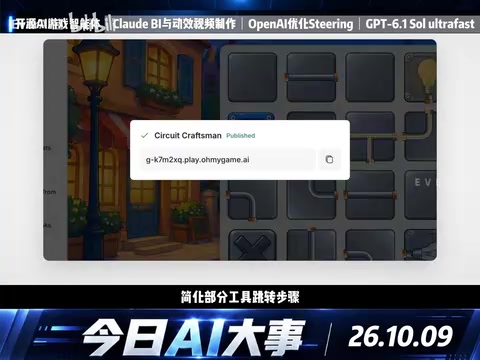
The process isn't a black box — users can view and debug the game in real time, which is critical for judging whether the AI-generated output meets expectations. According to its introduction, the tool integrates over 40 models, supports game sharing, and streamlines transitions between tools, reducing the friction of switching between multiple steps.
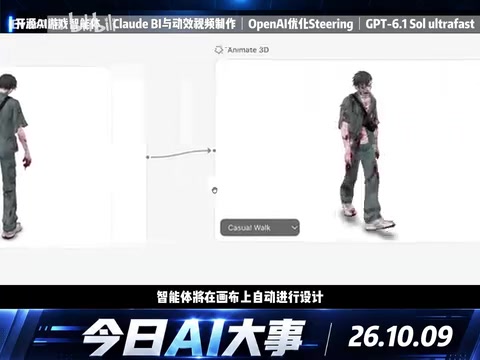
From a product philosophy standpoint, Oh My Game represents a trend toward "end-to-end agents": rather than forcing users to bounce between modeling software, code editors, and art tools, a single agent coordinates the entire workflow. Its open-source nature also means developers can extend models and features on their own. That said, a one-minute intro doesn't reveal the complexity of actual finished products — whether auto-generated games can reach a playable or commercially viable quality still requires more real-world testing.
Background: "End-to-End Agent" represents an important paradigm shift in AI application architecture over the past two years. Traditional workflows require users to manually pass intermediate outputs between multiple specialized tools — for example, modeling in Blender, exporting assets to assemble scenes in Unity, and then having programmers write the logic code. End-to-end agents use a unified orchestration layer to coordinate multiple specialized models (handling image generation, code generation, 3D modeling, and other subtasks) to complete the full workflow, with users only reviewing the final result. The core challenge of this architecture lies in context passing between models, error accumulation, and style consistency — a failure in any single step can be amplified downstream. Oh My Game's integration of 40+ models shows it needs extensive model coverage across the many specialized domains of game development, but it also implies significant coordination complexity. This is precisely why the "real-time view and debug" capability is so important for user intervention.
Claude's New Arsenal: Dashboards and Motion
Two new capabilities Anthropic has rolled out for Claude — Dashboards and Motion — are now in testing, targeting data analysis and motion video respectively.
Claude Dashboards can transform raw data into dynamic dashboards that automatically refresh with updated data. It supports connections to data platforms like BigQuery and Databricks, as well as CRM tools like Salesforce. This means it doesn't just generate one-off charts — it can connect to real enterprise data sources to create continuously updated BI interfaces, with direct implications for the daily workflows of data analysts.
Claude Motion goes a step further, converting content into dynamic animated explainer videos to aid the comprehension and communication of complex information. Even more interesting is its editing mechanism: users can either have Claude make changes directly via the underlying code, or bring in third-party software like Adobe or Hackersfield for further editing. This "code-controlled + professional software as a fallback" design balances the efficiency of automation with the flexibility of professional refinement.

Together, these two capabilities sketch out a complete pipeline from data to visualization to narrated video. For teams that need to report to non-technical stakeholders, tools like these can significantly reduce production costs.
Background: BigQuery is Google Cloud's serverless data warehouse, suited for PB-scale analytical queries; Databricks is an Apache Spark-based lakehouse platform widely used for machine learning and big data pipelines; Salesforce is a mainstream enterprise CRM system storing sales, marketing, and customer service data. Claude Dashboards' ability to connect to all three types of platforms means it covers the major layers of an enterprise data stack, from raw data warehouses to business systems. Traditional BI tools (like Tableau or Power BI) can also connect to these sources, but require users to master data modeling and visualization configuration. Claude Dashboards' differentiated value lies in replacing configuration with natural language, lowering the barrier for self-service analysis among non-technical users — though whether it can handle complex multi-table joins and custom calculation logic remains the key variable in determining whether it can replace professional BI tools.
OpenAI Refines Steering: Real-Time Course Correction
On the other side, OpenAI has improved its Steering capability. The pain point it addresses is concrete: in the past, you often had to wait for the model to finish generating an entire result before realizing it had gone off track. Now you can correct the model's direction in real time while it's still thinking, preventing it from wasting compute and time on the wrong path.
This improvement, combined with the high-speed mode mentioned for a new GPT model (reportedly up to 8x faster), makes for a smoother interactive experience — faster speed means shorter feedback loops for course correction, bringing the collaboration between user and model closer to "real-time conversational control." It's worth noting that specific model names and performance figures come from a single source's verbal introduction; refer to official announcements for confirmation.
Background: "Human-in-the-Loop" (HITL) is a core concept in AI system design, referring to mechanisms that preserve human intervention and judgment at critical points in an automated process. Early AI-assisted tools largely used a "Human-on-the-Loop" model — AI executes fully, then humans review the output and decide whether to use it. As model reasoning chains grow longer (especially with slow-thinking/Chain-of-Thought models), a single flawed assumption can lead to thousands of tokens of wasted computation, with the final output being difficult to partially correct. The Steering improvement moves the intervention point from the output end into the middle of the reasoning process — essentially refining the granularity of HITL down to the level of individual reasoning steps. This design is especially important for highly automated agent workflows: when AI is authorized to execute multi-step tasks, in-process controllability directly determines how much autonomy users are willing to grant.
Trend Watch: From Tools to Agentic Workflows
Looking at these developments together, the common thread is hard to miss: AI is no longer content with completing single-point tasks — it's evolving toward "full-workflow agents." Whether it's Oh My Game packaging every stage of game development, or Claude connecting data all the way to video, the underlying logic is the same — let AI handle coordination and execution, and let humans focus on ideas and oversight.
That said, OpenAI's Steering improvement highlights another critical question: as AI automation deepens, how humans maintain control over the process becomes increasingly important. Real-time course correction is precisely about moving the "human in the loop" from reviewing results to intervening in the process — a necessary complement to controllability in highly automated scenarios.
For general users, these tools lower the barrier to professional-grade work. For practitioners, they reshape how workflows are divided. The real test lies in whether generation quality and consistency can hold up under real production demands — a question that still needs to be answered with actual projects once these tools are fully released.
Related articles

Build an AI Super Employee System at Zero Cost: A Full Breakdown of Automated Agent Workflows
A deep breakdown of the AI super employee system demoed on Bilibili: agent orchestration, digital human voiceovers, map and enterprise lead generation, 24/7 customer service, and legal modules. We analyze the business logic and compliance risks behind zero-cost signup to help entrepreneurs judge the real ROI of this AI digital employee system.

The Essential Difference Between Chatbots and AI Agents: Crossing from Conversation to Execution
What's the difference between a chatbot and an AI agent? Based on the MCP series on the Learn Tech channel, this article uses examples like booking flights and summarizing notes to explain: a chatbot only gives answers, while an agent actually completes tasks through a think-act-observe loop. It breaks down the four core components—model, tools, memory, and goal—as well as MCP's role as a bridge, and discusses agents' applicable boundaries and permission risks.

Free GitHub Repo: 342 Hours of AI Courses, from Math to MCP Servers
A free GitHub repo offers 342 hours of AI courses: 523 lessons across 20 phases, from math fundamentals to agent building and MCP servers. Nearly 100,000 learners have started.