Open Source Community Bans AI Projects? R/open source's New Rules Spark Controversy

R/open source community bans both solo projects and LLM projects, sparking debate over open source governance boundaries.
The R/open source community issued new rules banning both solo-maintained projects and any project developed with LLM assistance, sparking discussion on Hacker News. The two bans point to different anxieties: banning solo projects aims to reduce orphan project risk, while banning LLM projects reflects concerns over training data license contamination, increased code review burden, and reduced contributor transparency. The article points out that one-size-fits-all rules fail to distinguish the degree of LLM assistance, may harm many modern development workflows, and push high-quality contributors to platforms with looser rules—contrary to the original intent of improving project quality. The real value of the controversy is prompting open source communities to think about how to establish an operable governance framework for AI-assisted development, rather than simply banning or allowing it.
Open Source Community Bans AI Projects? R/open source's New Rules Spark Controversy
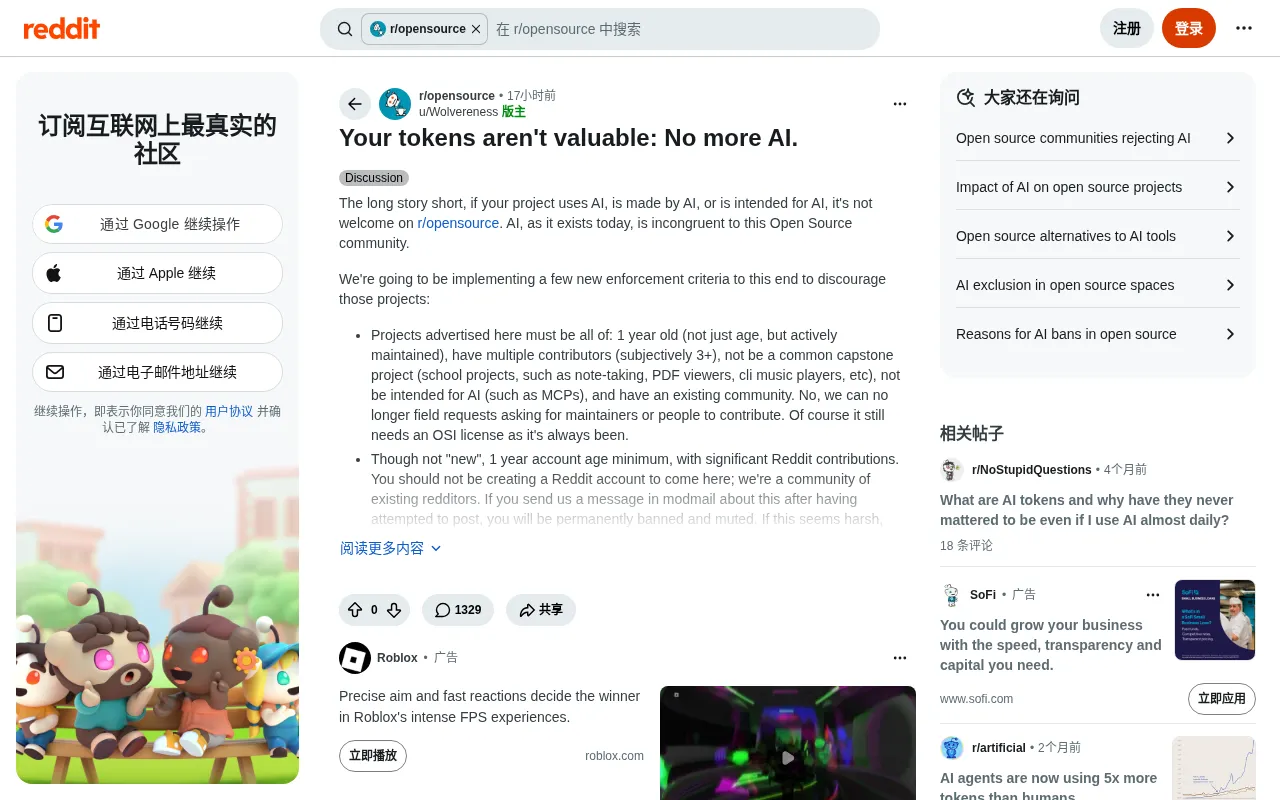
A community called r/open source recently dropped a bombshell rule: banning all solo projects, as well as any project that uses large language models (LLMs). The news received 48 points and 26 comments on Hacker News—not an explosive level of discussion, but the topic itself is sharp enough. It touches the most sensitive nerve in the open source community in the AI era: when code can be generated by models, where exactly is the boundary of "open source"?
What the New Rules Actually Ban
According to the information revealed in the post title, this rule contains two independent prohibitions. First, all solo projects (i.e., projects maintained by a single person) are excluded from the community; second, any project that uses LLMs to assist development is likewise not accepted.
Stack these two bans together, and the affected developer population is quite large. A great many open source projects start out maintained by a single person, and LLM-assisted coding has by now become part of the default workflow. This means the community is effectively excluding the two fastest-growing categories of projects in the current open source ecosystem.
The post does not disclose more detailed enforcement rules—for example, how to detect whether a project used an LLM, whether a solo project can reapply after bringing in a second maintainer, or whether historical projects will be retroactively cleaned up. These gaps are precisely the focus of controversy in the comments.
The Logical Conflict Behind the Two Bans
Looking at the two bans together, it becomes clear that they point to different anxieties.
Banning solo projects usually stems from two considerations: first, reducing the risk of "orphaned projects" caused by maintainers going missing; second, the community wants projects to have some degree of collaboration and code review capability. This is more like an extension of traditional open source governance thinking.
Banning LLM projects is another matter entirely. It targets the transparency of code provenance—if a piece of code is generated by a model, does the contributor truly understand it? Will licensing issues in the training data be transmitted into the project? Such concerns have been widely discussed in open source circles, but few communities have escalated from concern to an explicit ban.
The problem is that enforcing both rules simultaneously produces absurd results: a project collaboratively maintained by two people, but where one of them used an LLM to write part of the code, is rejected; while a purely hand-written project with only a single maintainer is equally rejected. There is a clear mismatch between the granularity of the rules and the complex forms of real projects.
Orphan Projects and Bus Factor
The risk of "orphaned projects" is often measured in open source governance by the bus factor: how many core maintainers would need to leave simultaneously for the project to stall. A solo project has a bus factor of 1—once the maintainer goes missing, issues go unanswered, security vulnerabilities go unpatched, and downstream dependents are directly harmed. Many communities therefore require projects to have at least two active maintainers or to establish a clear succession mechanism. However, bus factor is only one governance metric; equating it directly with "banning solo projects" amounts to substituting maintainer count for a comprehensive assessment of project health—which is one reason the rule has sparked controversy.
Why the Community Is So Wary of LLMs
Judging from the context of the Hacker News discussion, opposition to LLMs entering open source projects centers on several directions.
The most direct is copyright and license contamination. LLM training corpora contain large amounts of code under various licenses, and generated output may inadvertently reproduce snippets of GPL or other copyleft-licensed code. Once a project incorporates such code, the entire licensing system may be implicated—a substantive risk for open source communities that emphasize compliance.
Second is the review burden. Model-generated code often "looks right," but hidden logic errors require maintainers to check line by line. As project scale grows, the cost of reviewing LLM code may exceed rewriting it oneself. Some commenters argue this turns "contribution" into a transfer of burden.
There is also an impact on community culture. Open source has long relied on trust and reputation accumulated between people. The intervention of LLMs makes "who wrote this code" ambiguous, making it difficult for reviewers to judge the true ability of contributors. This sense of opacity is the core reason many veteran maintainers resist it.
Copyleft and License Contagion
The GPL mentioned in the article is a copyleft license whose core mechanism is "contagion": once a project contains GPL code, the entire derivative work generally must also be released under GPL. This stands in sharp contrast to permissive licenses like MIT and Apache 2.0, which allow closed-source commercial use. LLM training corpora mix code under various licenses; if a model-generated snippet is highly similar to a piece of GPL code, it may "infect" the project incorporating that snippet with copyleft obligations. This is precisely the root of why open source compliance communities are especially wary of AI-generated code: the risk lies not in whether the code itself runs, but in whether the license chain is inadvertently contaminated.
The Real Cost of One-Size-Fits-All Rules
From a community governance perspective, the advantage of an explicit ban is that it is enforceable and unambiguous. But the costs are equally obvious.
The most direct is collateral damage. LLM assistance spans an extremely wide range—from completing a single function signature to generating an entire module, all count as "using LLMs." If the rule does not distinguish degree, it will shut out virtually all modern development workflows.
The deeper problem is the signal effect. When mainstream open source communities begin explicitly excluding AI-assisted projects, high-quality contributors may flow to platforms with looser rules, and the excluding community may instead face a decline in project quality. This runs counter to the rule's original intent of improving project quality.
Another possible interpretation is that the rule itself is a statement of position—against the backdrop of rampant AI-generated content, the community chooses to draw the line in the most drastic way, even at the cost of sacrificing some growth. Such an approach is not without precedent in small, values-driven communities.
Attribution and Disclosure Practices for AI-Generated Code
At present, the industry has not formed a unified standard for governing AI-assisted code, but several reference practices have emerged. For example, some projects require declaring in the PR template whether AI tools were used and to what extent; the Linux kernel community has discussed the Signed-off-by tag for AI-generated patches, emphasizing that submitters remain responsible for code quality and license compliance; tools like GitHub Copilot also offer code similarity detection and filters. The common thread of these practices is "disclosure + attribution of responsibility" rather than blanket prohibition, consistent with the tiered governance direction proposed in this article, and they provide realistic material for communities to develop detailed rules.
Open Source Governance Needs Finer Granularity
The real value of this controversy lies not in judging whether a particular rule is right or wrong, but in putting a problem on the table that must eventually be faced: how can open source communities establish an operable governance framework for AI-assisted development?
Feasible directions include: requiring contributors to declare the extent of AI use rather than banning it outright; imposing stricter review processes on submissions with a high proportion of AI-generated content; and clarifying attribution rules for AI-generated code at the licensing level. These approaches are all more complex than a one-size-fits-all ban, but they are closer to how real projects operate.
The new rules of r/open source may be just the beginning. As LLMs further penetrate development workflows, similar rule contests will repeat in more communities. For developers, what is worth paying attention to is not a particular ban itself, but how their own communities will define "acceptable contributions."
Related articles

64-Microphone Acoustic Camera Hands-On: Seeing Sound for $800
Hands-on review of the $800 TD2E acoustic imaging camera: a 64-microphone array localizes sound in real time, covers 2000–100000 Hz including ultrasound, and suits industrial inspection—though the software ecosystem is thin.

Manufacturing Accelerator Re:Build Raises $2.1B, Spins Out Slate Auto
Manufacturing accelerator Re:Build closes $2.1B funding, calling itself "America's answer to Shenzhen," and spins out Slate Auto. Known facts, positioning, and information gaps.

OpenAI's Public Breakthroughs Draw Academic Criticism: Research Transparency in the Spotlight
OpenAI announces math, CS, and physics breakthroughs and claims improved communication, but researchers tell The Verge dissatisfaction is mounting, criticizing selective disclosure and lack of reproducible details as the tension between corporate research and open science resurfaces.