OpenAI Adds Parallel Agents to GPT-6 Pro

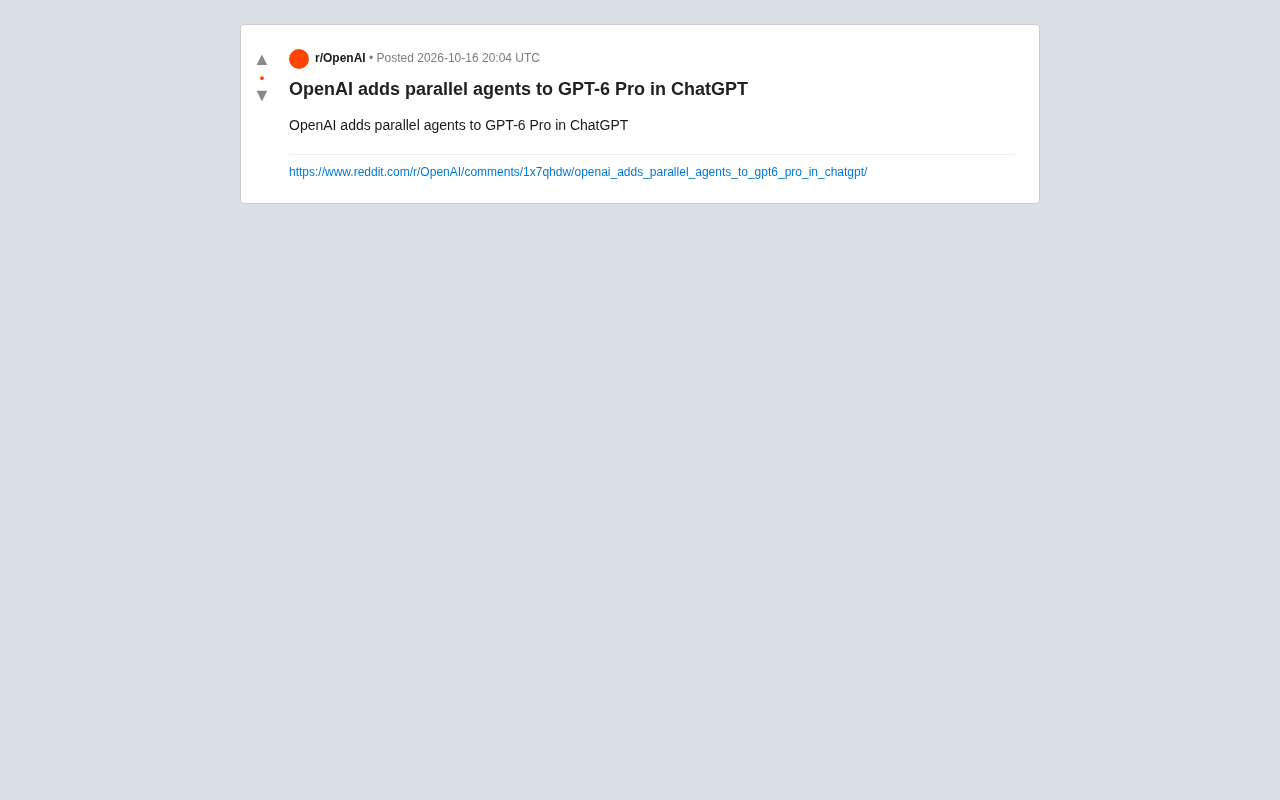
Reddit reports OpenAI added parallel agents to GPT-6 Pro, as ChatGPT moves toward multi-agent orchestration.
According to Reddit, OpenAI has added parallel agents to GPT-6 Pro in ChatGPT, letting the model split a task into sub-goals advanced simultaneously rather than serially. This aligns with the industry's Agentic AI direction, signaling ChatGPT's evolution from a single-turn assistant into a multi-subtask orchestration platform; the higher tier receiving it first fits OpenAI's tiered rollout. Parallelization can shorten long chains like multi-file analysis and coding generation/verification, but raises new engineering challenges of merging outputs and resolving conflicts. Public info is limited to the feature's existence, lacking official parameters and quota details, and the source is a single community post—official announcements should prevail.
According to reports from the Reddit community, OpenAI has added parallel agents capability to GPT-6 Pro in ChatGPT. This development signals that ChatGPT is evolving from a single-turn conversational assistant into an execution platform capable of simultaneously orchestrating multiple subtasks.
What Parallel Agents Mean
Parallel agents means the model can break a single task into multiple sub-goals that are advanced simultaneously by multiple agent instances, rather than waiting serially. For users, the response structure for complex requests (such as multi-file analysis or multi-step research) may shift from "one question, one answer" to "multiple tracks running in parallel."
This capability aligns with the industry's direction for Agentic AI: models no longer merely generate text but take on the role of task orchestration. As a higher-tier subscription level, GPT-6 Pro being the first to receive this capability also fits OpenAI's consistent tiered release strategy.
Agentic AI refers to AI systems with autonomous planning, tool use, and environmental interaction capabilities. The core difference from purely text-generating conversational models is that it can decompose a high-level goal into an executable sequence of steps and adjust strategy based on intermediate results during execution. The industry typically classifies levels by "degree of autonomy"—from assistants that merely respond to single instructions, to execution agents that can autonomously orchestrate multiple tools and subtasks and self-verify. OpenAI, Anthropic, and Google have all made Agentic direction a product mainline over the past two years, with key technical components including planning, tool use, memory, and multi-agent orchestration. Understanding this background helps assess: parallel agents is not an isolated feature but a productized implementation of the "multi-agent orchestration" stage in the Agentic AI roadmap, and its maturity depends on whether planning quality and result aggregation mechanisms are reliable.
Tiered rollout is a gradual release approach OpenAI has long employed: new capabilities are first opened to higher-priced subscription tiers or a small group of users, and after collecting feedback and load data, they are progressively extended downward. From early GPT-4 plugins and web browsing to later Advanced Data Analysis and Operator, all follow the path of "Pro/Plus first, free tier lagging." This strategy has three motivations: first, parallel agents significantly increases inference-side compute consumption, requiring subscription pricing to filter high-value users and control costs; second, the failure modes of multi-agent orchestration are complex, and small-scale rollout facilitates rapid rollback; third, it accumulates stability data for the API and enterprise editions. Therefore, "GPT-6 Pro receiving it first" is itself not surprising—what truly deserves attention is when this capability will trickle down to the Plus tier and whether API orchestration interfaces will be opened, the latter determining whether third-party developers can build their own parallel workflows.
Potential Impact on Use Cases
The most direct value of parallelization is shortening long task chains. For example, retrieving multiple sources simultaneously, processing multiple documents in parallel, or in coding tasks having different agents responsible for generation and verification respectively. But parallelism also brings new problems of result merging and conflict resolution—how to unify the outputs of multiple agents remains an engineering challenge.
Currently, public information only stays at the level of the feature's existence, lacking official parameters, invocation methods, and quota details. Reddit discussions also do not provide verifiable official links, and actual experience may vary by account tier and region.
Result aggregation & conflict resolution is a classic engineering challenge in multi-agent systems. When multiple agents process sub-parts of the same task in parallel, outputs may contradict each other in factual standards, format specifications, or even conclusions, requiring an additional "aggregation layer" to adjudicate: common approaches include setting up an orchestrator agent responsible for aggregation and review, using voting or confidence-weighted mechanisms to select the best result, and introducing structured output constraints so that branch results can be mechanically compared. The difficulty lies in that conflicts often stem from differences in information sources rather than computational errors, and simple majority voting may amplify erroneous consensus. This is why the actual benefits of parallel agents in tasks such as research and coding highly depend on whether subtask boundaries are clearly defined—when boundaries are fuzzy, parallelism instead increases merging costs and may even be less reliable than serial execution.
Points Requiring Caution
A single community post is insufficient to confirm the specific form of the feature: whether parallel agents is an explicit user-visible feature or a backend scheduling optimization remains unclear. It is advisable to rely on official OpenAI announcements and to watch whether parallel orchestration interfaces at the API level will be opened subsequently.
Overall, this news points to a clear trend: ChatGPT is becoming the front-end entry point for multi-agent orchestration, and GPT-6 Pro is the first testing ground for this evolution.
One-line Summary
Reddit reports that OpenAI has added parallel agents to GPT-6 Pro, with ChatGPT moving toward a multi-agent orchestration platform.
Paragraph Summary
According to the Reddit community, OpenAI has added parallel agents capability to GPT-6 Pro in ChatGPT, enabling the model to break a single task into multiple sub-goals and advance them simultaneously rather than waiting serially. This development aligns with the industry's Agentic AI direction, meaning ChatGPT is evolving from a single-turn conversational assistant into a task orchestration platform capable of scheduling multiple subtasks, and the higher-tier subscription level receiving this capability first also fits OpenAI's tiered release convention. The most direct value of parallelization is shortening long task chains such as multi-file analysis, multi-step research, and coding generation and verification, but it also brings new engineering challenges of how to merge multi-agent outputs and resolve conflicts. Currently, public information only stays at the level of the feature's existence, lacking official parameters, invocation methods, and quota details, and the source is a single community post, so official announcements should be taken as authoritative.
Related articles

Cursor AI Programming in Practice: Build a Student Management System from Scratch in 30 Minutes
A Bilibili creator demonstrates Cursor AI programming: generating a student management system in 30 minutes with natural language. Details on Agent mode, Claude selection, prompt techniques, and thresholds.

Top 20 AI Coding Tools Ranking: From Rock-Solid to Lackluster, a Scored Matrix
Bilibili creator releases top 20 AI coding tools ranking, tiered T0–T4 from rock-solid to lackluster, with Claude Code and Codex tied at T0. This article details the scoring dimensions (capability, reliability, robustness, durability, cost, domestic availability) and tool performances to help developers choose the right AI coding assistant.

Vibe Coding Systematic Tutorial: Master AI-Assisted Programming from Zero
A three-month Vibe Coding tutorial from a Bilibili creator covering Codex, ClaudeCode, and Cursor, from core logic to commercial project practice for beginners.