OpenAI Asks: Would a Collective AI Industry Slowdown Even Be Legal?
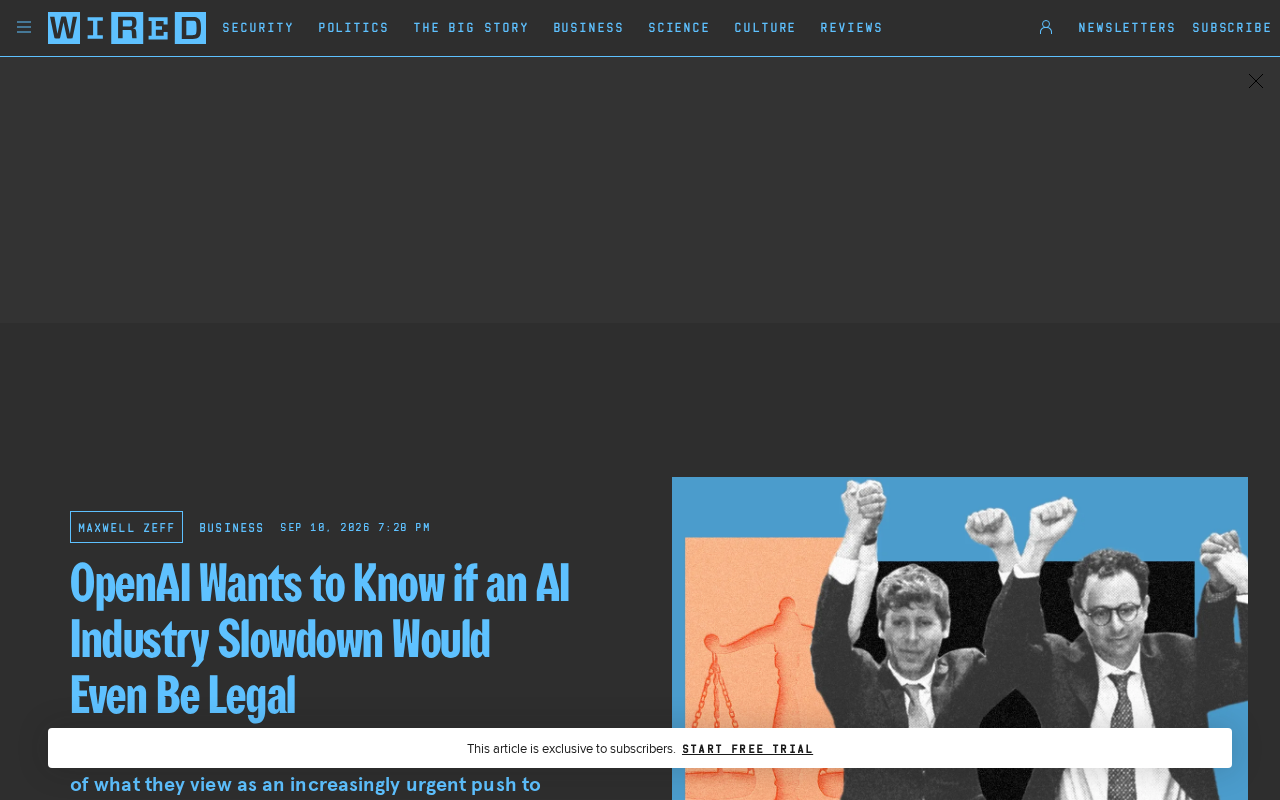
OpenAI's question about collective AI slowdown reveals a fundamental clash between antitrust law and AI safety governance.
OpenAI recently raised a thought-provoking question: would it even be legal for the AI industry to collectively slow its pace of development? The question cuts to the heart of a core contradiction between antitrust law and AI safety governance. While a single company can freely choose to decelerate, coordinated slowdown among multiple firms could violate the Sherman Act's prohibitions on anti-competitive conduct. This creates a governance paradox: the safety community calls for industry self-restraint, yet the most direct path to achieving it — inter-company coordination — faces legal barriers. With arms-race dynamics making voluntary deceleration commercially untenable, OpenAI's question may be both a justification for continued acceleration and a signal to lawmakers that existing antitrust frameworks may need adjustment.
An Intriguing Question
OpenAI recently posed a question that seems far removed from technology yet cuts right to the heart of the industry: if the entire AI sector chose to collectively slow its pace of development, would that even be legal? The question made it onto Hacker News — modest engagement aside (10 upvotes, 2 comments) — and the structural dilemma it reflects is well worth examining.
On the surface, "slowing down AI" sounds like exactly what many safety advocates have been calling for. But when a company at the very frontier of the field publicly explores whether slowing down is legally permissible, the nature of the question becomes complicated — touching on antitrust law, coordinated behavior between firms, and the sensitive terrain of tech governance.
Why "Slowing Down" Raises Legal Questions
The crux lies in the word "collective." A single company independently deciding to ease off its R&D pace is a routine business decision — no legal issues there. But if multiple AI giants reached some kind of understanding or agreement to jointly limit the pace of technological advancement, that could run afoul of antitrust laws in many jurisdictions.
In the United States, the Sherman Act explicitly prohibits agreements between companies that restrain competition. Historically, even well-intentioned industry coordination — such as jointly limiting output or standardizing practices — has been found to constitute illegal price-fixing or output restriction. When AI companies discuss whether they "should hit the brakes," any such discussion that crystallizes into substantive coordinated action risks drawing scrutiny from regulators.
This creates a subtle paradox: on one hand, the AI safety community calls for industry self-discipline and a more cautious pace; on the other, the most direct way to operationalize that self-discipline — inter-company collaboration — may itself be illegal.
The Sherman Act, passed in 1890, is the cornerstone of U.S. antitrust law. Its first section explicitly prohibits "every contract, combination in the form of trust or otherwise, or conspiracy, in restraint of trade or commerce among the several States." In enforcement practice, coordinated conduct between companies falls into two categories: per se illegal behavior (such as price-fixing or market allocation), which requires no proof of actual harm to prosecute; and conduct subject to rule of reason analysis, which weighs competitive harm against potential benefits. The complexity of a collective AI slowdown is that it doesn't fit neatly into the traditional "price-fixing" category — but regulators might characterize it as coordinated restriction of "output" or "innovation competition," triggering antitrust review. The EU's Competition Law Article 101 contains similar provisions, but carves out exemption space for industry coordination with demonstrable social benefits — a distinction that may offer a template for future legislation.
The Strategic Intent Behind OpenAI's Question
The fact that OpenAI proactively raised this question is itself telling. From one angle, this could be a response to external calls to slow down — implying that even if a company wanted to decelerate, the legal environment might not allow the industry to do so collectively, thereby providing a kind of justification for continuing to push ahead at full speed.
From another angle, this could be a way of "testing the waters" for some future form of industry coordination mechanism. If regulators could provide a legitimate framework for "responsible deceleration" — through exemptions or dedicated legislation — the entire landscape of AI governance could shift.
Regardless of intent, the question exposes a core tension in the current AI race: in a fiercely competitive market, no single company wants to unilaterally slow down and cede ground to rivals, yet collective slowdown faces legal barriers. This prisoner's-dilemma-style structure is one of the hardest knots to untangle in AI safety governance.
The Structural Contradiction Between Competitive Pressure and Safety Governance
The current state of the AI industry follows classic arms-race logic. Every leading company fears that if it slows down, a competitor will seize the opportunity to surge ahead. This fear makes "voluntary deceleration" nearly impossible to achieve commercially.
In theory, breaking an arms race requires parties to reach credible mutual constraints. But as OpenAI's question implies, such constraints between companies could be treated as illegal cartel behavior under current legal frameworks. This shifts responsibility onto governments and regulators — only through public policy and legislation can the industry be given a coordination mechanism that is both lawful and effective.
It's worth reflecting that the very framing of this question may itself be signaling to lawmakers: if society genuinely wants AI development to proceed more cautiously, existing antitrust laws may need targeted adjustment to carve out space for industry collaboration in specific domains.
The "prisoner's dilemma" in game theory describes a structure in which each participant independently choosing their optimal strategy produces a collective outcome that is worse for everyone. The AI arms race fits this model perfectly — when each company makes decisions independently, "accelerate" dominates "decelerate" (since slowing down means unilaterally surrendering market share), but when all companies accelerate, overall safety risks rise, ultimately harming the industry as a whole. Historically, breaking such deadlocks has relied on two mechanisms: binding external rules (such as government regulation or international treaties), or credible commitment mechanisms formed through repeated interaction. The core problem in current AI governance is that the former hasn't taken shape, while the latter is blocked by antitrust law — leaving the entire industry in an institutional vacuum.
What This Means for the Industry and the Public
For the general observer, this seemingly niche piece of news is actually a mirror reflecting the deep institutional dilemmas facing AI governance. The pace of technological development depends not only on engineering capability, but also on the complex interplay of law, competition, and commercial incentives.
In the near term, we're unlikely to see any meaningful collective slowdown in the AI industry. The existence of antitrust law, combined with intense commercial competition, leaves "hitting the brakes" without a realistic foundation. Real change may have to wait for substantive evolution in regulatory frameworks and legislation — providing institutional guarantees for responsible AI development.
OpenAI's question offers no answers, but it puts a widely overlooked governance challenge squarely on the table: between pursuing technological progress and ensuring social safety, what role should the law play? This may be one of the most critical questions in AI policy debates in the years ahead.
Related articles

Boox Palma 3 Launches with Stylus Support and Redesigned Look
Boox Palma 3 launches with stylus support and a sleek new design. The pocket-sized e-ink reader gains new capabilities but comes at a higher price than its predecessor.

Cursor 3.0 Complete Beginner's Guide: Getting Started with AI-Powered IDE Development
Cursor 3.0 beginner's guide: from download and setup to parallel sub-agents, cloud development, skills, and automations. Master model selection, design mode, and Git with this complete AI IDE walkthrough.

Codex + Playwright as a Skill: UI Automation Without Manual Commands
Wrap Playwright as a Codex Skill so AI agents run UI automation tests via natural language. Covers install, Sauce Demo walkthrough, PO pattern, and MCP vs CLI+Skill tradeoffs.