OpenAI Astra Approaching Release, Qwen Local Model Closing in on Closed-Source Frontier

OpenAI Astra nears release as multi-agent orchestrator while Qwen's local 27B model rivals closed-source frontiers.
OpenAI's next-generation model Astra is approaching release, positioned as a multi-agent orchestrator for Codex. Meanwhile, Qwen 3.8's 27B parameter model scores 51 on the Agentic Index, surpassing GPT-5.6 Terra and DeepSeek v4 Pro. Cursor launched Origin to challenge GitHub, Sol launched a price war, and DeepSeek v5 rumors hint at a September release—signaling AI capability boundaries are expanding rapidly across multiple fronts.
Astra Nearing Release: Clues from Codex
Over the past week, the most explosive news in the AI space has centered almost entirely around OpenAI's next-generation model, Astra. The story began rather dramatically—just as Anthropic was experiencing a service outage, OpenAI swiftly posted an image showing Codex achieving 99.9% uptime, carrying a subtle hint of provocation.
Codex is OpenAI's cloud-based AI coding agent platform that allows developers to delegate programming tasks to AI for autonomous completion in sandboxed environments. Unlike traditional code completion tools, Codex can independently execute complete development workflows—including understanding requirements, writing code, running tests, and submitting pull requests. Its 99.9% uptime figure means the service virtually never goes down, which is critical for enterprise users relying on AI to work continuously.
Shortly after, OpenAI's Thibault publicly dropped several key pieces of information: Codex's reliability is approaching 100%, parts of its tech stack may be open-sourced, and the most heavyweight statement—"We will also have Astra."
This seemingly casual remark instantly ignited the entire community. Multiple OpenAI employees subsequently began "vague-posting" about Astra, with all signs pointing to this next-generation model rapidly approaching release—possibly even before the end of this month.
The Mew4 Mystery: A Hidden Model in Production Code
What truly set imaginations running was a codename discovered by the community in OpenClause deployment records: Mew4.
According to those who dug it up, in deployment activity on August 5th, maintainer Peter Steinberg was working on actual production UI code, and the deployment history contained a very specific entry—"engine codex model Mew4, thinking x-high." This means Mew4 isn't some mysteriously mentioned name conjured from thin air, but was actually integrated into Codex as an independent code reviewer in "x-high" reasoning mode, reviewing real pull requests involving interface components like the composer menu, connectors, tool access, skills, and sidebar controls.
The "x-high" reasoning mode deserves explanation: modern reasoning models (like the o-series) allow users to set different "thinking intensity" levels, from low to high to x-high. Higher levels mean the model spends more time unfolding and verifying its internal chain of reasoning before generating a final answer. X-high is typically used for complex tasks requiring extremely high accuracy, such as verifying logical correctness during code review.
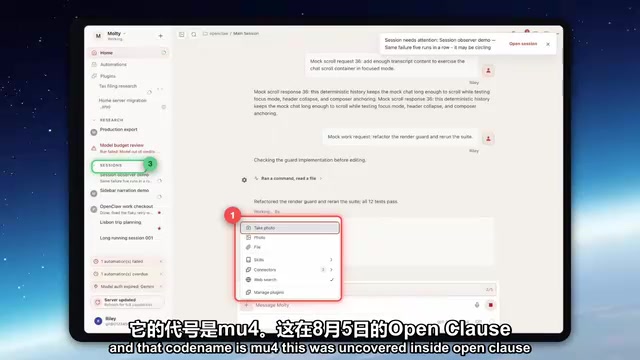
Curiously, however, public references to Mew4 subsequently began disappearing. According to reports, on August 7th, Mew4's name was scrubbed from 52 pull requests, and these references were later replaced with "GPT-5.6-Sol." Even more intriguing, six days later Mew4's name appeared again in OpenAI's own Codex repository.
This sequence of events sparked considerable speculation. If Mew4 is indeed an internal model whose name was later hidden beneath GPT-5.6-Sol, it's very likely an internal checkpoint or deployment candidate that OpenAI isn't ready to publicly disclose. In deep learning, a "checkpoint" refers to a snapshot of model parameters saved at a specific stage during training. Research teams typically evaluate multiple checkpoints and apply post-training—including RLHF alignment, instruction fine-tuning, and other steps—ultimately selecting the best-performing version as the release candidate.
Of course, there's currently no direct evidence equating Mew4 with Astra—it could be one of Astra's checkpoints, a post-training branch, or an entirely unrelated research model. But combined with recent developments (Thibault publicly confirming Codex will have Astra, and even Sam Altman going to Washington to confirm Astra's release), the likelihood of this connection is growing.
Why Astra Is Worth the Excitement: Multi-Agent Orchestration
Setting leaks aside, Astra's positioning itself is what deserves the most attention. Previous reports indicated that Astra's core training objective is enabling multiple agents to collaborate and solve extremely difficult problems over extended time spans. OpenAI has already built infrastructure within Codex that precisely matches this goal.
Multi-Agent Orchestration is an increasingly mature AI system architecture pattern in which multiple specialized AI agents each handle different subtasks, coordinated by a central orchestrator. This contrasts with the paradigm of a single large model handling all tasks. In coding scenarios, the orchestrator can decompose a complex project into subtasks like frontend, backend, and testing, assign them to different agents for parallel processing, and then integrate the results. The advantages of this architecture include: using low-cost models for simple tasks to conserve resources, dramatically reducing completion time through parallel execution, and allowing agents to review each other's work to improve output quality.
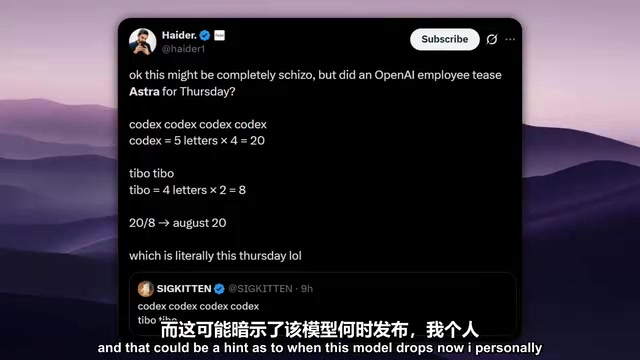
Currently, Sol and Terra can work in parallel and communicate with each other, while Luna can run as a sub-agent within Codex's multi-agent system. Under this architecture, Astra would likely serve as the "orchestrator": you give it a massive task, Astra breaks it down, dispatches work to cheaper models like Luna, runs multiple agents simultaneously, then reviews their outputs and integrates them into a final result.
This pattern isn't entirely new in software engineering—it resembles the master-worker pattern in distributed systems, but replaces traditional compute processes with reasoning-capable AI agents, enabling the system to handle complex tasks requiring creative judgment rather than merely parallelizable computation.
If rumors about Astra being an entirely new pre-trained model prove true, these multi-agent capabilities may have been trained into the model from the ground up. Just as Claude Code represented a breakthrough in agentic coding, Astra could mark a major leap in long-horizon, multi-agent capabilities.
Codex Unlocks 1 Million Token Context Window
Another nearly overlooked update is that Thibault documented how to unlock a 1 million token context window for GPT-5.6 Sol within Codex. By default, Codex uses a smaller tuned context to balance performance and cost, but Sol itself supports approximately 1 million tokens. Users simply need to open the Codex configuration, add the corresponding model slug, set the context window to 1 million, and the auto-compact threshold to 900,000 to manually enable it.
The context window refers to the maximum amount of text a model can "see" and process in a single inference. One million tokens is roughly equivalent to 750,000 English words or the combined content of hundreds of code files. For large codebases, a traditionally limited context window forces agents to frequently "forget" previously processed content, leading to incoherent decision-making. The auto-compact threshold is an automatic compression mechanism that summarizes earlier content when the context approaches its limit to free up space. Setting it to 900,000 means maintaining complete memory until 90% capacity is consumed, triggering compression only in extreme situations.
This is highly significant for massive codebases and extended coding sessions—agents no longer lose track of earlier decisions so easily. Many people didn't even know this capability existed, and once they began testing it, long-context coding demonstrated impressively effective results.
Cursor Launches Origin Code Hosting Platform: A Direct Challenge to GitHub
The developer tools space is also buzzing. Cursor launched its own code hosting platform, Origin—most directly understood as Cursor mounting a frontal assault on GitHub.
Since its founding in 2008, GitHub has become the de facto standard platform for global developer collaboration, hosting over 300 million repositories and acquired by Microsoft for $7.5 billion in 2018. Its core features include Git version control hosting, code review (Pull Requests), and CI/CD (Continuous Integration/Continuous Deployment). Cursor, as an AI-native code editor launching Origin, is essentially attempting to build a closed-loop ecosystem from writing to hosting to deployment, bypassing GitHub as an intermediary layer.
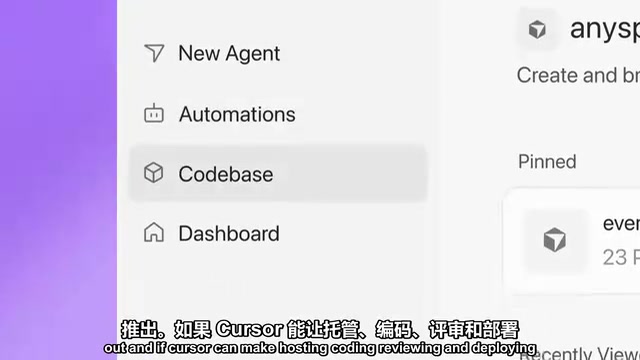
Origin allows you to sync existing GitHub repositories, emphasizes speed and simplicity, and is deeply integrated with Cursor's workflow. It has also established partnerships with mainstream integrations like Vercel, Buildkite, and Depot, with more partners joining over time. Vercel is a leader in frontend deployment platforms, while Buildkite and Depot focus on CI/CD pipeline acceleration—together these tools constitute the complete toolchain for modern developers from coding to going live. The feature is currently in beta and rolling out gradually.
If Cursor can truly unify hosting, coding, review, and deployment into a seamless workflow, Origin could become a pivotal component in developers' tech stacks. The underlying strategic logic is this: as AI takes on an increasing share of coding work, the competitive focus for developer tools will shift from "whose editor is better" to "whose end-to-end automation pipeline is smoother."
Qwen 3.8 27B: Local Model Performance Approaching the Closed-Source Frontier
If Astra represents the ceiling of the closed-source frontier, the 27B parameter model from Qwen 3.8 demonstrates the staggering pace of progress in local models.
A 27B (27 billion) parameter model is called "locally runnable on consumer hardware" because after quantization compression (such as 4-bit quantization), the model requires approximately 16-20GB of VRAM—loadable on a single high-end consumer GPU (like the RTX 4090 with 24GB VRAM). By contrast, closed-source models like GPT-5.6 are estimated to potentially have hundreds of billions or even trillions of parameters, only runnable on large-scale datacenter clusters. Local execution means data never leaves the user's device, offering both privacy and zero-latency advantages with no per-token charges.
According to the latest data from Artificial Analysis, this 27 billion parameter model scored 51 on the Agentic Index, surpassing GPT-5.6 Terra, DeepSeekAd v4 Pro, GPT-5.6 Luna, and Gemini 3.7 Flash. The Agentic Index measures a model's comprehensive ability to autonomously execute multi-step tasks, including tool calling, planning, error recovery—precisely the capabilities coding agents need most. On the more comprehensive Artificial Analysis Intelligence Index, it also reached the level of DeepSeek v4 Pro and GPT-5.6 Luna.
More critically, these benchmarks translate reasonably well into real-world results. Someone had Qwen 3.8 27B build a Call of Duty-style game, and it completed a fairly complex project on local consumer hardware. This means local models are gradually reaching a level where you can generate truly complex projects without continuously paying for expensive frontier model APIs and subscriptions. The gap between local models and closed-source frontier models is shrinking at an astonishing rate.
The Qwen series is developed and open-sourced by Alibaba's Tongyi Lab, and its rapid iteration also reflects the vitality of the current open-source model community—Meta's Llama, Mistral, DeepSeek, and Qwen have formed a multi-polar competitive landscape where each breakthrough is quickly absorbed and improved upon by the entire community.
Sol Price War and DeepSeek v5 Rumors
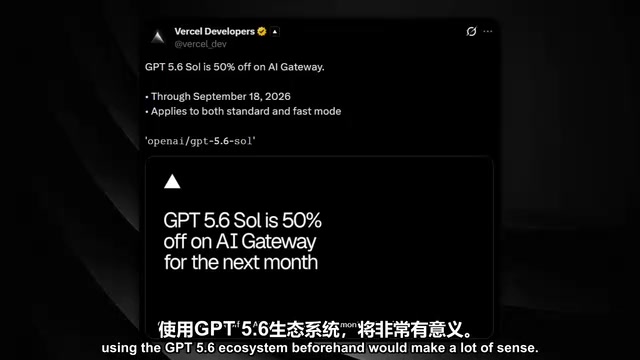
Meanwhile, GPT-5.6 Sol has suddenly launched a price war. Vercel announced Sol at 50% off on AI Gateway through September 18th (applicable to both standard and fast modes), and OpenRouter promptly followed with its own 50% discount, covering Batch, Flex, and Priority tiers, with Flex mode as low as $1.25 per million input tokens.
AI model pricing typically charges by token—$1.25 per million input tokens means processing approximately 750,000 English words of input for just $1.25. This price was nearly unimaginable a year ago, when models of equivalent capability cost one to two orders of magnitude more. The deeper logic behind the price war lies in the strong network effects and switching costs of AI services: once developers build applications around a specific model API, accumulate prompt engineering experience and evaluation pipelines, the cost of migration is extremely high. Therefore, aggressive short-term pricing is essentially competing for long-term ecosystem lock-in, similar to the early cloud computing price competition between AWS and Azure.
Why is everyone suddenly racing to cut prices? The simplest explanation is to boost usage—after OpenAI substantially reduced Luna and Terra prices previously, usage surged immediately. But in the context of Astra's impending arrival, the timing is thought-provoking: if OpenAI is preparing to launch a model stronger and potentially more expensive than Sol, then deeply locking developers into the GPT-5.6 ecosystem in advance makes perfect sense. Sol's price cut can be viewed as a "hook"—once developers are drawn into the ecosystem, they'll naturally consider upgrading when faced with the more powerful Astra.
Additionally, rumors about DeepSeek v5 have begun circulating, with a possible release window in September. While architecture and model details remain unclear, given the v4 flash model's exceptional cost-effectiveness, a truly next-generation flash model offers enormous possibilities. DeepSeek is known for its MoE (Mixture of Experts) architecture, which dramatically reduces computational costs by activating only a subset of parameters during inference while maintaining performance close to that of full-parameter models. According to sources, if DeepSeek v5 flash can reach the level of certain top-tier models, its pricing would "directly rewrite the landscape."
Conclusion: AI Capability Boundaries Are Being Pushed Simultaneously in Multiple Directions
Worth noting is that OpenAI co-founder Greg Brockman recently revealed that OpenAI has begun specifically training models to write so-called "superhuman-level secure" code, capable of presenting security fix proposals directly to engineers. This means AI is not only generating code but understanding security vulnerability patterns within code—such as SQL injection, cross-site scripting (XSS), buffer overflows—and proactively fixing them. Combined with Astra and increasingly powerful coding agents, cybersecurity may become the next important battleground for these models.
From Astra's multi-agent orchestration, to Qwen's local model approaching the frontier, to DeepSeek v5 rumors and Cursor's direct challenge to GitHub—this week's developments collectively paint a clear trend: the boundaries of AI capability are being rapidly pushed in multiple directions simultaneously. Closed-source models continue climbing in reasoning depth and system integration, open-source models are rapidly catching up in efficiency and accessibility, and the developer tools ecosystem is competing over who gets to define the next generation of software engineering workflows. The convergence of these three forces is reshaping the entire software industry.
Key Takeaways
Related articles

Free Unlimited Claude Code Solution: Agnes AI + CC Switch Setup Guide
No paid subscription needed — pair the free AI platform Agnes AI with the open-source tool CC Switch to provide a backend for Claude Code, enabling unlimited free calls to text, image, and video models. This guide covers the full setup, test results, and usage boundaries.

A Complete Zero-Cost Guide to Getting Started with Claude Code for Beginners in China
A beginner's guide to Claude Code for users in China: two installation methods (command line and IDE plugin), full configuration steps for replacing the official API with the free domestic LongCat model, and a hands-on demo of building a small tool with natural language, plus tips.

When the NSA Gets Involved: The AI Supply Chain Crisis Behind Open-Source CVEs and API Key Hijacking
Multiple open-source projects disclosed severe CVEs in one day, PHP flaws alarmed the FBI, and Railway and OpenCode were breached with API keys stolen. This article breaks down the vulnerability window, AI-accelerated exploitation, and the AI supply chain crisis behind the API key black market, with a developer defense checklist.