OpenAI Astra Is Coming: A Complete Breakdown of Multi-Agent Collaboration and the Latest AI Industry Developments

A comprehensive breakdown of OpenAI Astra's multi-agent capabilities and key AI industry developments.
This article covers OpenAI's upcoming Astra model and its multi-agent orchestration capabilities, the mysterious Mew4 codename found in Codex deployment logs, Cursor's GitHub-challenging Origin platform, Qwen 3.8 27B's frontier-rivaling local performance, GPT-5.6 Sol price cuts, potential DeepSeek v5 arrival in September, and OpenAI's push toward superhuman-level AI cybersecurity.
The AI space has been buzzing with activity lately — from OpenAI's mysterious next-generation model Astra, to Cursor launching Origin (a code hosting platform squarely aimed at GitHub), to a local Qwen model with only 27 billion parameters rivaling frontier models. Industry competition has reached a fever pitch. This article breaks down these key signals and analyzes the underlying technical logic and industry trends.
Astra Surfaces: The Mysterious Codename Mew4 Sparks Speculation
Recently, OpenAI's Codex team dropped a series of intriguing hints. During an Anthropic service outage, OpenAI swiftly showcased Codex's impressive 99.9% uptime. Shortly after, team member Thibault revealed three key pieces of information: Codex is approaching near-100% reliability, the team is still addressing occasional reset issues, and parts of the tech stack may be open-sourced. But the most eye-catching statement was — "We will also have Astra."
Astra is OpenAI's widely discussed next-generation model. The biggest clue surrounding it comes from an internal codename called "Mew4." According to leaks, OpenAI's deployment activity logs from August 5th contained the entry "engine codex model Mew4, thinking x-high." This suggests Mew4 has already been integrated into Codex, functioning as an independent code reviewer running in x-high reasoning mode, actually reviewing real Pull Requests involving UI components like composer menus, connectors, tool access, and sidebar controls.
OpenAI's internal model naming has always followed specific coding conventions. Previously, the GPT series used incrementing numerical names (GPT-3, GPT-4), but internal development stages typically use codenames to avoid premature leaks of product roadmaps. The "Mew" in "Mew4" may derive from some internal classification system, while the number "4" suggests an iteration version. Notably, the "thinking x-high" reasoning mode refers to a capability tier where the model allocates more computational resources for deep reasoning during inference — similar to the "thinking budget" concept introduced in the o1 and o3 series. The model can switch between different reasoning intensities, with x-high representing the highest level of reasoning depth, suitable for complex tasks requiring extreme accuracy, such as code review.
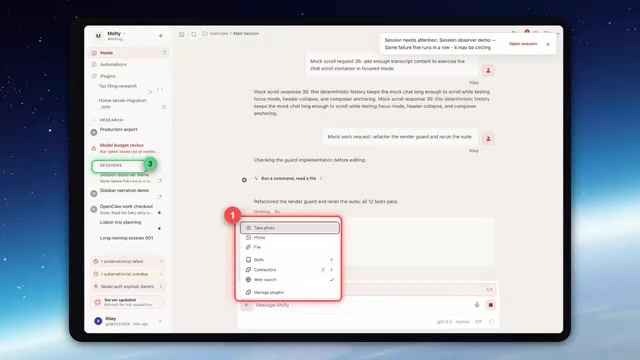
What happened next was even more intriguing. According to the person who discovered it, public references to Mew4 were scrubbed from 52 Pull Requests on August 7th — and the timing coincided with roughly two and a half hours after a post about Astra went live. These references were subsequently replaced with "GPT-5.6-SOL." Six days later, the Mew4 name reappeared in OpenAI's own Codex repository. This pattern of concealment and reappearance suggests Mew4 may be an internal checkpoint or deployment candidate model not yet ready for public disclosure.
It's important to emphasize that there is currently no direct evidence equating Mew4 with Astra. Mew4 could be a checkpoint of Astra, a post-training branch, or an entirely unrelated research model. But combining recent signals — including Sam Altman's trip to Washington to confirm the Astra release — the industry broadly believes Astra's launch has entered the countdown phase and could arrive as early as this month.
Why Astra Matters: Long-Horizon Multi-Agent Collaboration
The core reason Astra generates so much excitement lies in its positioning. According to earlier reports, Astra was trained around the goal of "multiple agents collaborating over extended periods to solve extremely difficult problems." And OpenAI has already built the corresponding infrastructure within Codex.
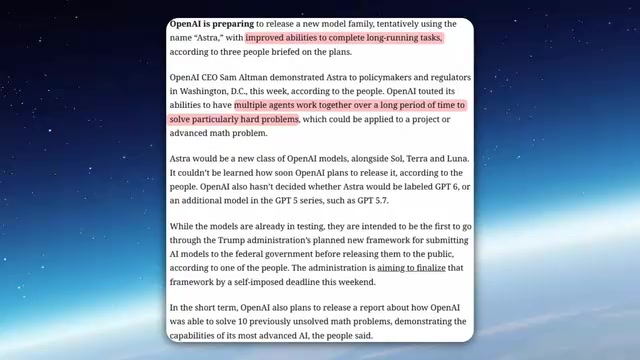
Currently, Sol and Terra within Codex can work in parallel and communicate with each other, while Luna can operate as a sub-agent within a multi-agent system. Under this architecture, Astra would likely serve as the "orchestrator": you give it a massive task, Astra breaks it down, delegates work to lower-cost models (like Luna), lets multiple agents push forward simultaneously, then reviews their outputs and synthesizes the results.
Multi-Agent Systems are one of the core research directions in AI. The central idea is decomposing complex tasks into multiple subtasks, each handled by different specialized agents. In traditional software engineering, a similar design pattern is known as microservices architecture. The "orchestrator" role borrows from the concept behind container orchestration tools like Kubernetes — a central scheduler responsible for assigning tasks, monitoring progress, and integrating results. In the AI context, this means a high-capability model (like Astra) is responsible for understanding the overall objective, formulating an execution plan, and then distributing the actual execution work to lower-cost but sufficiently capable models. The economic logic of this architecture is crystal clear: avoid using the most expensive model for every subtask, and instead invoke models at different capability tiers as needed, achieving an optimal balance between overall effectiveness and cost.
If the rumors about Astra being an entirely new pre-trained model are true, then these multi-agent capabilities may be trained into the model from the ground up. Just as Claude Code achieved breakthroughs in agentic programming, Astra could bring a qualitative leap in "long-horizon multi-agent" capabilities. This also explains why Codex has seen such a dense wave of recent upgrades — they're all paving the way for Astra's arrival.
Hidden Feature: 1-Million-Token Context Window
An easily overlooked update is that Thibault publicly shared how to unlock a 1-million-token context window for GPT-5.6 Sol in Codex. By default, Codex uses a tuned smaller context to balance performance and cost, but Sol itself supports approximately 1 million tokens.
The context window determines how much information a model can "see" and "remember" in a single interaction. One million tokens is roughly equivalent to 7.5 million English words, or about 15,000 pages of documentation. For coding scenarios, this means the model can simultaneously understand the contents of hundreds of files in a large code repository and their interrelationships. The "auto-compact" mechanism is a dynamic context management strategy: when conversation history approaches the limit, the model automatically compresses older content (retaining key information, discarding redundant details) rather than simply truncating it. Setting the auto-compact threshold to 900,000 tokens means the model won't trigger compression until it has consumed 900,000 tokens, maximally preserving complete working memory.
Users simply need to open the Codex configuration, add the corresponding model slug, set the context window to 1 million, and set the auto-compact token limit to 900,000. This allows Codex to dynamically retain more codebase content, tool outputs, and session history before compressing older context — critically important for large repositories and long coding sessions, effectively mitigating the problem of agents "forgetting earlier decisions."
Cursor Launches Origin Platform: Taking Aim at GitHub's Home Turf
The developer tools space is equally active. Cursor has launched its own code hosting platform, Origin, widely interpreted as a direct challenge to GitHub.
GitHub has been the de facto standard for code hosting and collaboration since its founding in 2008, further solidifying its ecosystem position after Microsoft's $7.5 billion acquisition in 2018. GitHub is more than just a code repository — it's a complete developer platform built around Git version control, encompassing CI/CD (Continuous Integration/Continuous Deployment), project management, code review, and more, with over 100 million developer users. Cursor, as an AI-native code editor, previously focused primarily on intelligent coding assistance. Its launch of the Origin platform represents a strategic leap from the tool layer to the platform layer.
Origin's core selling points are "fast, clean, and deeply integrated with the Cursor workflow." Users can directly sync their existing GitHub repositories to get started. Cursor has also partnered with major integrations like Vercel, Buildkite, and Depot, with more integrations on the way. Vercel is a well-known frontend deployment platform, Buildkite specializes in CI/CD pipelines, and Depot provides container build acceleration services — the choice of these partners indicates Origin is targeting full-chain integration of modern cloud-native development workflows. Origin is currently in Beta and rolling out access gradually.
If Cursor can deliver a truly seamless workflow that unifies hosting, coding, review, and deployment, Origin could become an indispensable part of the developer tech stack. This also reflects the broader trend of AI programming tools evolving from "coding assistance" to "full-lifecycle platforms."
Local Models Approaching the Frontier: Qwen 3.8 27B's Stunning Performance
Progress in local models is equally impressive. Artificial Analysis has released clear benchmarks for the Qwen 3.8 27-billion-parameter model: it scored 51 on the Agentic Index, which is remarkable for a model that can run locally.
Artificial Analysis is an independent AI model evaluation organization. Its Agentic Index specifically measures a model's ability to autonomously complete multi-step complex tasks — including tool calling, code generation and execution, long-chain reasoning, and self-error correction. Unlike traditional static knowledge tests like MMLU (Massive Multitask Language Understanding), the Agentic Index more closely reflects a model's real-world performance as an "agent" working independently. The reason Qwen 3.8 27B has caused such a stir is that the 27B parameter count means the model can run in quantized form on consumer-grade GPUs with 24GB of VRAM (such as the NVIDIA RTX 4090), without expensive data-center-grade hardware. This breaks the established equation of "frontier capability = massive parameters = cloud deployment," carrying significant implications for data-privacy-sensitive enterprises and independent developers.
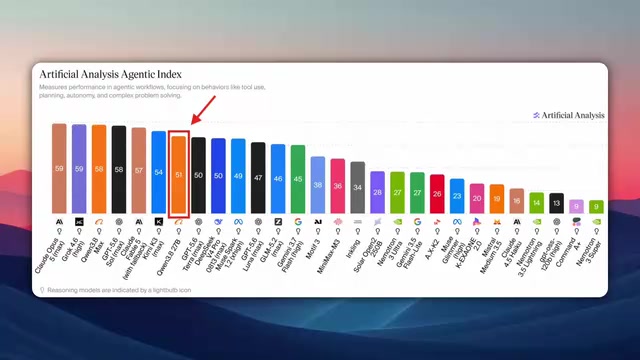
This score places it above GPT-5.6 Terra, DeepSeekAd v4 Pro, GPT-5.6 Luna, and Gemini 3.7 Flash on this benchmark. On the broader Artificial Analysis Intelligence Index, it also reaches levels approaching DeepSeek v4 Pro and GPT-5.6 Luna.
In other words, you can now get intelligence approaching Opus and GPT levels on consumer-grade local hardware. Testers have had Qwen 3.8 27B build a Call of Duty-style game, and the locally generated results were quite impressive. The deeper significance here is that local models are approaching the critical threshold where they can generate truly complex projects — without the need to continuously pay for expensive frontier model APIs, tokens, and subscriptions. The gap between local models and closed-source frontier models is shrinking at breakneck speed.
GPT-5.6 Sol Gets a Price Cut, DeepSeek v5 May Arrive in September
Notable movements are happening on the pricing front as well. Vercel announced a 50% discount on Sol through the AI Gateway until September 18th (applicable to both standard and fast modes), and OpenRouter immediately followed with the same 50% discount across Batch, Flex, and Priority tiers, with Flex input token pricing as low as $125 per million tokens.
AI model pricing strategies are undergoing a "land grab" reminiscent of the early days of cloud computing. The core logic behind price cuts isn't just stimulating short-term usage — it's establishing developer switching costs. Once developers have built prompt engineering, fine-tuning pipelines, and application architectures around a specific model's API, the cost of switching to a competing model rises significantly. Batch mode refers to asynchronous batch processing (suitable for non-real-time tasks, with lower pricing), Flex mode offers a flexible latency-cost balance between batch and real-time, and Priority mode guarantees the lowest-latency real-time responses. The Flex input price of $125 per million tokens is approaching the self-hosting cost of open-source models, putting direct pressure on competitors known for cost efficiency, like DeepSeek.
Why are various companies suddenly so aggressive about cutting prices on OpenAI's flagship model? The most straightforward explanation is stimulating usage — after OpenAI previously slashed Luna and Terra prices, usage surged. But in the context of Astra's imminent release, the timing is quite telling: if OpenAI is preparing to launch a model that surpasses Sol and could be more expensive, getting developers deeply locked into the GPT-5.6 ecosystem ahead of time makes perfect strategic sense.

Additionally, there are rumors about DeepSeek v5, with a possible launch window pointing to September. While architectural details remain unclear, considering v4 Flash's exceptional cost-performance ratio, a truly next-generation flash model that matches top-tier models in capability could deliver a disruptive shock to the market through its pricing alone.
AI Cybersecurity: Superhuman-Level Code Protection Emerges as a New Frontier
OpenAI co-founder Greg Brockman has pointed to another direction — "superhuman-level cybersecurity." According to his statements, OpenAI has begun specifically training models to write "superhuman-level secure code," enabling AI to discover and fix vulnerabilities in infrastructure before they can be exploited.
Traditional cybersecurity relies on human security researchers manually auditing code, writing penetration test cases, and patching vulnerabilities — a process that is both slow and prone to oversights. The AI-driven "superhuman security" concept envisions models automatically scanning for potential security vulnerabilities at the code commit stage — including SQL injection, cross-site scripting (XSS), buffer overflows, privilege escalation vulnerabilities, and more. The "superhuman" qualifier means the model can work 24/7 without interruption while possessing vulnerability pattern recognition capabilities spanning multiple programming languages and frameworks, with coverage and speed far exceeding even the best human security teams. This direction aligns with DARPA's previously launched AI Cyber Reasoning Challenge (AIxCC), which aims to advance AI's ability to automatically discover and fix vulnerabilities in open-source software. Brockman's statement implies that OpenAI is making secure coding capability a dedicated optimization objective in model training, rather than a simple post-processing plugin.
Brockman believes that in the coming months, organizations will need to dramatically automate their security programs to keep pace. Humans will still review critical changes, but AI can continuously identify real vulnerabilities and immediately provide engineers with secure fix recommendations. Combined with Astra and increasingly powerful coding agents, cybersecurity is likely to become a key domain that next-generation models compete to conquer.
Conclusion
From Astra's multi-agent architecture to local models approaching the frontier, developer tool platformization, price wars, and new security directions — the AI industry is advancing on multiple fronts simultaneously. While questions like whether Mew4 is Astra and the exact timing of DeepSeek v5 remain speculative, what's certain is that the boundaries of model capability, cost, and application form are being rapidly rewritten. For developers and enterprises alike, closely monitoring these signals and adjusting tech stacks accordingly will be the key to staying competitive.
Related articles

Cursor AI Programming in Practice: Build a Student Management System from Scratch in 30 Minutes
A Bilibili creator demonstrates Cursor AI programming: generating a student management system in 30 minutes with natural language. Details on Agent mode, Claude selection, prompt techniques, and thresholds.

Top 20 AI Coding Tools Ranking: From Rock-Solid to Lackluster, a Scored Matrix
Bilibili creator releases top 20 AI coding tools ranking, tiered T0–T4 from rock-solid to lackluster, with Claude Code and Codex tied at T0. This article details the scoring dimensions (capability, reliability, robustness, durability, cost, domestic availability) and tool performances to help developers choose the right AI coding assistant.

Vibe Coding Systematic Tutorial: Master AI-Assisted Programming from Zero
A three-month Vibe Coding tutorial from a Bilibili creator covering Codex, ClaudeCode, and Cursor, from core logic to commercial project practice for beginners.