OpenAI Claimed to Solve VP≠VNP Before Anthropic, Sparking Debate
An evidence-free Hacker News post claimed OpenAI solved VP≠VNP before Anthropic, showing how fundamental science gets pulled into AI rivalry narratives.
The article examines a Hacker News post titled "OpenAI Reveals they solved VP ≠ VNP before Anthropic," which had only one sentence and no paper, code, or formal proof. It clarifies that VP and VNP are Valiant's algebraic complexity classes analogous to P and NP, whose inequality is still unproven and carries a high credibility bar. It explains why such claims spread in AI circles—people conflate benchmark performance with mathematical proof, and the "before Anthropic" framing boosts virality—and stresses distinguishing claims from proofs via reproducible materials, peer review, or machine verification.
A "Complexity Declaration" Sparked by a Headline
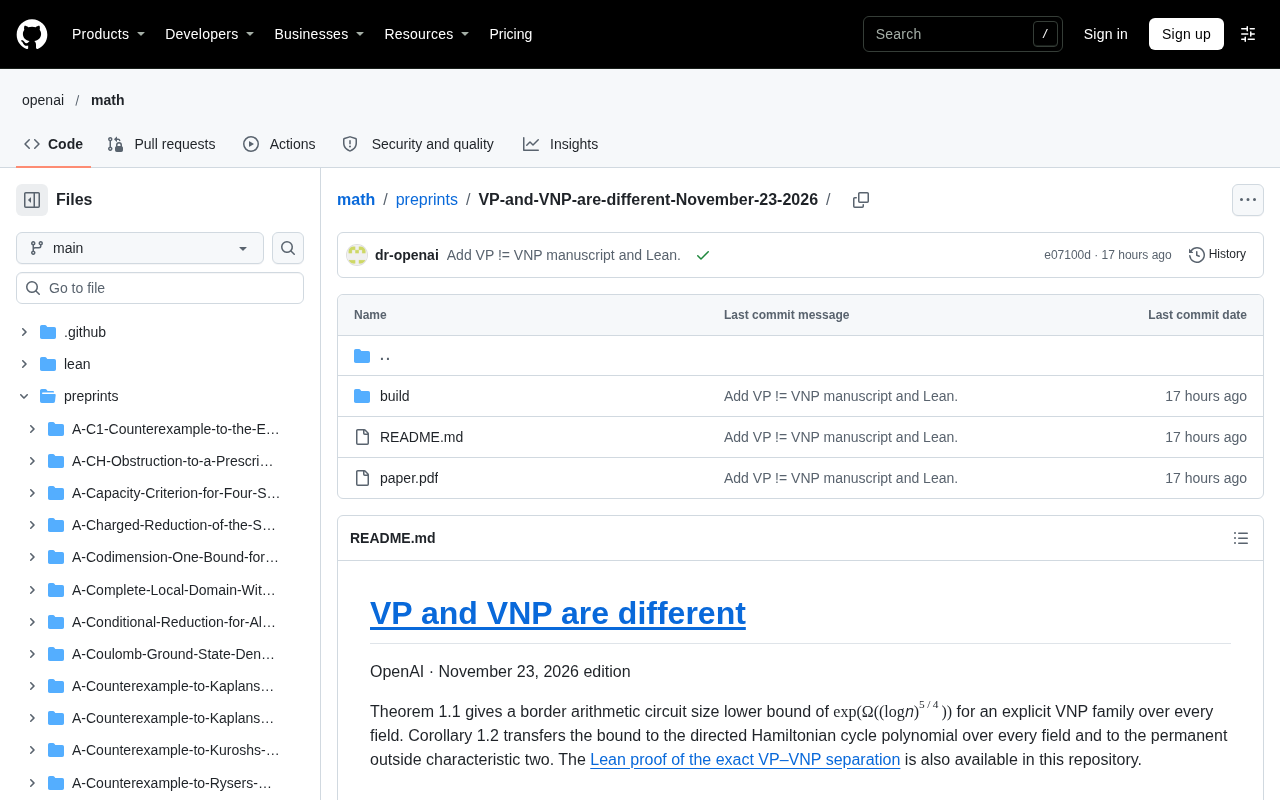
On Hacker News, a post titled "OpenAI Reveals they solved VP ≠ VNP before Anthropic" briefly appeared and quickly sparked a small-scale discussion. The post body contained only a single sentence—no technical attachments, no paper links, no formal proof—yet it directly threw out a claim capable of shaking the computational complexity theory community: that OpenAI had already "solved" VP ≠ VNP, and did so earlier than Anthropic.
First, let's clarify the concepts. VNP is a counting class introduced by Valiant in algebraic complexity theory, which can be understood as "counting problems verifiable in polynomial time"; VP is the corresponding class of polynomial families efficiently computable by arithmetic circuits. VP ≠ VNP is often regarded as the algebraic-counting analogue of P ≠ NP. It is not an engineering metric but an unresolved fundamental mathematical problem—like P vs NP, it has no accepted proof to this day.
Because of this, the statement "OpenAI solved VP ≠ VNP" carries an extremely high credibility threshold. This Hacker News post provided no verifiable material, and the discussion thread had yet to produce any substantive exchange. This means we should treat it as an industry signal to be examined, not as a confirmed scientific result.
Why Such Claims Easily Gain Traction in the AI World
The "Misplaced Association" Between Large Models and Complexity Theory
Over the past two years, AI companies have frequently released results in reasoning capabilities, math competitions, formal proofs, and related areas, and the public easily conflates "a model can solve hard problems" with "a model proved a major conjecture." In reality, a model's performance on a specific benchmark is separated from the rigorous proof standards demanded by the mathematics community by a vast gap.
In mathematics, a proposition being "proved" means there exists a finite sequence derived step by step from axioms according to inference rules, with every step mechanically checkable. Formal proof systems (such as Lean, Coq, and Isabelle) encode this standard into computers so that proofs can be verified line by line by machine—this is known as "proof assistants" or "interactive theorem proving." By contrast, mathematical text generated by a large model, even if the conclusion is correct, is only a natural-language argument and may contain hidden leaps, circular reasoning, or misuse of theorem conditions. Recent "neural theorem proving" research has models search for valid proof steps within systems like Lean, where success is premised on the compiler accepting the proof, not on the text appearing reasonable. Therefore, there is an essential difference between "the model answered correctly on a benchmark" and "the model produced a formally verifiable proof"—the former cannot substitute for the latter.
Competitive Narratives Amplify the Headline Effect
The qualifier "before Anthropic" is the entire headline's engine of virality. The rivalry between OpenAI and Anthropic is one of the most closely watched narratives in the AI industry today, and any statement that places the two companies in the same sentence for comparison will earn extra clicks and shares. Even without any evidence in the original post, the "who did it first" framing alone can generate discussion.
From this angle, the value of this post lies not in what it claims but in what it exposes: fundamental scientific propositions are being drawn into the brand-competition discourse of AI companies.
How to Treat Unsubstantiated Claims
Distinguish "Claiming" from "Proving"
Mathematics and theoretical computer science have clear standards for "solving": formal definitions, reproducible derivations, and proofs that have undergone peer review or machine verification. A single forum headline cannot constitute evidence at any level. For a proposition like VP ≠ VNP, what the community needs is a complete proof or a checkable formalization file, not the sequencing of announcement schedules.
Default Skepticism Toward Industry Information
The Hacker News discussion ecosystem itself illustrates this point: the post had limited heat and few comments, indicating that most readers did not treat it as a genuine breakthrough. In the absence of a paper, code, or formal verification, the rational attitude is to classify it as unconfirmed rumor.
Hacker News uses a voting-based ranking mechanism, where the number of votes and comments a new post receives in a short time jointly determine whether it reaches the front page. A one-sentence post with no external links claiming to solve a major conjecture would typically sink quickly due to the lack of verifiable material; the comment section's "flag" mechanism also helps hide suspected clickbait or misinformation. This community self-purification mechanism does not guarantee correct conclusions, but it can filter out most claims without substance. To judge the credibility of a technical claim, one can check in sequence: whether a preprint or paper ID is attached, whether reproducible code or data is provided, whether the authors are willing to respond to technical challenges publicly, and whether the conclusion has been independently reviewed by third parties. Missing any one of these, it should be treated as information pending verification rather than established fact.
Implications for AI Research and Communication
If a team does make progress in algebraic complexity or related fields in the future, a reasonable release should include reproducible materials, a clear definition of the proposition, and an honest explanation of "what was proved and what was not." Conversely, packaging unverified assertions into competitive headlines may bring short-term traffic but will erode public trust in AI companies' technical claims over time.
For readers, such posts offer a sample for exercising judgment: when you see "solved a famous conjecture," look for the proof first, then look at the headline. Progress in fundamental science will not be established by a forum post, nor will it be buried for lack of trending attention.
FAQ
What is VP ≠ VNP?
It is one of the central conjectures in algebraic complexity theory, analogous to P ≠ NP, exploring whether the counting class VNP is strictly larger than the efficiently computable VP. There is currently no accepted proof.
In his 1979 paper Completeness Classes in Algebra, Valiant systematically proposed algebraic complexity theory, aiming—much like NP-completeness theory—to establish complexity classes and completeness problems for computational problems based on algebraic computational models (arithmetic circuits). VP can be analogized to P: it consists of polynomial families computed by arithmetic circuits of polynomial size (nodes performing addition or multiplication). VNP is analogous to NP: there exists a polynomial-time verification relation such that a polynomial belongs to VNP if and only if it can be written as the sum of another polynomial over some of its variables—an operation similar to projection or existential quantification. The permanent is the standard example of a VNP-complete problem, while the determinant belongs to VP; the formal similarity between the two is precisely the intuitive source of this conjecture. VP ≠ VNP expresses that counting problems are indeed harder than polynomial evaluation under the algebraic circuit model; this proposition implies certain algebraic analogues of P ≠ NP, but the two are not equivalent, and their proof paths are independent.
Did OpenAI really solve it?
Based on available public information, there is no paper or formal proof supporting this claim. The statement comes from a Hacker News post and is an unverified claim.
Why does the headline mention Anthropic?
Placing two rival companies in the same comparative framing can significantly boost a topic's spread. This is a narrative technique, not a technical argument.
One-line Summary
An evidence-free Hacker News post claimed OpenAI solved VP≠VNP before Anthropic, reflecting how fundamental scientific propositions are being drawn into AI competition narratives.
Paragraph Summary
The article centers on a Hacker News post titled "OpenAI Reveals they solved VP ≠ VNP before Anthropic," which contained only one sentence and no paper, code, or formal proof. The author first clarifies that VP and VNP are counting classes in Valiant's algebraic complexity theory analogous to P and NP, whose inequality remains unresolved and carries a very high credibility threshold. The article then analyzes why such claims easily gain traction in the AI world: the public readily equates large models' performance on math benchmarks with mathematical proof, while the "before Anthropic" competitive framing amplifies the headline's virality. It emphasizes distinguishing "claiming" from "proving," relying on reproducible materials, peer review, or machine verification, and notes that packaging unverified assertions into competitive headlines will erode public trust in AI companies' technical claims over time.
Related articles

Pure-Code Video Generation Tested: Which AI Model Actually Follows Instructions?
A Bilibili creator tested three AI models' pure-code video generation with unified prompts and three revisions each: Xiaonaomao has a high ceiling but lacks stability, GPT 6.2 Extra models well but only follows half the instructions, and OPAS 5.5 remains the benchmark.

GPT-6 Six-Tier Hands-On Test: Astra Ultra Dominates but Bills Double
GPT-6 six-tier test: Astra Ultra sweeps 3:0 in 3D tasks thanks to sub-agents and runs 14% faster, but hidden backend bills make its real cost 2.6x single-threaded.

GPT-6.2 Astra vs Fable 5.2: Huge Cost-Efficiency Gap Across 12 Real-World Tests
Bilibili creator tests GPT-6.2 Astra vs Fable 5.2 across 12 real tasks: Fable wins 7-5 but costs 7.2x more and takes nearly 5x longer. Token efficiency emerges as the key selection metric.