OpenAI Claims to Have Solved the Navier-Stokes Problem — and a Data Plagiarism Controversy Erupts

OpenAI claims AI solved a century-old math problem, but the researcher behind it says his unpublished drafts may have been used.
OpenAI announced that an internal model solved the Navier-Stokes existence and smoothness Millennium Prize Problem, immediately triggering an academic data theft controversy. Scholar Tristan Buckmaster, who spent a year working on the problem with colleague Levent Alpöge while uploading drafts to OpenAI's Codex, noted that OpenAI's model arrived at the exact same unique research approach — "forced blowup" — that almost no one else knew about. When asked whether the model trained on user data, OpenAI gave no clear answer. Researcher Sebastian Bubeck denied some allegations and shared text records, but his offer to hand all academic credit to Buckmaster only deepened suspicions. The case highlights a fundamental legal and ethical gray zone around unpublished research uploaded to commercial AI platforms.
OpenAI recently dropped a bombshell: they claim an internal model has solved one of the seven Millennium Prize Problems — the Navier-Stokes existence and smoothness problem. This is a challenge that has stumped mathematicians for over a century and carries a $1 million prize. But instead of applause, the announcement immediately sparked a fierce controversy over academic data theft. This article, based on a YouTube channel's breakdown of the entire incident, reconstructs the key points where both sides tell very different stories.
Background: A Century-Old Problem and Two Researchers
The Millennium Prize Problems are seven extraordinarily difficult and unsolved mathematical challenges selected by the Clay Mathematics Institute in 2000, including the famous P vs NP problem. The Navier-Stokes equations describe the fundamental laws governing fluid motion, and their existence and smoothness is one of those seven problems. Anyone who solves it wins $1 million.
According to the video's author, scholar Tristan Buckmaster and Levent Alpöge — who works at Anthropic — had spent the past year working on this problem. They used both Anthropic's Claude and OpenAI's Codex (including tools like ChatGPT) to assist their research. This detail is critical: it means the research drafts and ideas from both researchers entered these AI platforms' session logs in some form.
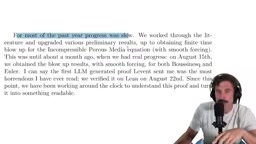
According to Buckmaster, progress was slow for most of the past year, but then suddenly accelerated. By mid-August, they had a proof generated by a large language model — described by the video's author as "the most hideous proof I've ever read" — but this proof passed formal verification in Lean by late August. Lean is a programming language that can verify the correctness of mathematical proofs; once it confirms "this is a proof," the credibility is extremely high.
The Navier-Stokes equations describe the motion of viscous fluids (such as water and air), independently developed by 19th-century physicists Claude-Louis Navier and George Gabriel Stokes. The equations are widely used in engineering and physics for aircraft aerodynamic design, weather forecasting, ocean current simulation, and more — but their mathematical foundations contain a fundamental unsolved problem: in three-dimensional space, given any smooth initial conditions, do solutions always exist and remain smooth (without developing singularities or "blowup")? That is precisely what the Clay Institute is offering a prize to solve. The research path Buckmaster's team chose — "forced blowup" — attempts to prove that under external forcing, solutions collapse in finite time. This is a constructive counterexample approach, rather than proving solutions always exist. Both paths represent substantive progress on this problem.
The Starting Point of the Controversy: A "Measurement Race"
Things turned strange in early September. Rumors circulated in the market that Anthropic might have solved an open problem. According to the video, OpenAI immediately mobilized resources upon hearing this, determined to get there first — in the author's slightly mocking words, it became a "pissing contest" around the hardest math problem in human history.

Buckmaster then emailed the relevant scientists to clarify: it wasn't Anthropic that solved the problem — it was him and Levent, and it took them a full year. The other party responded warmly and even expressed interest in collaboration. But over the following days, he was repeatedly pressured to attend meetings. He was told internally that OpenAI's model had "generated a proof of forced finite-time blowup for the Navier-Stokes equations."
What truly alarmed Buckmaster was this: when Levent asked for the precise statement of the proposition, the answer was "existence of forced blowup in R3 and T3" — which was exactly the unique research path he had been pursuing and had told almost no one about. To him, this was a glaring red flag.
Lean is an interactive theorem prover developed by Microsoft Research and now maintained by the open-source community, built on Dependent Type Theory. Unlike ordinary math papers, Lean requires every logical step to be rigorously machine-verified — there's no such thing as "roughly correct." Once Lean compiles, a proof is considered formally airtight. In recent years, Lean has attracted increasing attention in the mathematical community; Fields Medal winner Terence Tao and others have publicly advocated using Lean for serious mathematical research. This is why the milestone of "passing Lean formal verification in late August" carries extremely high technical credibility — far beyond ordinary peer review — which is also why the outside world found it difficult to simply dismiss Buckmaster's team's claim to a valid proof.
The Core Accusation: Was the Data Used for Training?
Buckmaster directly raised the question in a four-page public statement. He wrote: "I asked the model whether it had been trained on our sessions, or had access to the Codex sessions where we had been uploading all of our drafts. The answer I received was that the model doesn't look at user data. I asked about training again and received no answer."
This evasive response became the fuse for the entire plagiarism accusation. OpenAI then offered three options: first, both parties publish their results separately in sequence; second, Buckmaster alone writes a paper presenting the general solution; third, when he publishes his paper, he must acknowledge that "an OpenAI internal model solved the problem."
The sharpest part cited in the video: an OpenAI researcher named Sebastian allegedly wanted Levent removed from the author list because "Levent works at Anthropic" was inconvenient. When Buckmaster said he would go public if OpenAI published things this way, the researcher reportedly replied "why would you want to destroy your career?" and even added something to the effect of "if you don't want me to be nice, I can be not nice." As a tenured scholar, Buckmaster found such threats meaningless.
Codex is OpenAI's code generation model, also the underlying technology behind GitHub Copilot, allowing users to upload code and text via API or platform for assisted development. For researchers, uploading mathematical drafts, Lean proof code, or computational scripts to Codex sessions is a common workflow. The legal and ethical ambiguity lies here: OpenAI's user agreements typically distinguish between "runtime data is not viewed" and "data may be used for model improvement/training" — two very different things that many users never read carefully. Even if data is de-identified, if a highly unique mathematical derivation path is mixed into a training set, the model may still be "guided" toward the same solution approach when facing a similar problem — and it's nearly impossible to technically prove or disprove such influence. This is the fundamental reason why this controversy is so difficult to untangle legally.
OpenAI's Response
Facing the accusations, Sebastian Bubeck publicly responded, denying that he had asked for Levent to be removed from authorship of his own work, and sharing what he claimed were the original text message records as evidence.
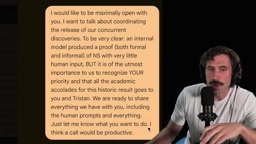
According to the text messages cited in the video, Bubeck wrote: "I want to be completely transparent with you. An internal model produced a formal and informal proof of Navier-Stokes with very little human input, but what matters most to us is to acknowledge your priority and give all academic credit for this historic achievement to you and Tristan. We are prepared to share everything, including the human prompts."
The video author's observation is telling: if OpenAI had truly derived this century-old problem independently, why would they proactively offer to give all the credit to Buckmaster? This gesture of "handing over the glory" actually makes the whole affair look suspicious — as if it implies they know their model may have genuinely consumed someone else's year of research.
A More Plausible Explanation
The video author ultimately leans toward a middle-ground judgment: they don't believe OpenAI directly stole results in a brazen act of academic fraud, but de-identified data may have indeed been mixed into the training set, helping the algorithm find the right starting point in a near-infinite solution space.
What truly enabled the breakthrough may have been the belief that it was solvable. When rumors spread that one of the seven Millennium Problems had been cracked, OpenAI immediately threw in resources — reportedly deploying 10,000 internal model agents (jokingly referred to as next-generation models in the video), running for 88 hours at a cost of tens of millions of dollars. That investment far exceeds the $1 million prize, making it a losing proposition from a purely commercial standpoint.
But the real motivation was this: solving the problem before Anthropic would prove the absolute superiority of their own models. The possibility that a competitor might be ahead was the one outcome OpenAI could not accept. A simple rumor was enough to lever an entire investment of this scale.
The "10,000 internal model agents" mentioned in the article reflects the cutting-edge paradigm of "Multi-Agent Parallel Reasoning" in current AI research: distributing the same hard problem to a large number of model instances simultaneously exploring different solution paths, then filtering valid results through a verifier (like Lean). The core logic is trading compute for search breadth — in the near-infinite space of mathematical proofs, if the approximate direction is already known (say, from implicit information in someone else's drafts), the success rate improves dramatically from "needle in a haystack" levels. The scale of 88 hours and tens of millions of dollars also confirms this was no ordinary model inference, but rather a systematic engineering effort approaching "brute-force search + formal verification." Whether this approach constitutes genuine mathematical "understanding" is itself a point of fundamental disagreement in academic circles.
Questions Worth Asking
This incident exposes a sharp gray zone in the era of AI-assisted research: when researchers upload unpublished ideas and drafts to AI platforms, where exactly do the boundaries of data ownership and usage lie? "The model doesn't look at user data" and "the model trains on user data" are two entirely different questions — and the evasion of the latter is precisely the core of this controversy.
Regardless of whether OpenAI truly completed this work independently, this case is a reminder for the academic community to reassess the data confidentiality and intellectual property risks of using commercial AI tools. As for whether P vs NP will be the next target to be cracked by "10,000 agents over 88 hours" — we'll have to wait and see.
Related articles

LLaMA-Factory in Practice: A Complete No-Code Guide to Fine-Tuning Large Models
An introduction to LLaMA-Factory, the open-source fine-tuning tool: its 60.1K-star background, supported models and algorithms, local vs. cloud deployment, and CUDA setup steps.

Zeng Ming's Deep Retrospective: Why OpenAI May Not Be the Ultimate Winner — and Why the Corporate System Will Disappear
Zeng Ming's deep retrospective on the AI endgame: model companies are just infrastructure, OpenAI and Anthropic won't be the final winners; the next battle is the Agent entry point standard; the corporate system will disappear as AI restructures collaboration, and only mission-driven companies can survive the cycle.

OpenHands v1.28.0: OpenCode and PI Added as Built-in Agents, API Keys Requestable In-Conversation
OpenHands ships 5 releases in 21 days: v1.27.0 adds OpenCode and PI as built-in agents, v1.28.0 enables in-chat key requests. ACP integration, credential reuse, model list changes, and upgrade advice.