OpenAI Codex Bonus Resets Are Speeding Up: 32 Data Points Reveal a 2.5x Frequency Increase
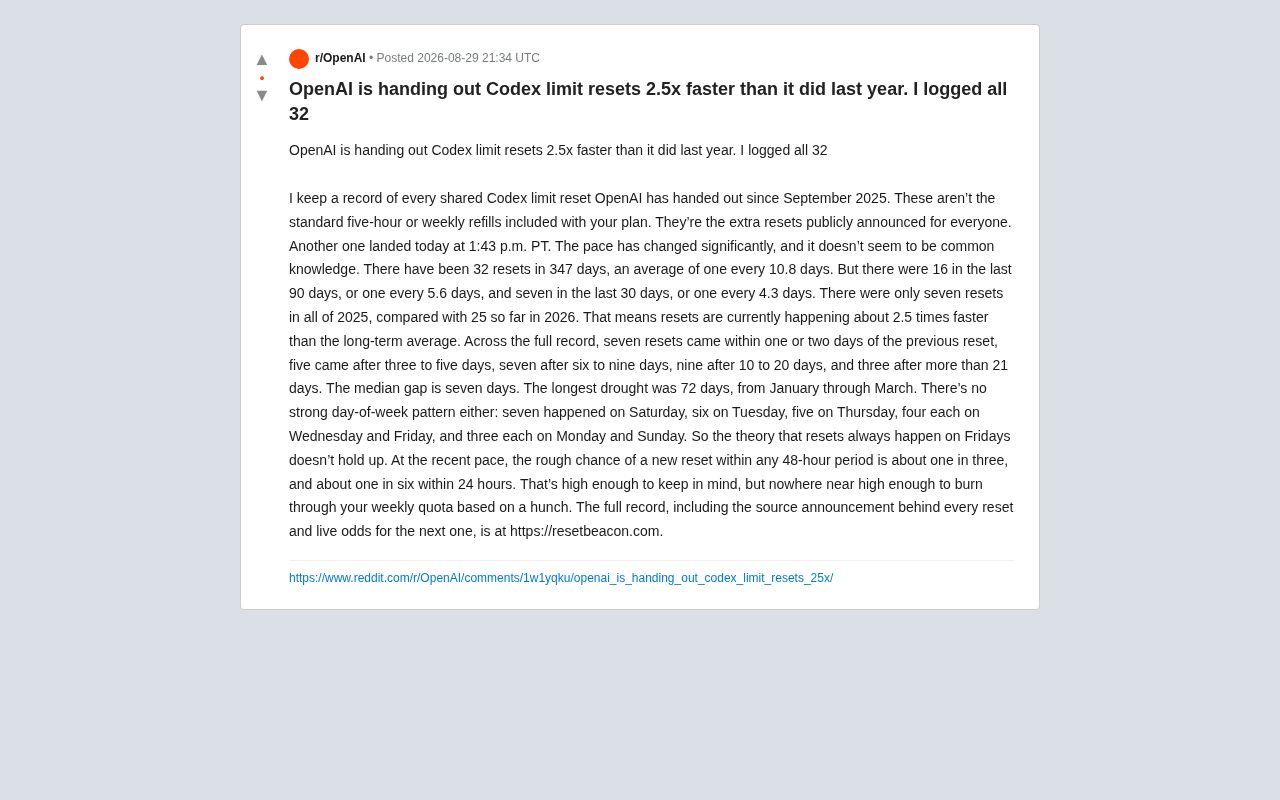
32 tracked Codex bonus resets show OpenAI's reset frequency has sped up 2.5x in recent months.
A Reddit user meticulously tracked 32 OpenAI Codex bonus resets over 347 days, revealing that reset frequency has accelerated from an average of every 10.8 days to every 4.3 days in the past month — a 2.5x increase. The data shows irregular intervals with a 7-day median, debunks the "Friday reset" myth, and estimates roughly a one-in-three chance of a reset within any 48-hour window.
An Overlooked Data Record
If you're a heavy user of OpenAI Codex, you may have noticed that your usage limits occasionally get an extra reset — not the standard five-hour or weekly refresh included in your subscription plan, but publicly announced "bonus resets" that OpenAI rolls out to all users. Since September 2025, one Reddit user has been diligently logging every single one of these public resets, accumulating 32 entries in total, with the complete dataset published on resetbeacon.com.
This seemingly trivial record reveals a little-known trend: OpenAI is issuing Codex quota resets at a significantly faster pace.
Reset Frequency Has Increased 2.5x
Long-Term Average vs. Recent Pace
According to this user's tracking, 32 resets occurred over 347 days, yielding a long-term average of one every 10.8 days. But narrowing the time window reveals a clear acceleration signal:
- Past 90 days: 16 resets, averaging one every 5.6 days
- Past 30 days: 7 resets, averaging one every 4.3 days
The year-over-year comparison is even more striking — all of 2025 saw only 7 resets, while 2026 so far has already reached 25. This means the current reset pace is roughly 2.5 times the long-term average.
The Signal Behind the Data
For developers who rely on Codex for coding assistance, this shift is far from trivial. More frequent bonus resets reflect some kind of adjustment in OpenAI's capacity allocation strategy — perhaps more compute reserves are available, or perhaps it's an effort to alleviate user frustration with usage caps and improve the product experience. Whatever the motivation, the practical result is that users are getting more "buffer" quota to work with.
Distribution Patterns of Reset Intervals
Time Intervals Are Far from Uniform
Looking only at averages can be misleading. The user further broke down the interval between each consecutive reset:
- 7 occurred within 1–2 days
- 5 occurred after 3–5 days
- 7 occurred after 6–9 days
- 9 occurred after 10–20 days
- 3 occurred after 21+ days
The median interval is 7 days. The longest "drought" lasted 72 days, spanning from January to March of this year. This shows that resets are distributed quite irregularly — sometimes clustered in quick succession, other times absent for over two months.
The "Friday Reset" Myth Doesn't Hold Up
There's been a persistent rumor in the community that OpenAI tends to issue resets on Fridays, but the data doesn't support this theory. By day of the week: Saturday had 7, Tuesday had 6, Thursday had 5, Wednesday and Friday each had 4, and Monday and Sunday each had 3. The distribution is relatively spread out with no clear bias toward any particular day.
Can We Predict the Next Reset?
Based on the recent pace, the user offers a rough probability estimate: the chance of a new reset within any given 48-hour window is approximately one in three, and within 24 hours, roughly one in six.
That probability is high enough to be worth noting, but the author also offers a sensible caveat: it's nowhere near high enough to justify burning through your weekly quota in anticipation. In other words, counting on an imminent reset and recklessly consuming your allocation is still a losing bet. This is the most pragmatic value of this dataset — it transforms a vague "feeling" into quantifiable probabilities, helping users make more rational usage decisions.
Practical Takeaways for Developers
The significance of this data goes beyond mere "bonus hunting" tactics. It highlights several noteworthy aspects:
First, a transparency gap in product strategy. While these bonus resets are publicly announced, there's no systematic aggregation channel — to the point where users need to build their own tracking tools. OpenAI still has room to improve communication around quota management.
Second, the capacity competition among AI coding tools. In an era of fierce competition from Claude Code, Cursor, and other tools, Codex's accelerated bonus quota distribution may be a tactic to retain power users. Usage limits are becoming a critical variable in the AI coding product experience.
Third, the self-organizing power of user communities. From one individual's personal log to the public resetbeacon.com tracking site, this demonstrates the strong information aggregation and sharing instincts of AI tool user communities — when official information falls short on transparency, the community steps in to fill the gap.
For developers who depend on Codex, rather than guessing when the next reset will arrive, it's better to treat this kind of data as background context: understand the rhythm, plan your quota usage accordingly, and maintain realistic expectations. After all, tools are meant to boost productivity — not to gamble on luck.
Related articles

AI-Powered SRC Vulnerability Hunting: A Hands-On Guide to Building the Hermes Agent Workbench
Based on a hands-on Bilibili video: how to build an AI-powered SRC vulnerability hunting workbench—three-step method, four report elements, Agent mode vs web chat, and tool selection.

CLI-Anything Complete Beginner's Guide: How AI Operates Software — Principles and Practice
A complete beginner's guide to CLI-Anything: how AI Agents operate professional software via the command line, covering the three-layer architecture, CLI Hub installation, DrawIO practice, generator principles, and limits.

Carbon-X: A 14.8B Open-Source Model That Handles DNA and Text Simultaneously
Carbon-X is a 14.8B open-source multimodal model on Hugging Face where DNA and text share a token stream. 6-mer tokenization, 302B token mid-training, deployable on a single 80GB GPU, 66.7% average on five DNA benchmarks, Apache 2.0 license.