OpenAI Codex Goes Fully Cloud-Native: Start Tasks on Mobile, Pick Up on Desktop — Agents API Now in Public Beta

OpenAI moves Codex fully to the cloud and opens the Agents API to public beta, pushing AI coding toward cloud-native autonomy.
OpenAI's latest update centers on cloud-native autonomy: Codex is now fully cloud-hosted, enabling tasks to run asynchronously across devices without local sessions. A new Codex Security Cloud module continuously scans for vulnerabilities and prepares verified fixes. The Agents API — powering Codex and other OpenAI products — is now in public beta, offering Hosted Memory, multi-agent orchestration, and Computer Use. Enterprise options include AWS-native execution and OpenAI Private Intelligence with zero data retention for compliance-heavy industries. The Response API has grown 100x in call volume over the past year, with first-token latency down 45% and tool call speed up 30%.
OpenAI has rolled out a major upgrade to its developer tools: Codex is now fully cloud-based, letting agents run continuously without being tied to a local device. At the same time, OpenAI has opened the Agents API to public beta, bringing private deployment, security scanning, and a range of other new capabilities. The throughline of this update is a shift from "AI as a local assistant" to "AI as a cloud-native autonomous agent."
Codex Goes to the Cloud: Close Your Laptop, Tasks Keep Running
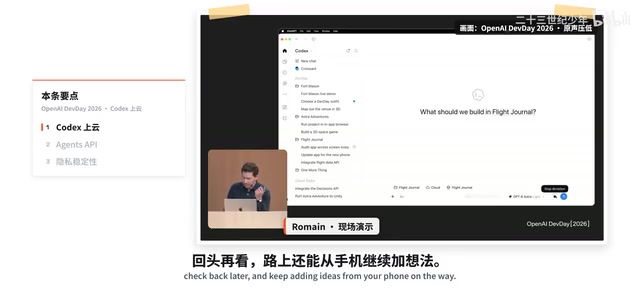
Previously, coding assistants like Codex were session-bound — close the terminal or shut the laptop, and the context was gone. The most immediate change here is that Codex now runs entirely in the cloud. You can kick off a task on your phone, then pick it back up in a browser or on your desktop, and the agent will continue right where it left off. Nothing gets lost.
The demo scenario says it all: create a new task, select "cloud," and issue a command like "rewrite the entire backend in Rust." That kind of job can take a long time. With cloud execution, you can close your computer and go do something else — or keep adding requirements and ideas from your phone on the go — while the agent just keeps working.

This represents a fundamental shift in how development workflows are structured: from "watching AI write code" to "setting goals and asynchronously reviewing results." For long-running tasks like refactoring or migration, this async model significantly reduces the time developers spend waiting around.
Codex Security Cloud: Continuously Hunt for Vulnerabilities, Have Fixes Ready to Review
A new security module — Codex Security Cloud — has been added to the cloud offering. It continuously scans codebases for security vulnerabilities and, rather than just flagging issues, prepares "verified fix patches" ready for developers to review and approve.
This is paired with automated scheduled scanning, with the core interface reportedly available the same day. Turning security auditing from a one-off manual task into a persistent background process is particularly valuable for large codebases. Compared to the traditional "scan → report → manually locate → manually fix" pipeline, having pre-prepared, verifiable patches dramatically lowers the barrier to responding to security issues.
Agents API Public Beta: The Building Blocks Behind Codex, Now for Developers
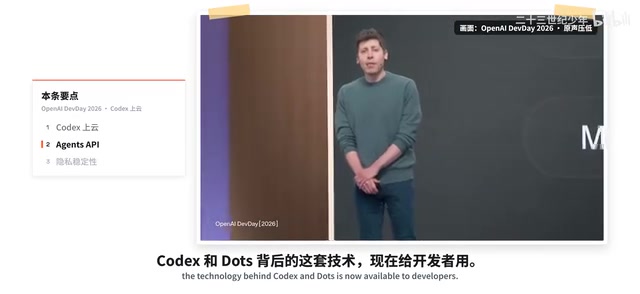
The most significant piece of this update is the Agents API opening to public beta. The underlying technology powering Codex and products like Dots is now directly available for developers to build their own agent applications.
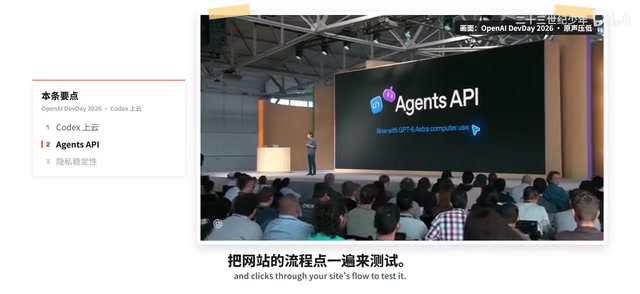
According to the demo, the API bundles several key capabilities: Hosted Memory, giving agents persistent contextual memory across sessions; Multi-agent orchestration, supporting coordination between multiple agents; and a newly added Computer Use capability.
Computer Use is arguably the most imaginative of the three. The demo shows an agent opening a browser and walking through an entire website's business flow end-to-end for testing purposes. This means agents are no longer limited to generating text or code — they can directly interact with graphical interfaces to complete real tasks, covering use cases like automated testing and workflow automation.
Hosted Memory deserves a closer look. Traditional API calls are stateless — every request is independent, and the server retains no context. If developers want an agent to "remember" previous conversations or actions, they have to manage the context window themselves, packing historical information into every request, which burns tokens and risks hitting length limits. Hosted Memory offloads that state management to the platform, allowing agents to retain key information across sessions and tasks without having to replay the full history on every call. For applications that need to run over long periods and accumulate knowledge — like an assistant tracking a project's ongoing progress — this is a fundamental shift from "starting from scratch every time" to having genuine, continuous memory.
Enterprise Deployment: AWS-Native Execution and Private AI
For enterprise customers, OpenAI has laid out two deployment paths.
The first is deep integration with AWS — OpenAI agents can run directly on Amazon's cloud, right alongside a company's existing applications and data. For organizations with infrastructure already built on AWS, this eliminates the cost and compliance concerns of moving data across cloud environments.
The second is OpenAI Private Intelligence, now available in preview, built around zero data retention and private secure processing, with content never stored on OpenAI's servers. This is a direct response to industries like finance and healthcare that have extremely strict data privacy requirements — and it addresses one of the biggest barriers enterprises face when adopting large language models.
Zero Data Retention is a critical concept in enterprise compliance contexts. Normally, when calling an LLM API, the service provider may temporarily store requests and responses for security auditing, abuse detection, or model improvement. For sensitive data — financial statements, medical records, legal documents — even temporary storage can trigger regulatory requirements like GDPR, HIPAA, or domestic data security laws, or violate internal data governance policies. Zero data retention means request content is discarded immediately after processing: nothing is written to disk, nothing is used for training. Combined with Private Intelligence's isolated processing environment, the offering closes off the potential data leakage paths that standard deployment leaves open — giving high-sensitivity industries a credible, compliant procurement option.
Performance Numbers: Response API Grows 100x in One Year
Beyond the new features, OpenAI shared some stability and performance figures. The Response API saw a 100x increase in call volume over the past year — a useful proxy for how fast the developer ecosystem is adopting these tools.
On the performance side, time-to-first-token improved by 45%, and tool call speed increased by over 30%. For agent applications, first-token latency and tool call efficiency directly affect the quality of interaction and the time it takes to complete tasks — these are meaningful gains for real-world deployments.
Wrapping Up
Looking at these updates together, OpenAI's direction is clear: free agents from single-device constraints, enable cross-device continuous execution, and open up the underlying capabilities driving its own products to developers through the Agents API. Cloud-native autonomy, continuous security scanning, Computer Use, and private deployment — each piece is laying the groundwork for AI agents to genuinely enter production environments. For developers, the async, reviewable, real-environment-capable agent workflow may well become the dominant paradigm in the period ahead.
Related articles

Free Unlimited Claude Code Solution: Agnes AI + CC Switch Setup Guide
No paid subscription needed — pair the free AI platform Agnes AI with the open-source tool CC Switch to provide a backend for Claude Code, enabling unlimited free calls to text, image, and video models. This guide covers the full setup, test results, and usage boundaries.

A Complete Zero-Cost Guide to Getting Started with Claude Code for Beginners in China
A beginner's guide to Claude Code for users in China: two installation methods (command line and IDE plugin), full configuration steps for replacing the official API with the free domestic LongCat model, and a hands-on demo of building a small tool with natural language, plus tips.

When the NSA Gets Involved: The AI Supply Chain Crisis Behind Open-Source CVEs and API Key Hijacking
Multiple open-source projects disclosed severe CVEs in one day, PHP flaws alarmed the FBI, and Railway and OpenCode were breached with API keys stolen. This article breaks down the vulnerability window, AI-accelerated exploitation, and the AI supply chain crisis behind the API key black market, with a developer defense checklist.