OpenAI Commits $17 Million to Support U.S. Department of Energy's Genesis Mission to Accelerate Scientific Discovery

OpenAI invests $17M to bring frontier AI to U.S. DOE researchers through the Genesis Mission.
OpenAI announced a $17 million commitment to support the U.S. Department of Energy's Genesis Mission, aimed at expanding frontier AI access and deepening technical collaboration with national laboratory researchers. The investment addresses compute costs, model adaptation, and security challenges that hinder scientific AI adoption, while reflecting broader strategic trends of AI labs engaging with government research to prove reasoning capabilities, build public-sector credibility, and position themselves in the evolving regulatory landscape.
OpenAI Doubles Down on Scientific AI: $17 Million Toward DOE's Genesis Mission
OpenAI recently announced a new $17 million commitment to support researchers participating in the U.S. Department of Energy's (DOE) "Genesis Mission." The core objective of this funding is to expand access to frontier AI technologies and deepen technical collaboration, thereby accelerating the pace of scientific discovery in the United States.
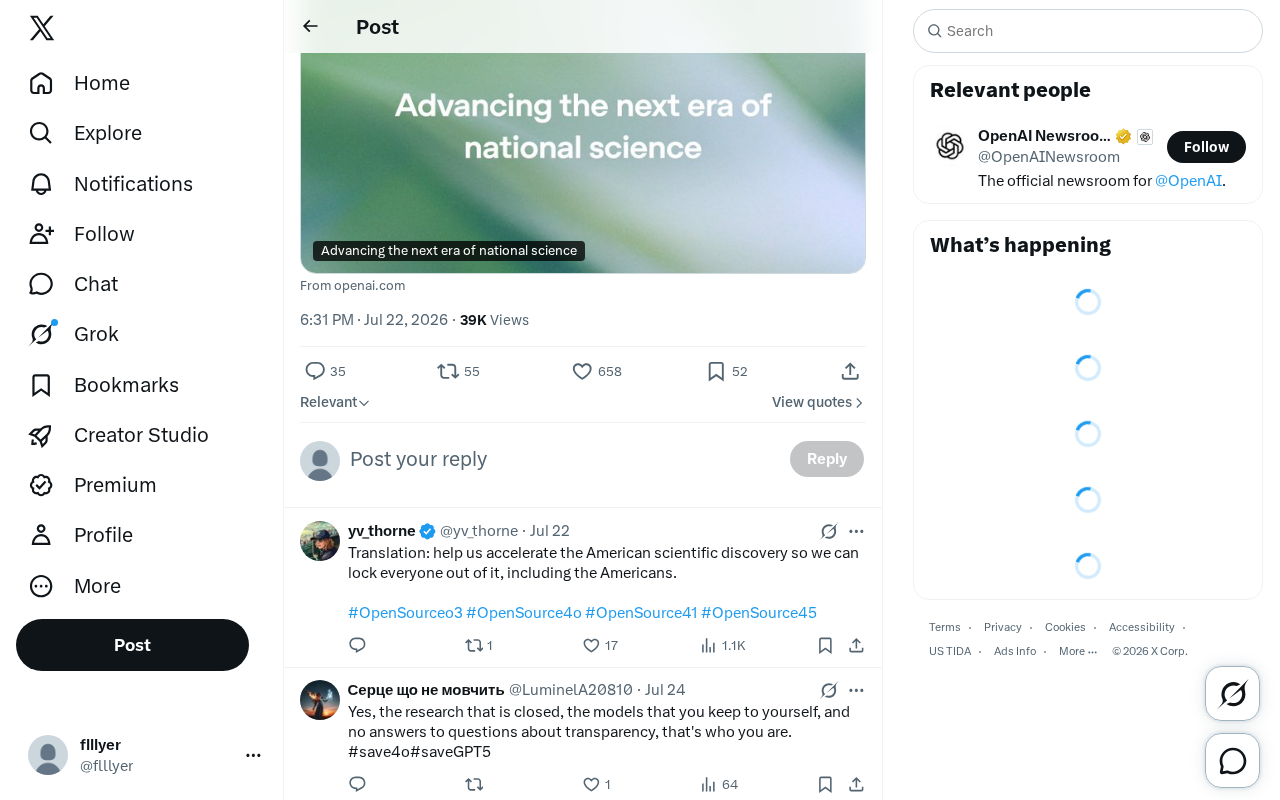
This move signals an increasingly tight bond between leading AI labs and national-level research institutions. For fundamental scientific research that has long relied on massive compute power and complex models, the involvement of frontier AI is becoming an undeniable accelerator.
What Is the DOE's Genesis Mission?
The U.S. Department of Energy's Genesis Mission is a strategic initiative designed to integrate national laboratory resources and advance AI-driven scientific research. The DOE commands the nation's most powerful supercomputing clusters and top-tier research teams in physics, materials science, and energy, with long-standing responsibilities spanning nuclear fusion, climate modeling, novel material discovery, and high-energy physics.
Notably, the DOE oversees 17 national laboratories, including world-class institutions such as Oak Ridge National Laboratory, Argonne National Laboratory, and Lawrence Livermore National Laboratory. These facilities house the world's most powerful supercomputer clusters, such as Oak Ridge's Frontier—the first system to break the exascale barrier—and Argonne's Aurora. The DOE's annual research budget exceeds $40 billion, and its Office of Science is the largest federal funder of physical sciences in the United States. This vast infrastructure makes the DOE an ideal platform for the convergence of AI and fundamental science.
Injecting frontier AI capabilities into these research settings means scientists can leverage the reasoning and generative powers of large models to accelerate the cycle of hypothesis testing, data analysis, and experimental design. Scientific explorations that traditionally took months or even years may be significantly compressed with AI assistance. In fact, AI-driven research has already demonstrated breakthrough results across multiple fields: DeepMind's AlphaFold solved protein structure prediction—a 50-year-old challenge in biology; in materials science, AI can screen millions of possible compound combinations to identify candidates with specific properties, shortening discovery timelines from years to weeks; in climate modeling, AI can handle multi-scale coupling problems that traditional numerical simulations struggle with. The addition of large language models brings a new dimension—researchers can interact with models using natural language for literature review, hypothesis generation, and experimental protocol optimization.
Where the $17 Million Will Go
According to OpenAI's statement, the $17 million commitment is primarily directed toward two areas:
- Expanding access to frontier AI: Enabling researchers involved in the Genesis Mission to more easily leverage OpenAI's most advanced model capabilities.
- Deepening technical collaboration: Going beyond mere API access to pursue deep engineering and technical partnerships centered on specific research challenges.
This combination of "funding + technology + compute access" holds more practical value than a simple cash donation, as it directly lowers the barriers for research teams to use frontier AI. To understand this point, one must recognize the multiple technical hurdles involved in using frontier AI models for scientific research: first, compute costs—a single complete large model inference call can consume substantial GPU resources when tackling complex scientific problems, with cumulative costs for large-scale experiments potentially reaching hundreds of thousands of dollars; second, model adaptation—general-purpose large models require fine-tuning or prompt engineering optimization for specific scientific domains to produce reliable scientific outputs; additionally, research data often involves sensitive information or requires special security and compliance measures, imposing additional architectural design requirements for API access. The value of OpenAI's commitment lies precisely in systematically helping researchers overcome these obstacles.
Why AI Labs Are Betting on Fundamental Science
In recent years, leading AI companies have increasingly turned their attention to scientific research. The strategic logic behind this is clear.
First, fundamental science serves as the "ultimate exam" for AI reasoning capabilities. Compared to routine tasks in commercial applications, frontier scientific problems often demand complex multi-step reasoning, rigorous logical chains, and cross-disciplinary knowledge integration. If AI can deliver real value in these domains, it powerfully demonstrates that models have moved beyond simple pattern matching.
Second, collaboration with government agencies and national laboratories helps AI companies build credibility and influence in the public sector. At a time when AI regulation is receiving increasing attention, demonstrating an "AI for good" narrative through service to national research missions carries clear positive social and political significance. Between 2024 and 2025, AI regulation has become a global policy focal point. While the U.S. has not yet passed comprehensive federal AI legislation, the White House has issued multiple executive orders governing AI development and deployment. In this context, collaboration between AI companies and government agencies carries multiple strategic implications: on one hand, it showcases the positive societal value of the technology, creating a favorable negotiating position for potential incoming regulations; on the other hand, by serving national security and research needs, AI companies gain a voice in the policymaking process while paving the way for future government procurement contracts.
Finally, scientific discoveries may themselves feed back into AI development. New materials, new energy sources, and more efficient computing paradigms could directly improve the underlying conditions for AI training and deployment, creating a virtuous cycle. For example, novel semiconductor materials can enhance chip performance, breakthroughs in nuclear fusion could provide cheaper energy to support increasingly massive data center demands, and advances in quantum computing could fundamentally alter machine learning algorithm paradigms.
National Strategic Considerations Behind "Accelerating American Scientific Discovery"
In its statement, OpenAI explicitly used the phrase "accelerate American scientific discovery," tightly linking corporate action with national technological competitiveness.
This reflects an important trend in current AI development: frontier AI is no longer merely a commercial product but is viewed as a national strategic resource. Against the backdrop of global technological competition, embedding AI capabilities within national research systems is considered one of the key pathways to maintaining technological leadership.
For the scientific community, such collaborations represent both an opportunity and a source of new considerations. On one hand, researchers gain access to unprecedented AI tools; on the other hand, maintaining scientific independence and reproducibility while leveraging commercial AI capabilities is an issue that demands ongoing attention. When research teams rely on closed-source models from commercial AI companies, the reproducibility of scientific research faces new challenges. Traditional scientific methodology requires that experiments be independently verifiable and repeatable, but if key findings depend on a specific version of a commercial model—one that may be updated or discontinued at any time—the verification chain could break. Furthermore, the "black box" nature of models means researchers may struggle to fully understand the reasoning paths behind AI-assisted conclusions, posing a potential risk to fundamental science that requires rigorous causal explanations. Open-source models and auditable AI toolchains are increasingly viewed by academia as important approaches to addressing this challenge, and how to embed these principles within commercial collaboration frameworks will be a noteworthy detail in the OpenAI-DOE partnership.
Conclusion: A New Starting Point for the Fusion of AI and Fundamental Research
$17 million may not seem enormous within OpenAI's vast commercial landscape, but its symbolic significance far exceeds the dollar amount. It signals that frontier AI is accelerating its move from consumer-level applications to the center stage of national-level fundamental research. As AI and scientific research converge more deeply, we may be standing at the threshold of a new paradigm for scientific discovery—an era driven jointly by human intelligence and machine intelligence.
Key Takeaways
Related articles

EmbeddedSass for .NET: A Sass Compilation Solution Without Node.js Dependencies
EmbeddedSass for .NET uses the official Embedded Sass Protocol, enabling .NET developers to compile Sass/SCSS natively without Node.js. Learn how it works and integrates with ASP.NET.

San Francisco to Singapore Time Difference: The Trans-Pacific Routine of Silicon Valley Tech Workers
SF and Singapore are 15-16 hours apart, and frequent travel between them is now routine for tech workers. Explore the time difference challenges, AI industry globalization, and talent flows.

Anthropic Launches Official Claude Code Plugin Directory: A Curated High-Quality Extension Ecosystem
Anthropic launches claude-plugins-official, a curated directory of high-quality Claude Code plugins. Learn about its positioning, core value, and impact on the AI coding ecosystem.