OpenAI Cuts Off Cursor: A Wake-Up Call for the AI Programming Supply Chain

OpenAI ends Cursor's model access after SpaceX acquisition, exposing AI supply chain risks.
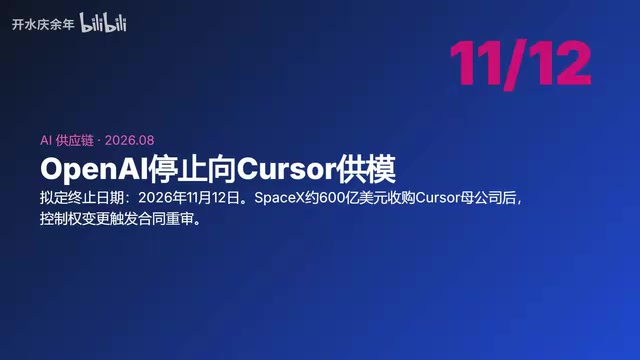
OpenAI announced it will terminate its model supply contract with AI coding tool Cursor by November 12, 2026, triggered by SpaceX's $60 billion acquisition of Cursor's parent company Anysphere. The change of control clause activation highlights how AI model supply is evolving from simple commerce into relationships governed by capital and compliance boundaries. While only 5% of Cursor's traffic uses OpenAI models, the event signals a broader industry shift toward supply chain risk management, multi-model architectures, and in-house model development.
The Core Event: OpenAI Announces Termination of Model Supply to Cursor
For developers who work with code every day, a recent piece of news could directly impact their daily workflow. OpenAI has officially announced that its model supply contract with AI programming tool Cursor is set to terminate on November 12, 2026, after which it will no longer provide model services to Cursor.
It's important to clarify that this is not an "immediate cutoff." OpenAI has provided the contractually required notice period and buffer time, giving downstream vendors and users ample room to prepare. But one thing is certain: OpenAI has decided it no longer wants to do this business.
The reason this news has drawn so much attention isn't simply that a popular AI programming tool might lose access to GPT-series models. More importantly, it reveals an industry trend that's quietly taking shape: AI model supply is evolving from a straightforward commercial transaction into a long-term relationship governed by capital and compliance boundaries.
The SpaceX Acquisition as the Trigger: A $60 Billion Deal Sets Off a Chain Reaction
The real trigger for this event was SpaceX's acquisition of Cursor's parent company for approximately $60 billion. Following the completion of the acquisition, OpenAI promptly invoked the "Change of Control Clause" in the contract.
A change of control clause is a common protective mechanism in commercial contracts: when a client is acquired and its actual controlling party changes, the supplier has the right to reassess or even terminate the business relationship. This isn't unusual in enterprise procurement, but seeing it invoked so prominently in the AI model supply space is relatively rare.
This type of clause has decades of precedent in traditional enterprise software and defense procurement. The core logic is straightforward: when a contract is signed, the supplier's risk assessment of the client is based on the shareholder structure, management team, and business direction at that time. Once the client is acquired, these underlying assumptions can fundamentally change — the original client might be acquired by a competitor, or the new parent company's business might involve sanctioned countries or sensitive domains. In the AI model supply space, triggering this clause is particularly sensitive because large language models inherently have "dual-use" characteristics — the same model that writes code can also be used to generate disinformation or assist in cyberattacks. Therefore, a supplier's identity verification of downstream users is effectively a form of technology proliferation risk management.
The Capital Game Behind the Acquisition
SpaceX's approximately $60 billion acquisition of Cursor's parent company Anysphere reflects how seriously tech giants are taking the AI development tools space. SpaceX, as Elon Musk's space exploration company, has been continuously expanding its business footprint in recent years, and Musk also owns xAI (which develops the Grok model) and the X platform, among other AI-related assets. This means that after the acquisition, Cursor's actual controller is in direct competition with OpenAI. The history between OpenAI and Musk is well known — Musk was a co-founder and early investor in OpenAI, but left due to strategic disagreements and has repeatedly criticized OpenAI's commercialization pivot publicly, even filing lawsuits. In this context, OpenAI's reluctance to funnel its most advanced model capabilities to a company controlled by a competitor becomes entirely understandable.
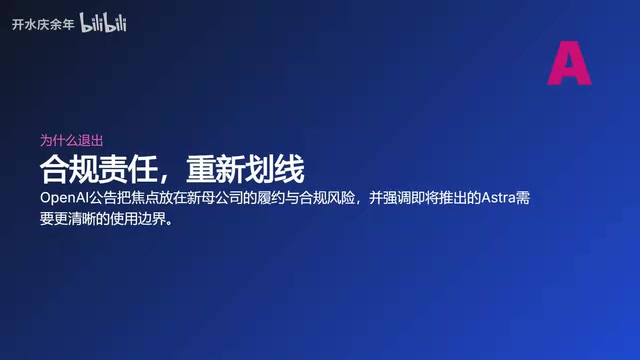
Notably, OpenAI's announcement emphasized that the issue was not with the Cursor product itself, but with the compliance and contractual risks introduced by the new parent company. In other words, OpenAI's concern isn't about how well Cursor performs, but whether its new "owner" can be trusted.
The Astra Model: Greater Capability Means Stricter Supply Boundaries
The announcement also mentioned OpenAI's upcoming Astra model. This sends an intriguing signal: the more capable the model, the more the supplier needs to verify use cases and contractual boundaries.
This represents an important industry trend — capability-tiered and differentiated model supply. As large language models evolve from GPT-4-level capabilities toward more powerful reasoning and multimodal abilities, model providers are beginning to segment their product lines into different tiers: base models can be broadly offered via API access, while frontier models require more rigorous client screening and use-case evaluation. This parallels the logic of export controls in the chip industry — NVIDIA can sell consumer-grade GPUs worldwide, but its most advanced AI training chips (such as the H100 and B200) are subject to strict export restrictions. OpenAI is building a similar tiered system: when a model's capabilities reach a certain threshold, it's no longer a simple commodity but a strategically significant controlled technology asset.
For OpenAI, the safest strategy is to prevent its top-tier technology from flowing into channels it doesn't fully trust. When a model's capabilities are sufficient to confer strategic advantage, it's no longer just an API product — it's a core asset that requires strict governance.
Surface vs. Substance: A Systemic Reassessment of AI Supply Chain Trust
On the surface, this is an ordinary commercial contract termination. But dig deeper, and what lies beneath is a systemic reassessment of AI supply chain trust.
In the past, developers habitually assumed that the stability of AI products depended solely on "whether the API works today." But this incident reminds everyone that the stability of AI products also encompasses contract terms, shareholder structures, and backup channels. When capital operations enter the model supply chain, factors beyond technical capability begin to dictate the direction of partnerships.
For the industry as a whole, this may signal the gradual end of the era of "freely callable models." Developers can no longer take for granted that paying for a subscription guarantees permanent, stable access to any provider's top-tier models.
Real-World User Impact: 5% of Traffic and Vastly Different Migration Costs
So how much will OpenAI's cutoff of Cursor actually affect ordinary users and enterprises? The answer is: it varies enormously depending on who you are.
Regular Users: No Need to Panic in the Short Term
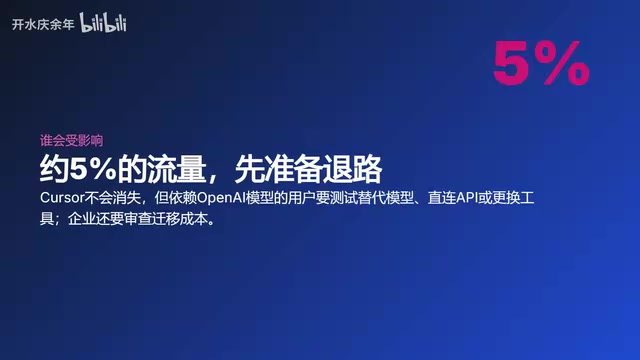
According to Cursor's co-founder, OpenAI's models account for only about 5% of Cursor's user traffic. This means the vast majority of users are working with Anthropic's Claude, Google's Gemini, or other models. Therefore, regular users absolutely do not need to uninstall Cursor immediately — it will continue to function normally with other models.
For users who fall into that 5% and are accustomed to using OpenAI models, it's recommended to complete testing of alternative models before November 12, 2026. Options include connecting directly via API or evaluating a switch to a different programming tool.
Enterprises and Power Users: Carefully Review Contracts and Migration Plans
For enterprises and professional developers, the changes are far more concrete. Migration isn't as simple as just swapping out a model:
- Historical prompts may need to be re-tuned for the new model
- Workflows and team standards may need to be adjusted
- Model source auditing becomes a new step in the procurement process
On a technical level, different models exhibit significant differences in context window size, code generation style, instruction-following ability, and latency performance. For example, Claude excels at long-context code comprehension, while the GPT series may be more precise at code completion in certain programming languages. When migrating between models, developers often need to rewrite their prompt engineering strategies, adjust temperature parameters and sampling settings, and even redesign the interaction patterns of entire workflows. For enterprise users, this also entails additional costs for output consistency verification, security audits, and compliance re-certification.

During procurement, enterprises need to re-examine three critical questions: Can the model supplier ensure continuous, stable supply? Could a change of control trigger an exit clause? How much time and money will the alternative route actually cost? These are no longer technology selection questions — they are supply chain risk management questions.
Cursor's Response Strategy: Accelerating In-House Model Development
Facing uncertainty in upstream supply, Cursor is also actively building out its own proprietary models.
This is actually a forward-looking strategic choice. As downstream companies increasingly recognize the risks of over-reliance on a single model supplier, building in-house model capabilities becomes the key to maintaining control. While a self-developed model may not match OpenAI's capabilities in the short term, it provides supply chain redundancy and avoids the vulnerable position of being "held hostage."
For similar AI programming tools, Cursor's experience serves as a warning: multi-model architecture and self-developed capabilities aren't nice-to-haves — they're the baseline for survival. The current market's major competitors include GitHub Copilot (backed by Microsoft, using OpenAI models), Google's Gemini Code Assist, Amazon's CodeWhisperer (now integrated as Amazon Q Developer), and a range of open-source alternatives like Continue and Cody. Notably, GitHub Copilot, as a Microsoft product, has a deeply intertwined capital relationship with OpenAI — Microsoft is OpenAI's largest investor and exclusive cloud computing partner. This means that in the AI programming tools space, model supply, capital relationships, and product competition have formed a complex triangular structure. Cursor's situation may drive more independent AI programming tools to diversify their model supply, and even accelerate the adoption of open-source code models (such as Meta's Code Llama, DeepSeek Coder, etc.) in commercial products.
Conclusion: November 12 Is a Supply Chain Boundary Line
November 12, 2026 — this date isn't just an ordinary software update reminder. It's a clear boundary line for the AI supply chain.
For individual users, the action plan is simple: test alternative models before that date. For enterprises, the task is to review contract terms and develop migration contingency plans.
At a deeper level, this OpenAI-Cursor cutoff is a public lesson for the entire AI industry. It tells us that in an era where AI infrastructure is increasingly critical, choosing a model provider requires looking beyond performance benchmarks and pricing — you must also assess the underlying capital relationships, contractual constraints, and long-term stability. When AI capabilities become strategic assets, the "free flow" of models can no longer be taken for granted. Developers and enterprises need to cultivate supply chain risk awareness early and keep backup plans ready for potential disruptions.
Key Takeaways
Related articles
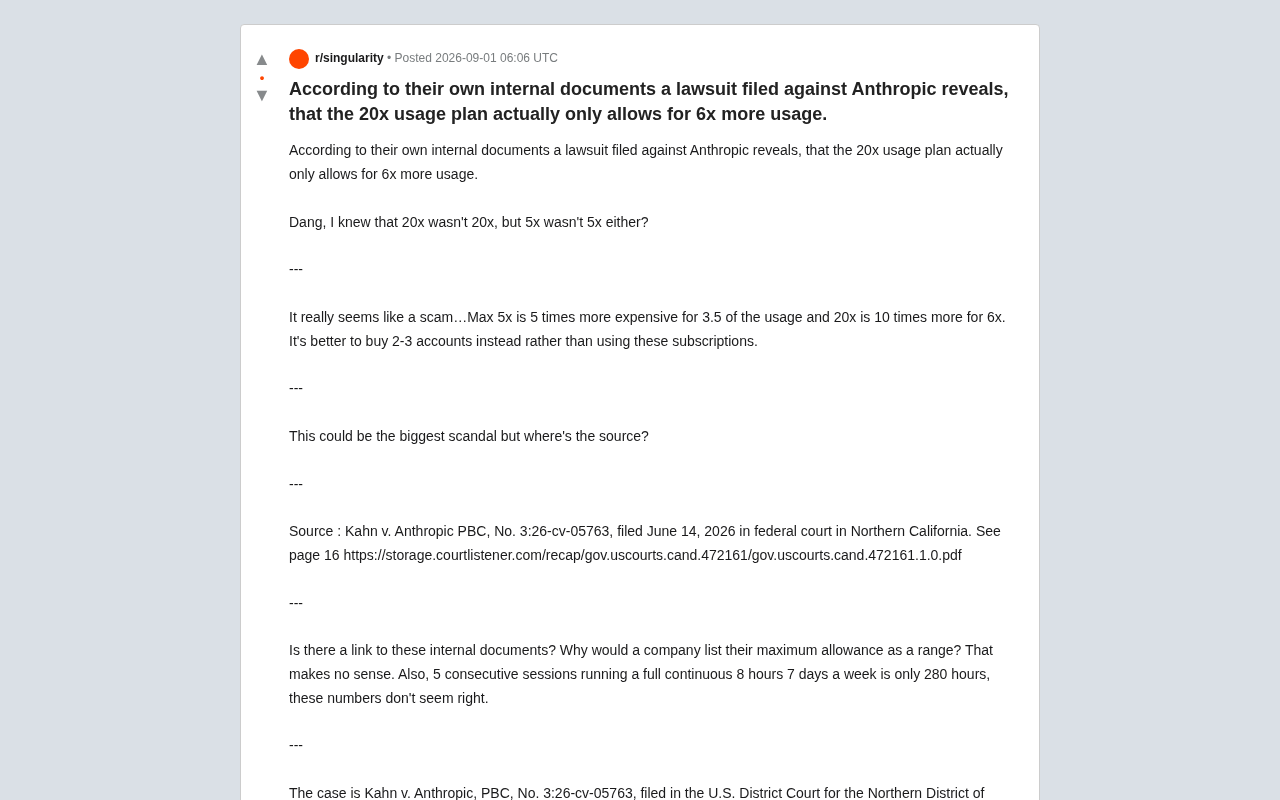
Anthropic Sued: Claude Max 20x Plan Allegedly Delivers Only 6x Usage?
A lawsuit against Anthropic alleges Claude Max's 20x plan delivers only ~6x usage, and the 5x plan just 3.5x. We break down the legal details, community reactions, and the AI subscription transparency crisis.

Cursor Beginner's Guide: A Six-Step Workflow for Managing Changes, Rollbacks, and Validation
New to Cursor and keep breaking things? Learn a six-step dev workflow covering Cursor Rules, Plan mode, Diff review, and Checkpoint rollback to go from guesswork to engineering.
Is Cheap Cursor Reselling Reliable? The Real Risks of Shared Account Pools Exposed
An in-depth analysis of Cursor Pro budget reselling services, exposing the shared account pool model behind so-called legitimate accounts and deep discounts from technical, compliance, and data security perspectives.