OpenAI Data: AI Agents Now Account for Over Half of EU Enterprise Output Tokens

OpenAI data reveals agentic AI output tokens now exceed half of EU enterprise usage.
OpenAI's economic research report shows that Codex and ChatGPT Work contribute over 50% of output tokens among its EU ChatGPT Enterprise and Business customers, signaling a shift from Q&A to delegated task execution. SME weekly active users grew more than eightfold since May across all EU member states. Agentic token share varies widely by country, from ~22% in Slovenia to ~85% in Lithuania, reflecting differences in adoption pace and market structure. The report urges enterprises to evaluate AI through concrete repeatable workflows and distinguish usage intensity from real ROI.
OpenAI's latest economic research report reveals a turning point: among its EU enterprise customers, output tokens generated by agentic products like Codex and ChatGPT Work now exceed half of the total. This means enterprises are shifting their use of generative AI from "ask-answer" to "delegate-execute."
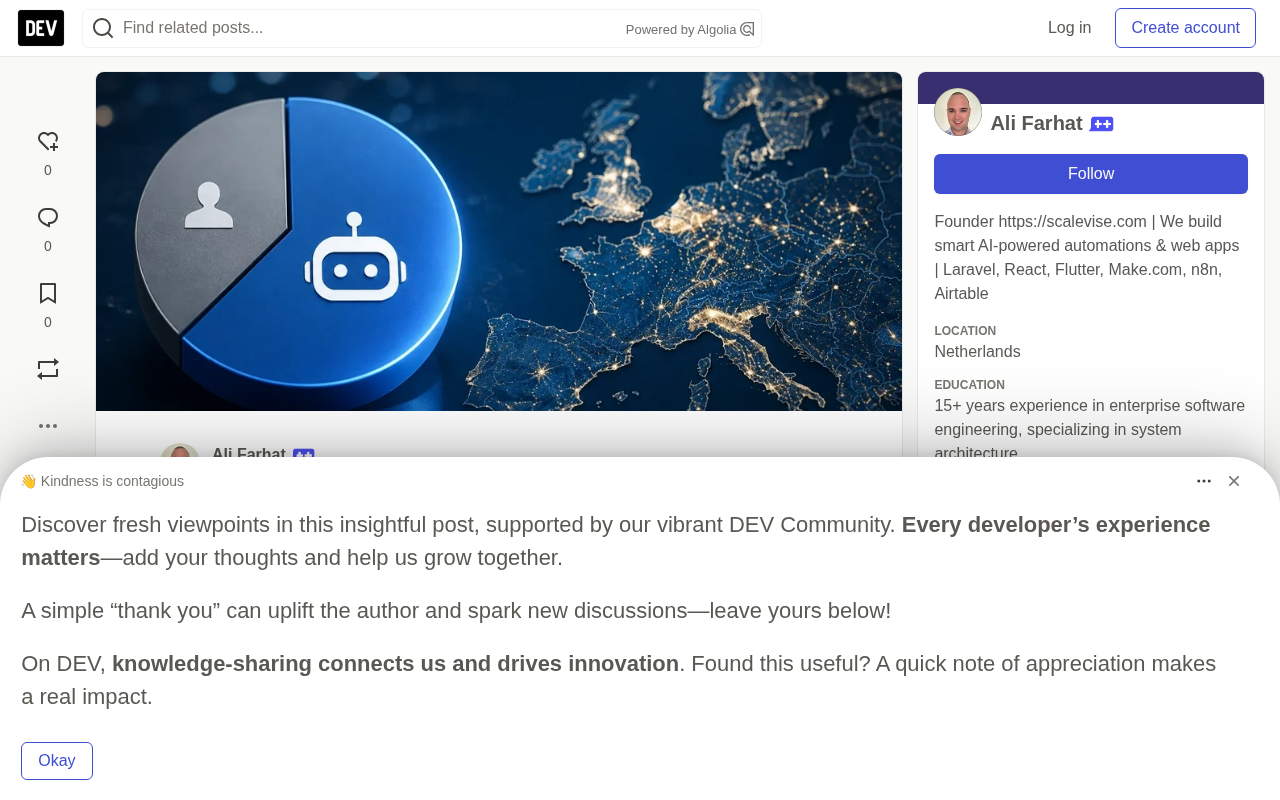
The State of Agentic AI Adoption in the EU Market
According to the European agentic AI adoption report published by OpenAI's economic research team, among its EU ChatGPT Enterprise and Business customers, the two agentic tools Codex and ChatGPT Work contribute more than 50% of output tokens. This proportion marks the transition of agentic products from marginal experiments to mainstream use cases.
The most noteworthy signal is not the overall growth in AI usage, but the rapid climb in the share of agentic products within the workload. In OpenAI's EU sample, among small and medium-sized enterprises with fewer than 200 employees, weekly active users of Codex and ChatGPT Work have grown more than eightfold since May, with growth covering every EU member state.
OpenAI defines "EU frontier firms" as companies ranked in the top 10% by output tokens per active user. As of September, these firms' output tokens per active user are more than four times that of typical EU enterprises. However, the report also notes that EU frontier firms still lag behind global frontier firms on the same metric—Europe has highly committed adopters, but a gap remains between the region's most intensive users and global leaders.
Stark Differences Between Countries
The agentic token share varies dramatically within the EU: Slovenia at approximately 22%, while Lithuania reaches as high as about 85%. This gap cannot simply be interpreted as "Lithuanian enterprises being more productive." Product mix, account composition, work patterns, and usage timing all affect this metric. But it does indicate that the migration to agentic workflows is not progressing at the same pace across all EU markets.
What is "agentic AI"? Agentic AI refers to AI systems capable of autonomously planning, executing multi-step tasks, and invoking external tools, distinguishing itself from traditional "ask-answer" chatbots. In the traditional model, a user sends a prompt, the model returns a block of text, and the interaction ends. Agentic systems, by contrast, can accept a goal, break it down into subtasks on their own, invoke tools for code execution, file reading and writing, web retrieval, and ultimately deliver usable results (such as a report or runnable code), adjusting strategy based on intermediate results along the way. OpenAI's Codex is an agentic coding tool for software development, while ChatGPT Work targets general enterprise workflows. What they share is that users delegate a "task," not a "question."
Why are output tokens a key metric for agentic usage? Tokens are the basic units of text processed by large language models; output tokens represent the amount of content the model actually generates. In traditional chat scenarios, a single interaction's output tokens are often just a few hundred; agentic workflows may need to generate complete documents, multiple rounds of code modifications, and tool-call logs, with a single task's output tokens reaching tens of thousands or more. Therefore, the scale and structure of output tokens can more accurately reflect the depth of "delegate-execute" rather than just frequency of use. OpenAI measures usage intensity by "output tokens per active user" precisely on this logic.
Why does product mix significantly affect token share? Agentic token share is a ratio: the numerator is output tokens generated by Codex and ChatGPT Work, and the denominator is the total output tokens across all enterprise products in that market. If enterprises in a given country heavily use traditional ChatGPT for writing, translation, or customer service assistance, the denominator rises, and even if absolute usage of agentic products is not low, their share gets diluted. Conversely, if a country's customer base is dominated by developers or enterprises that have deeply adopted automated workflows, agentic tool usage density is higher, and the share is naturally larger. In addition, account composition (more large enterprises or more SMEs), work patterns (project-based or daily operations), and usage timing within the statistical window (whether during a concentrated delivery period) can all cause fluctuations. Thus, the gap between Slovenia's 22% and Lithuania's 85% reflects differences in market structure and adoption pace more than differences in productivity.
How Enterprises Should Interpret This Shift
For enterprises, the key distinction lies between "experimental use" and "workflows that produce repeatable results." Traditional chatbot interactions may help someone draft an email or explain a spreadsheet formula; agentic workflows are more valuable when tasks have multiple interconnected stages—for example, information gathering, initial draft preparation, checking against established inputs, then handing results to human approval.
OpenAI's data does not indicate which workflows yield the highest returns, but it supports a more pragmatic conclusion: enterprises are using its agentic products at a scale far beyond occasional prompt assistance. Therefore, leaders should evaluate AI opportunities through concrete processes rather than broad transformation slogans.
A practical entry point is identifying work with clear inputs, repeatable sequences, and measurable outputs. Suitable candidates might include internal research preparation, document processing, software development tasks, or recurring customer and operational work. Before scaling up usage, teams should clarify: the task owner and result reviewer; the systems, documents, or data needed to complete the task; the quality threshold that makes output useful; and the baseline for time, cost, error rate, or throughput after implementation for comparison.
This approach helps distinguish "activity" from "value." High token usage may reflect deep adoption, but ROI requires evidence that workflows are faster, more reliable, require less manual intervention, or can support more work without proportional increases in investment. OpenAI CFO Sarah Friar stated that Europe is moving toward AI-enabled productivity, emphasizing the need to equip employees with the skills and confidence to use AI effectively.
How to define a "workflow that produces repeatable results"? Unlike traditional prompt assistance, repeatable workflows have three characteristics: first, clear trigger conditions and input sources, such as customer feedback forms received on a fixed weekly schedule or a code repository's to-do list; second, tasks can be broken down into stable multi-stage sequences, such as "scrape data → generate draft → check against rules → human approval"; third, outputs can be measured by uniform standards, such as processing time, error rate, or throughput per unit time. Enterprises should prioritize workflows meeting these three criteria for agentic pilots, because only repeatability enables establishing baselines, comparing before-and-after differences, and calculating ROI. If a task's inputs and judgment criteria differ each time, the value of agentic tools is greatly diminished, and a traditional assistant model is more suitable.
How to distinguish "activity" from "value"? High token usage only indicates the model generated a lot of content, but does not mean that content was adopted or produced business benefits. Value requires comparable evidence: after introducing AI to the same workflow, is completion time shorter, is manual rework reduced, is unit cost lower, or is throughput higher without adding staff? If token usage rises but the above metrics do not improve, it may simply mean more drafts are being handed to human reviewers without truly reducing workload. Therefore, before scaling agentic deployments, enterprises should set quantifiable baselines and success criteria for each candidate workflow, avoiding substituting usage intensity for effectiveness evaluation.
Data Boundaries and Interpretation Caveats
This report should be treated as a directional benchmark, not a full-market scorecard. Its dataset is limited to OpenAI's enterprise and business accounts, and its definitions and product usage patterns may not map directly to other providers' customer bases. Token volume can reflect usage intensity but does not by itself prove specific productivity gains, cost savings, or return on investment.
Nevertheless, within this ecosystem, the trend is clear: agentic tools are becoming a core part of EU enterprise AI usage. The next-stage question is not whether enterprises use AI, but whether they can apply AI to well-defined workflows and measure results.
Frequently Asked Questions
What did OpenAI find among EU enterprises?
OpenAI found that in its EU sample, Codex and ChatGPT Work contribute more than half of output tokens among ChatGPT Enterprise and Business users. The company presents this as evidence of a shift toward agentic, task-oriented AI usage.
How fast is agentic AI usage growing among EU SMEs?
OpenAI states that among EU enterprises with fewer than 200 employees, weekly active users of Codex and ChatGPT Work have grown more than eightfold since May, with growth in every EU member state.
Does the report prove that AI agents boost productivity?
No. The report measures output tokens within OpenAI enterprise accounts. It indicates usage intensity but does not directly measure productivity, cost savings, or ROI at individual enterprises.
Why do agentic AI adoption figures vary so widely across countries?
OpenAI's report shows that the output token share of Codex and ChatGPT Work ranges from about 22% in Slovenia to about 85% in Lithuania. The report's data does not identify a single cause; product mix, account composition, and usage timing may all affect comparisons.
One-line Summary
OpenAI's report shows agentic AI output tokens now exceed half among its EU enterprise customers, marking a shift from Q&A to delegated execution.
Paragraph Summary
OpenAI's economic research report indicates that among its EU ChatGPT Enterprise and Business customers, Codex and ChatGPT Work contribute over 50% of output tokens, with agentic AI moving from marginal experiments to the mainstream. Weekly active users of these two tools among EU SMEs have grown more than eightfold since May, covering all member states. EU frontier firms' output tokens per active user are more than four times that of typical enterprises, yet still lag behind global frontiers. Agentic token share varies widely across countries, from about 22% in Slovenia to about 85% in Lithuania, reflecting differences in adoption pace and market structure. The report emphasizes that enterprises should evaluate AI opportunities through concrete, repeatable workflows rather than transformation slogans, and distinguish usage intensity from real ROI. The data is limited to OpenAI enterprise accounts and serves as a directional benchmark.
Related articles

M&M's Spent Millions Replacing Artificial Blue Dye — Why Is It So Hard?
Mars spent millions trying to replace artificial blue dye in M&M's with spirulina, but thick material clogs pipes and residue risks mold, forcing a full production-line rebuild. Here's the engineering behind the reformulation.
Teammate Wanted for Meta Global AI Developer Hackathon: Computer Vision & Medical AI
A Reddit developer seeks teammates for the Meta Global AI Developer Hackathon, focusing on computer vision and medical AI. This article analyzes the track logic, skills-complementarity needs, and topic selection strategy behind this teaming signal.
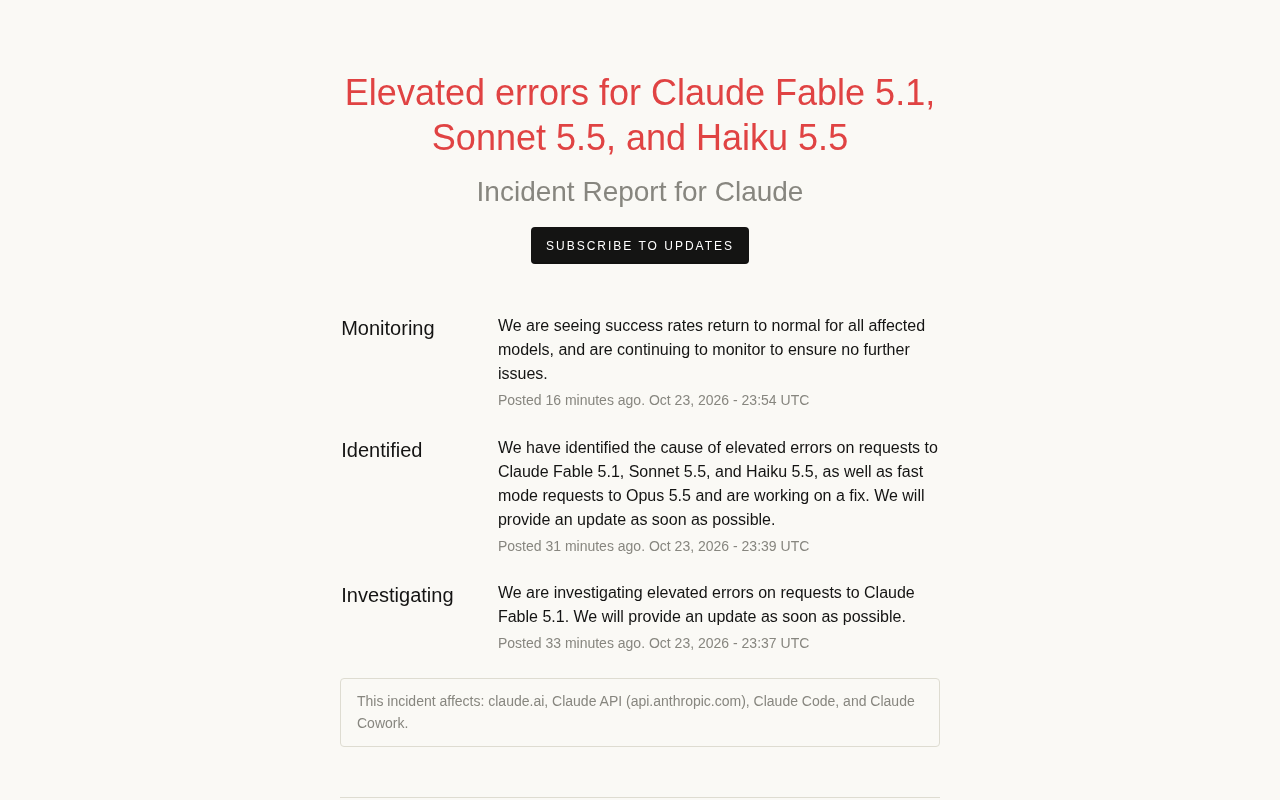
Multiple Claude Models Hit by Errors: A Postmortem of Fable 5.1, Sonnet 5.5, and Haiku 5.5
Claude Fable 5.1, Sonnet 5.5, Haiku 5.5, and Opus 5.5 fast mode saw elevated errors; Anthropic identified and resolved the issue in 17 minutes. This postmortem covers the timeline, the technical reasons for the multi-model cascading failure, and practical lessons for retry and degradation strategies.