OpenAI Decisions API Enters Public Beta: A New Approach to Decision Automation

OpenAI Decisions API enters public beta, moving LLM capabilities from free-form generation to structured, controllable decision-making.
OpenAI has opened its Decisions API to public beta, marking a further extension of its API capabilities from general text generation into structured decision-making scenarios. The interface aims to address long-standing developer pain points around prompt engineering: inconsistent output formats, difficulty constraining model choices, and lack of explainability. Key use cases include intelligent customer service routing, conditional branching in Agent workflows, and content moderation policy enforcement. Building on the function calling and structured output roadmap, the Decisions API raises the abstraction level to the semantic layer of "decision-making." With specs and pricing still in flux, developers are advised to trial it during prototyping and evaluate carefully before adopting it in core workflows.
OpenAI Launches Decisions API Public Beta
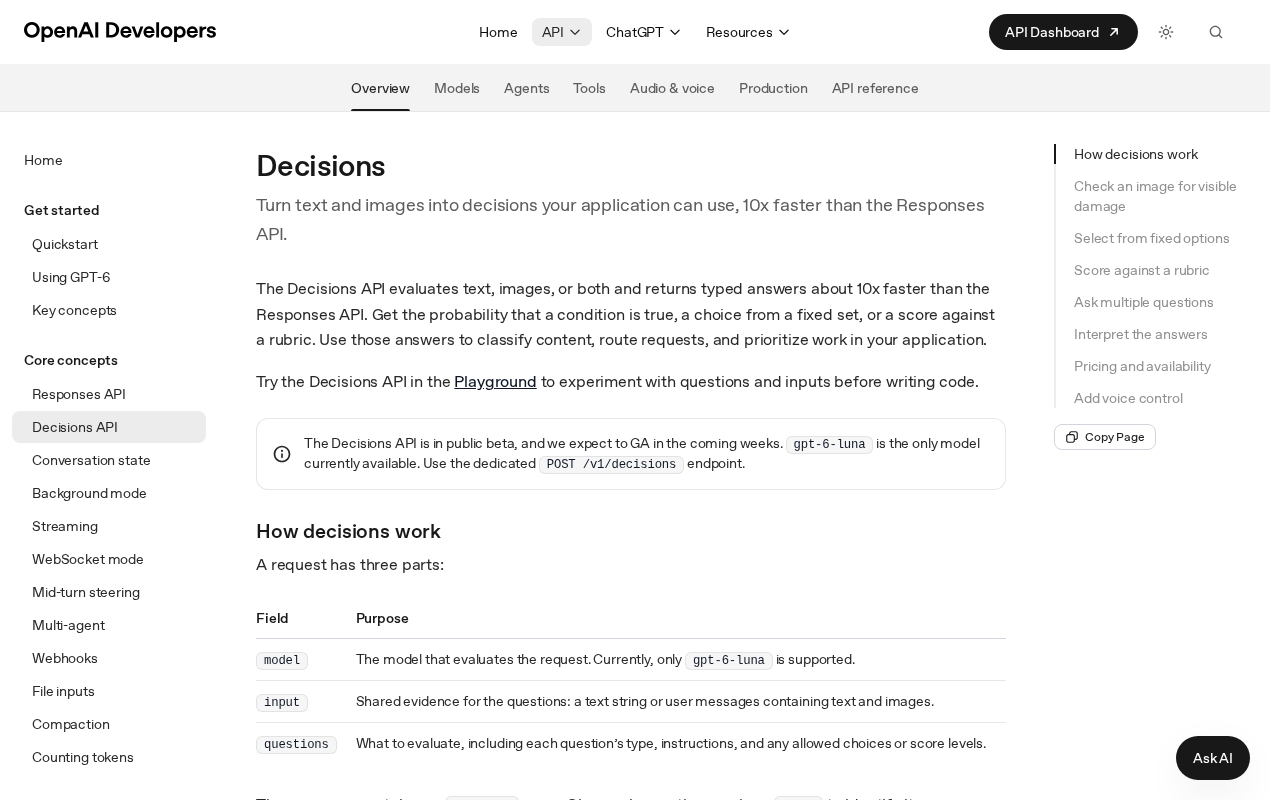
OpenAI recently announced that its Decisions API has entered public beta. The news sparked discussion on Hacker News — modest in scale so far (11 points, 3 comments) — but it signals that OpenAI is pushing its API capabilities beyond pure text generation into more structured "decision-making" use cases.
The name itself is telling: the Decisions API isn't positioned as yet another chat endpoint. Instead, it targets scenarios that require making choices, judgments, or routing decisions under well-defined constraints. For developers building automated workflows, intelligent routing systems, or applications that need explainable decision logic, this kind of specialized interface has real potential value.
Note: Publicly available information on this API remains limited. This article is based on the source headline and community discussion threads. For technical specifics, refer to OpenAI's official documentation.
Why "Decisions" Deserves Its Own API
In practice, AI application developers often use large language models as a general-purpose "text processor," cramming judgment logic into prompts via prompt engineering. It works, but the pain points are well known:
- Inconsistent output: Models may return results in varying formats that are difficult to parse programmatically.
- Weak controllability: It's hard to guarantee that the model strictly selects from a given set of options.
- Poor explainability: Tracing why the model made a particular judgment is difficult.
A dedicated Decisions API could theoretically address these issues through structured constraints — for example, enforcing selection from a candidate set, attaching confidence scores or reasoning rationale, and delivering more predictable response structures. This aligns with the broader trend of strengthening "structured output" and "function calling" at the API layer.
Structured Output and Function Calling are two key concepts for understanding this trend. Function calling was first introduced by OpenAI in 2023, allowing developers to predefine a set of functions with parameter schemas. During inference, the model determines whether to invoke a function and returns JSON conforming to the schema rather than free-form text. Structured output tightened this further — using JSON Schema constraints to ensure model output strictly matches a predefined format, nearly eliminating parsing failures.
The Decisions API can be understood as a higher-level abstraction built on top of these capabilities: rather than having developers simulate decision logic through schema constraints, it exposes "choosing from a finite set of options" as a first-class interface primitive. This higher level of abstraction means the platform can apply targeted optimizations for decision scenarios — guaranteeing output falls within the candidate set, providing per-option confidence scores, and logging traceable reasoning chains.
Potential Use Cases
If the Decisions API delivers on its name, here are the most likely target scenarios:
Intelligent Routing and Triage
Customer service and ticketing systems need to route requests to different handling flows based on user intent. Compared to stitching together judgment logic with a general-purpose conversational model, a dedicated decision interface makes it far easier to guarantee classification results fall within predefined categories.
Conditional Branching in Automated Workflows
In Agent pipelines or automation workflows, every step may require a "what happens next" judgment. A decision interface can serve as the "branch node" in a flowchart, reducing engineering complexity.
In AI Agent architectures, the stability of "branch nodes" directly affects the reliability of the entire pipeline. Current mainstream Agent frameworks (such as LangGraph, AutoGen, and CrewAI) typically implement routing decisions through prompts combined with structured output — but this places the burden on developers to design schemas and handle edge cases themselves.
If a dedicated decision interface can guarantee at the platform level that "output will always be one of the candidate actions," it would significantly reduce anomalous branches caused by model output ambiguity in Agent workflows, cutting down on the defensive code developers need to write. This aligns closely with the engineering goals of deterministic workflows and verifiable AI — especially in enterprise contexts requiring audit trails or regulatory compliance, where having every decision step fully traceable carries concrete value.
Content Moderation and Policy Enforcement
Determining whether content complies with a given rule — as a binary or multi-class judgment — is fundamentally a decision task, not a generative one. This makes it a natural fit.
What Public Beta Actually Means
"Public beta" typically means the feature is available for public use, but the API spec, pricing, and stability are still subject to change. Recommendations for developers:
- Try integrating it in non-critical workflows or during the prototyping phase to assess how it compares to your current approach.
- Watch for official updates on output format, rate limits, and pricing.
- Avoid hard-coupling your core business logic to the API too early — be prepared for interface changes.
Public beta is also the phase where OpenAI collects real-world usage feedback to refine the product. Early adopters tend to develop a faster, clearer understanding of the design intent and its boundaries.
Summary
The Decisions API public beta continues OpenAI's trajectory of moving large model capabilities "from generation toward structured, controllable, and integrable" functionality. For developers who have long struggled with prompt engineering and who want more predictable judgment results, this is a new option worth watching.
That said, with limited public information currently available, the actual capabilities — and how they differ from existing function calling and structured output — still need validation through official documentation and community practice. The recommendation: stay tuned, and evaluate rationally against your actual project needs before committing.
Related articles

Amphibious Transforming Drone: Beyond 100x Power Savings, What Are the Real Needs?
Is the amphibious transforming drone just a gimmick? Starting from the 100x power difference of the M4 Morphobot, explore real application scenarios and thesis topic ideas, analyzing boundary conditions where pure drones and pure ground robots both fail.

Warhound Raises $200 Million: Genetically Engineered "War Dogs" Paired with Anduril Gear
Warhound raises $200M, backed by Ben Lamm and Palmer Luckey, to genetically engineer dogs for military and law enforcement use and equip them with Anduril gear. This article analyzes its technology direction, funding logic, and ethical controversy.

Claude API Comes to Google Cloud: IAM Integration and SDK Access Guide
Anthropic hosts the full Claude API on Google Cloud with IAM-controlled permissions and unified billing. This guide covers the Vertex AI and Anthropic-hosted entry points, IAM role configuration, and SDK access.