OpenAI DevDay 2026 Full Breakdown: GPT-4.1 So and the Always-On Codex Agent
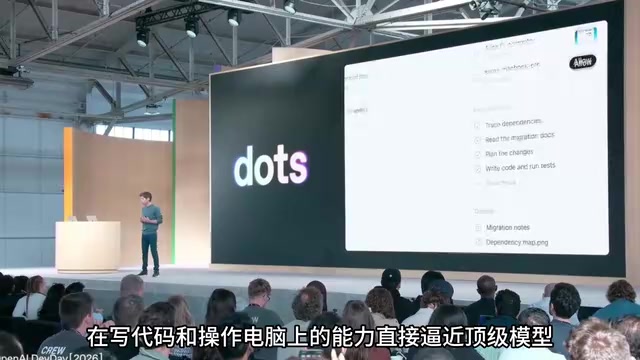
OpenAI DevDay 2026 delivers 20+ updates centered on a cost-efficient new model and a persistent autonomous Codex agent.
OpenAI DevDay 2026 revolves around two main threads: better value models and a persistent autonomous agent. GPT-4.1 So delivers near-flagship coding and computer-use performance at one-fifth the cost, with ultra-fast mode pushing speeds 8× higher. Codex, the always-on agent, breaks the traditional chat loop — assign it long-term tasks, close your laptop, and it keeps working in the cloud while proactively updating you via Slack or mobile. Compared to Manus (sprint tasks) and Meta Muse (lifestyle assistant), Codex targets high-value, long-horizon enterprise productivity — a clear signal that AI assistants are evolving into 24-hour digital employees.
OpenAI just wrapped up what Sam Altman called the company's largest-ever DevDay, dropping over 20 updates in one shot. The information density is high, but the core changes that actually matter to everyday users and developers aren't that complicated. It all comes down to two threads: a new wave of better-value models, and a persistent AI agent that fundamentally changes how we interact with AI.
Model and Tool Updates: More Capability, Lower Price
The most immediately tangible changes this round are about price-to-performance. The headline act is the new GPT-4.1 "So" model — think of it as the new king of cost-efficiency. Previously, tackling high-complexity tasks like writing sophisticated code, parsing extremely long PDFs, or autonomously operating a computer required the top-tier Aster model, which came at a significant cost. GPT-4.1 So now matches near-flagship performance in coding and computer-use tasks at roughly one-fifth the price.
The significance of this pricing move is that it dramatically lowers the barrier to high-intelligence AI. Whether you're an indie developer or a casual user, you can now access close-to-flagship reasoning and coding capabilities at a fraction of the cost — and in practice, that often does more to drive real-world adoption than releasing a more powerful but more expensive model.
Speed is another major leap. A new ultra-fast mode pushes generation speeds up to 8× faster, hitting around 300 tokens per second. For writing long documents or running complex code, what used to mean staring at a loading screen now takes mere seconds to produce thousands of tokens. The fluidity of interaction is qualitatively different.
Cloud Environment and Subscription Tiers: Run Tasks in the Background
Another practical addition is the Codex cloud environment. Previously, if you asked AI to help write or refactor a large codebase, you had to keep your computer on and stay connected the whole time. Now coding tasks can run entirely in the cloud — you can shut your laptop and go to sleep while the AI quietly keeps working on your code.

Beyond that, OpenAI also announced auto-generated presentations, cross-software connector extensions, and three new Pro subscription tiers to serve different user needs. None of these are jaw-dropping in isolation, but together they all point in the same direction: shifting AI from "real-time conversation partner" to "background worker."
The underlying logic of the Codex cloud environment is a complete decoupling of the AI's runtime from the user's local device. Traditional local AI assistants — or browser-based ChatGPT — depend on the user staying connected; close the session and the context and process die with it. The cloud environment migrates code execution, file I/O, and network requests entirely to a remote sandbox hosted by OpenAI. The AI effectively has a persistent "virtual machine" where task state is preserved across sessions. This is conceptually similar to GitHub Codespaces or Replit, but the critical difference is that the operator is the AI, not a human developer. Users simply issue instructions; the AI handles compilation, debugging, committing, and everything in between. For enterprise customers, this means time-intensive tasks like large-scale code refactoring or batch data processing can be fully delegated, without occupying an engineer's waiting time.
The Real Star: The Always-On Codex Agent
The largest and most significant portion of the entire keynote was dedicated to Codex, a persistent AI agent. Think of it as a digital employee with its own cloud computer — permanently online, available 24/7, never logging off.

We've always used ChatGPT in a question-and-answer loop: close the tab and the conversation ends. Codex breaks that boundary entirely. You can assign it a long-running task — say, "monitor competitor activity every day and compile a report," or "refactor the entire codebase" — and it will independently open a browser, write code, and debug errors inside its own cloud environment. Even if you shut down your machine and go to sleep, it keeps running in the background, proactively notifying you of progress via Slack or your phone at key milestones.
This shift from passive response to autonomous execution is the most defining signal of DevDay 2026.
How Codex Differs from Manus and Muse
Several agent products already exist in the market — Manus and Meta's Muse among them. What they share with Codex: none of them are simple chat boxes anymore. They all have access to virtual computers or browser environments, capable of genuinely clicking, typing, and operating software on the user's behalf.

But the differences are equally clear. Versus Manus: Manus is task-driven — the model is you give it a short-term task, it spins up a sandbox, completes the job in a few minutes, and it's done. Codex is a long-term, always-mounted "employee." You can have it continuously monitor a dataset for months, with stronger long-term memory and persistent environmental awareness.
Versus Meta's Muse: Muse targets everyday consumer life and social contexts — ordering food within a messaging app, sending reminders, scheduling plans. Codex targets deep office work and productivity, built directly on OpenAI's top-tier GPT-4.1 Aster model and the Codex coding environment, purpose-built for complex enterprise workflows, code automation, and cross-software integrations.
In short, the three are on clearly diverging paths: Manus is a sprint-style task tool, Muse is a lifestyle assistant, and Codex is betting on high-value, long-horizon productivity use cases.
AI systems capable of autonomously controlling browsers and applications are technically referred to as "Computer-Use Agents" or "GUI Agents." Their core capabilities rely on two combined technologies: large language model understanding and planning of task intent, and perception and control of graphical interfaces (recognizing the current screen state via screenshots, then outputting click and keystroke instructions). Anthropic's Claude Computer Use and OpenAI's Operator both follow a similar approach. Compared to traditional RPA (Robotic Process Automation), GUI agents don't require pre-written fixed scripts and can handle interface changes and unexpected situations — giving them stronger generalization. The trade-off is higher inference cost, slower speed, and the risk of error accumulation in complex multi-step tasks. Whether Codex can maintain stability across tasks lasting months is the biggest technical challenge for real-world deployment.
How We Collaborate Is Being Rewritten
Taken together, DevDay 2026 marks AI's evolution from "a chatbot that talks with you" to "a persistent employee that independently works for you." From the more affordable and capable GPT-4.1 So to the always-running Codex agent, the structural relationship between humans and AI is fundamentally changing.
Of course, the real-world reliability of these capabilities — error accumulation in long-running tasks, and where the safety boundaries lie — still needs validation through actual use. But directionally, once the concept of a "24-hour digital employee" matures, its impact on development workflows and enterprise operations will be profound.
Related articles

Bilibili's Hit Dify Tutorial: A Practical Guide to Building 20+ AI Apps from Scratch
A distilled guide to Bilibili's top-rated Dify tutorial: Windows + Docker deployment, MySQL connection, five app types, model integration strategy, and publishing.

Agent Skills Beginner's Guide: From Concepts to Multi-Agent Collaboration in Practice
A comprehensive guide to Agent Skills: core concepts, components, the importance of Description, standardization, beginner learning paths, and multi-agent collaboration.

One Neuron Detects Both Cats and Cars? We Reproduced It and Found a New Explanation
The cat-car neuron reinterpreted: researcher Cammarata argues it distinguishes pointy from round, not cats from cars. We reproduced the experiment and found the new explanation holds on most inputs—but cars are the exception. The interpretability debate continues on language models.