OpenAI DevDay Highlights: Dots Agent, GPT 6.1 Sol, Cloud Codex, and More

OpenAI DevDay launches Dots agent, GPT 6.1 Sol, cloud Codex, and a full developer ecosystem refresh.
OpenAI's latest DevDay announced a sweeping product push toward autonomous AI: Dots is an always-on agent powered by the Astra model that executes tasks across 4,000+ apps while keeping users in control. ChatGPT Space provides a shared human-agent workspace. GPT 6.1 Sol offers near-flagship intelligence at one-fifth the cost, UltraFast hits 300 tokens/second, and the Decisions API targets millisecond-level routing. Codex moves fully to the cloud, the Agents API bundles key infrastructure, and Sign in with ChatGPT opens new distribution channels for developers. Sam Altman framed the vision as a "new Renaissance" — AI giving people more agency, not less.
OpenAI unveiled a packed slate of new products at its latest DevDay — from the always-on Dots agent to the faster, cheaper GPT 6.1 Sol, to a fully cloud-hosted Codex. CEO Sam Altman called it "our best DevDay yet," with a clear through-line: transforming AI from a passive question-answering tool into a proactive team member that actually gets things done.
Dots: An Always-On Personal Agent That's Actually There for You
The undisputed star of the event is Dots. OpenAI describes it as an "incredibly capable, always-on agent" inspired by the all-knowing AI assistants of science fiction. Unlike traditional virtual assistants limited to booking restaurants or flights, Dots has far bigger ambitions — it learns how you work and what you care about, then takes initiative without needing step-by-step instructions.
In the demo, a user named their Dot "Alfred." It autonomously handled website launches, updated board decks, checked for code regressions, coordinated vendor changes for a wedding, and even noticed a scheduling conflict between a financial review and a daughter's recital — then proactively rescheduled. OpenAI described this "second brain" experience as "finally getting your attention back."
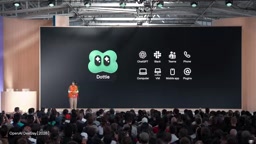
Technically, Dots is powered by Astra — OpenAI's most aligned model — and has its own dedicated cloud computer and browser. It can write code autonomously, run tests, and submit PRs for review. It connects to over 4,000 apps and can reuse all your existing plugin connections. Crucially, control always stays with the user: you can set boundaries per app and computer, customize instructions for each action, and delegate only as much as you're comfortable with.
Looking ahead, Dots will support SMS and phone interactions — you'll be able to text your Dot, receive updates, or call it directly to talk through decisions. Dots and Space (covered below) are available today for all ChatGPT Pro, Business Premium, and Enterprise users, and don't count against regular usage limits.
A note on Astra and alignment: Astra is OpenAI's current flagship model with the highest degree of alignment — its name comes from the Greek word for "star," reflecting a focus on long-term planning and safety. In AI, "alignment" refers to how closely a model's behavior matches human intentions and values. The higher the alignment, the less likely the model is to take actions users didn't intend — which is especially critical for an agent granted the authority to act autonomously. By building Dots on Astra, OpenAI ensures that when it submits code, reschedules calendar events, or contacts vendors, it respects the boundaries and permissions users set rather than expanding its own authority. This is why OpenAI kept emphasizing "control stays with the user" throughout the demo — for an agent that genuinely works on your behalf, alignment is the foundational safety guarantee.
ChatGPT Space: A Shared Canvas for Human-Agent Collaboration
Even the most capable individual Dot still needs a shared environment for team collaboration. OpenAI noted that virtually all productivity software was designed before AI collaboration was a reality — Space is built specifically for that new paradigm.
Space starts with a page where you can write plans, conduct research, generate images, and work with data. Dots can work alongside you directly within the page — you can @mention a Dot in comments just like tagging a senior engineer, or set persistent instructions for the page, such as "check the API platform's Slack channel daily and update findings here."
Product team member Holly demonstrated the full workflow using a fictional music app called "Blossom": her Dot "Dotty" proactively pulled overnight feedback, surfaced a design redesign and pushed a notification, synced progress via voice at any time, turned raw data into dynamic charts inside Space, and even took over forwarded task threads in Slack. OpenAI admitted to an unexpected discovery: employees started treating Dots as genuine delegation targets, looping them into group chats from the start, with engineers letting Dots automatically fix dozens of bugs per day.
For enterprise customers, OpenAI also previewed "Specialist Dots" — think company-level virtual colleagues capable of handling intensive accounting, marketing, legal, and similar workloads, with improvements shared across the organization. OpenAI is partnering with Microsoft to integrate Specialist Dots into Agent 365.
Model Updates: GPT 6.1 Sol, UltraFast, and the Decisions API
Following Astra's launch a few weeks prior, the two loudest user requests were simple: cheaper and faster. OpenAI delivered directly.
GPT 6.1 Sol is positioned around the balance of cost and capability, delivering near-Astra intelligence at roughly one-fifth the price. Cached input costs are discounted by 95% compared to standard input pricing, making it dramatically more economical for agents that reuse context, iterate on solutions, and handle long-running tasks. OpenAI is positioning it as the go-to model for everyday development.
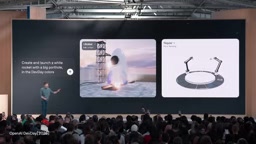
UltraFast chases raw speed — 8x faster than standard, reaching around 300 tokens per second — at a 6x price premium. A side-by-side "rocket generation" demo made the speed gap viscerally clear. OpenAI also launched the Decisions API, which lets you predefine option sets for the Luna model and get responses in fractions of a second. It's designed for request routing, image classification, determining an agent's next step, and similar scenarios, while retaining image understanding, multilingual support, and safety protections.
On the subscription side, OpenAI introduced Pro500 — offering 25x the usage of Plus with UltraFast access — and reopened the Pro200 subscription tier.
A quick primer on tokens and caching: A token is the basic unit of text that large language models process — roughly 3–4 characters in English. "300 tokens per second" means UltraFast can generate fast enough to power real-time voice interactions and streaming code completion. Cached input is a cost optimization: when an agent needs to repeatedly reference the same context (a codebase, a long document) across a long task, the system stores already-processed tokens and reuses them on subsequent calls, avoiding redundant computation and substantially cutting costs. GPT 6.1 Sol's 95% cached input discount makes multi-iteration agent workflows genuinely economical.
AI Research Intern: Models Starting to Accelerate Themselves
Tejal shared a significant milestone: a year ago, Sam and Jakob predicted "the first AI research intern within a year" — a claim most observers dismissed. That goal has now been met. The system can independently complete well-defined research tasks that would take skilled human researchers substantial time.
The data tells the story: in January, models handled short 15-minute tasks reasonably well but failed on nearly all tasks requiring a full day's work. By July, paired with UltraFast, models could complete over one-third of "one-day-level" research tasks without human intervention. These models also optimized the computer-use harness themselves, delivering more than 2x latency improvements while increasing refusal rates on unsafe scenarios and improving alignment. OpenAI noted that Astra-class models have helped resolve hundreds of mathematical problems that had been open for decades, and are contributing to antibiotic research, ancient language studies, and clean energy.
Developer Tools: Codex Goes to the Cloud and the Agents API
The developer story centers on a simple idea: "we're giving you the same tools we use internally." The Codex harness powering both Codex and Dots has been open-sourced so you can see exactly how it works under the hood.
The headliner is Codex going fully cloud-native — you can kick off a task on your phone, then pick it up seamlessly in a browser or on desktop without keeping your laptop running. Building on the cloud harness, OpenAI also launched Codex Security Cloud, which continuously discovers vulnerabilities and prepares verified fixes, with support for automatic deduplication and scheduled scans.
The new Agents API (in public beta) packages the harness, hosting, memory, multi-agent orchestration, and computer-use capabilities into a single offering. OpenAI deepened its AWS partnership to launch Bedrock-managed agents powered by OpenAI, and previewed OpenAI Private Intelligence — which uses ZDR (Zero Data Retention) private processing and private inference to deliver frontier model capabilities without storing user content. The Responses API, meanwhile, has grown 100x over the past year while maintaining 99%+ reliability, cutting time-to-first-token by 45% and speeding up tool calls by over 30%.
Roman's live demo was a highlight reel: real-time 3D scene manipulation with UltraFast, building an app via voice in the CLI, watching Astra autonomously learn to play a game, auditing an app across screen sizes with "app shot," and connecting live to Hugging Face's programmable robot Lavender — integrating vision, image generation, and voice.
What's a harness, and what's ZDR? In AI engineering, a "harness" refers to the execution framework built around a model — task scheduling, tool calling, error handling, result validation, and other scaffolding that transforms a model from "can answer questions" to "can complete tasks." Open-sourcing the Codex harness means developers can see and reuse the underlying task orchestration that powers Codex and Dots, rather than building reliable multi-step workflows from scratch. ZDR (Zero Data Retention) is a standard enterprise privacy architecture: data is discarded immediately after a request is processed and never written to persistent storage. Private Intelligence uses ZDR to ensure that even the inference process leaves no trace of user data — meeting the compliance requirements of finance, healthcare, legal, and other highly regulated industries.
Distribution and Ecosystem: Helping Developers Build Real Businesses
With 1.2 billion people using ChatGPT weekly, OpenAI wants to turn that platform into a commercial opportunity for developers. Sign in with ChatGPT lets users log into third-party apps using their ChatGPT subscription tokens, reducing acquisition friction for developers. Sixteen launch partners are already live.
Plugin Extensions let developers build complete applications that feel native to ChatGPT — editors, dashboards, and workspaces can all be embedded. Dozens of partners including Figma and Adobe are already building extensions. Plugins can also be intelligently discovered mid-conversation: when a user asks a question, ChatGPT recognizes which plugin can help and connects it on the spot. OpenAI has also streamlined the plugin submission process, adding support for tracking reviews, requesting human review, and pushing incremental updates.
Sign in with ChatGPT is essentially an OAuth authorization mechanism — similar to "Sign in with Google" — but with a key difference: users can bring their existing ChatGPT subscription credits directly into third-party apps. Developers don't need to manage their own AI billing or user account infrastructure. For indie developers and small teams, this is significant: lower acquisition cost (no new account required), lower billing complexity (built on OpenAI's existing subscription system), and users naturally carry over preferences and plugin connections they've already set up. Plugin Extensions extend this logic further — developers can embed full UI interfaces directly into the ChatGPT conversation flow, making their product feel like a native ChatGPT feature and reducing the psychological cost of switching.
From Industrial Revolution to New Renaissance
To close the event, Sam Altman shared a framing he finds more fitting than the common "AI as a new Industrial Revolution" narrative — which, he argued, implies turning people into faster-spinning cogs in a machine. He prefers the idea of a "new Renaissance": AI giving people more control over their own lives, and more tools to create, learn, and explore.
This DevDay was extraordinarily information-dense, but the throughline was clear: OpenAI is moving AI beyond the chat interface toward a form that can autonomously execute tasks and collaborate across applications — while handing those capabilities to developers through better price-performance tradeoffs and an open distribution ecosystem. Whether these ambitious visions hold up in real-world use remains to be seen.
Related articles

Free Unlimited Claude Code Solution: Agnes AI + CC Switch Setup Guide
No paid subscription needed — pair the free AI platform Agnes AI with the open-source tool CC Switch to provide a backend for Claude Code, enabling unlimited free calls to text, image, and video models. This guide covers the full setup, test results, and usage boundaries.

A Complete Zero-Cost Guide to Getting Started with Claude Code for Beginners in China
A beginner's guide to Claude Code for users in China: two installation methods (command line and IDE plugin), full configuration steps for replacing the official API with the free domestic LongCat model, and a hands-on demo of building a small tool with natural language, plus tips.

When the NSA Gets Involved: The AI Supply Chain Crisis Behind Open-Source CVEs and API Key Hijacking
Multiple open-source projects disclosed severe CVEs in one day, PHP flaws alarmed the FBI, and Railway and OpenCode were breached with API keys stolen. This article breaks down the vulnerability window, AI-accelerated exploitation, and the AI supply chain crisis behind the API key black market, with a developer defense checklist.