OpenAI Economic Research: How AI Is Reshaping the Way We Work
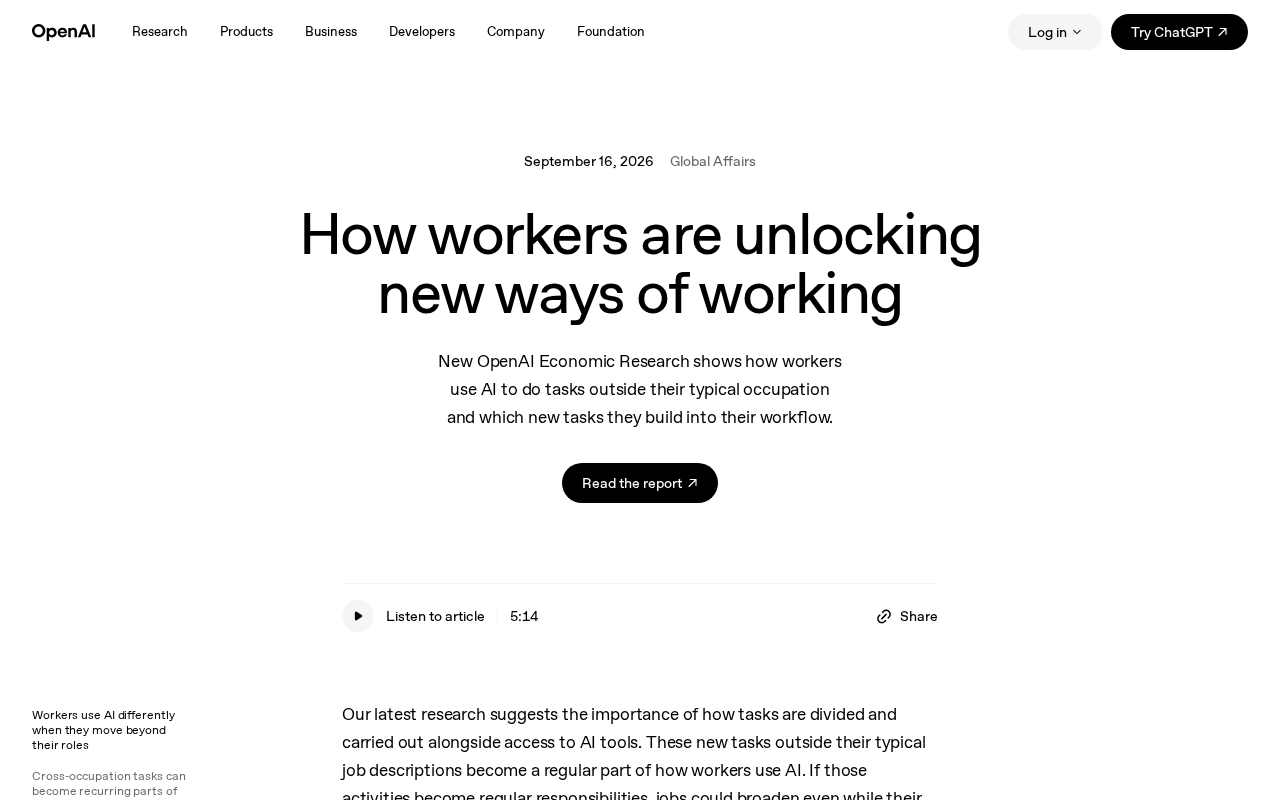
OpenAI research finds employees are spontaneously pushing past job boundaries with AI and turning effective uses into daily habits.
OpenAI's latest economic research shifts the conversation from "will AI replace jobs" to "how does AI expand the way we work," focusing on how employees are breaking out of traditional role boundaries in real-world usage. The study finds that workers across marketing, engineering, and other functions are using AI to complete tasks that once fell outside their responsibilities — and its central concern is which AI-assisted activities evolve from occasional experiments into high-frequency daily routines. This metric directly reflects where AI creates genuine value. For organizations, it signals a need to revisit rigid job structures and performance systems; for individuals, embedding effective AI use into habitual practice is emerging as a new form of professional competitiveness.
AI Is Changing the Nature of Work
OpenAI's latest economic research reveals a quiet but significant shift: employees are using AI in ways that extend far beyond their traditional job descriptions. The study focuses on a core question — when AI tools enter everyday workflows, which new activities gradually become recurring, routine parts of the job?
What makes this research valuable is that it moves past the debate over whether AI will replace jobs, and instead adopts a more constructive lens: how AI expands the ways people accomplish work. This narrative shift — from "displacement" to "augmentation" — reflects the real state of AI adoption in today's workplace.
AI Use Cases That Go Beyond the Job Description
The research notes that employees are using AI in contexts that stretch beyond what their original role definitions ever specified. A marketer might use AI to handle data analysis tasks; an engineer might rely on AI to draft communications — activities that previously fell outside their core responsibilities.
This pattern of cross-boundary usage carries two layers of meaning. On one hand, AI tools are meaningfully expanding individual capability — employees can now independently complete tasks that once required cross-departmental collaboration or specialized expertise. On the other hand, this is subtly redefining what a job actually entails. As certain supporting tasks become readily accessible, the center of gravity in work may shift toward higher-value judgment and creative thinking.
This cross-functional usage is known in organizational behavior as "Role Expansion" or "Job Crafting" — employees proactively adjusting the boundaries of their work to adapt to new tools or environments. Historically, the spreadsheet revolution allowed non-finance employees to take on basic data analysis; the internet enabled ordinary workers to conduct their own research without depending on a librarian or reference desk. AI tools are triggering a similar — but far larger — redrawing of boundaries: natural language interfaces dramatically lower the operational threshold for cross-domain tasks, significantly reducing the friction of skill transfer. The potential risk here is that if organizational evaluation and authorization structures don't keep pace, employees who venture beyond their formal roles may face institutional pushback.
Which Activities Are Becoming Routine
The study pays particular attention to the question of "which new activities are becoming recurring components of work." This is a critical metric, because there's a fundamental difference between a one-time experiment and a long-term, embedded work habit.
When an AI-assisted activity evolves from occasional use into a daily repeated routine, it has genuinely changed the structure of work. These high-frequency, stable usage patterns tend to reveal where AI creates real value — not features that were pushed onto users, but workflows that employees actively retained because they produced measurable efficiency gains. Identifying these high-retention scenarios matters deeply: for enterprises trying to understand the actual ROI of AI, and for tool developers looking to refine their product direction.
Behavioral economics' "habit formation" theory helps illuminate this phenomenon: once a tool is used frequently enough, it transitions from a conscious choice to an automated behavioral pattern. Researchers typically use "more than 3 times per week for at least 4 consecutive weeks" as a reference threshold for determining whether a work behavior has solidified into routine. For AI tools, this threshold is especially meaningful — because many enterprise AI deployments fail precisely because the tools never move past the "novelty phase" and never truly embed into the workflow. By focusing on "recurring components," OpenAI's research is essentially measuring behavioral stickiness rather than simple feature satisfaction. This sets it apart from conventional software usage surveys and makes it a more accurate reflection of AI's deeper structural impact on work.
Implications for Organizations and Individuals
From a management perspective, this research signals that organizations need to re-examine how they design workflows. If employees are spontaneously using AI to expand what they do, then rigid job classifications and performance evaluation frameworks may already be lagging behind actual working patterns. Organizations have an opportunity to observe these organically emerging AI usage habits and use them to optimize resource allocation and training priorities.
For individual career development, proactively exploring AI's applications within one's own work may become a meaningful new competitive advantage. Those who are adept at integrating AI into their daily workflows — and who convert effective applications into ingrained habits — are likely to gain a substantial productivity edge.
It's worth noting that this article is based on a summary of OpenAI's published research; specific data and methodology details remain to be examined in the full report. But the direction the research points to is already clear: AI is reshaping work from the bottom up.
Related articles
The Siberian Ice Maiden and the Archaeological Mysteries of the Scythian World
The Siberian Ice Maiden is a Scythian female mummy from the Ukok Plateau. Her tattoos, silk garments, and grave goods reveal ancient nomadic art, social hierarchy, and cross-regional trade — alongside ongoing repatriation controversies.
SQL Row Pattern Matching: Implementing "Row-Level Regex" with MATCH_RECOGNIZE
MATCH_RECOGNIZE gives SQL regex-like power over row sequences. Detect brute-force attacks, fraud patterns, and user behavior flows with clean, declarative syntax — no more messy self-joins.
Hackers Break Into Flock Surveillance Cameras, Exposing the Inner Workings of License Plate Recognition Systems
Hackers breached Flock Safety's ALPR cameras, exposing how license plate recognition systems collect data and the privacy and security risks they pose.