Spring AI Full-Stack in Practice: RAG + MCP + Real-Time Search

Spring AI integrates RAG, MCP, and real-time search to build a practical Java AI application architecture.
This article dissects a Java large model integration course based on Spring AI. The course uses three major modules—RAG knowledge base, MCP tool invocation, and real-time web search—to build a closed-loop AI application skeleton covering model knowledge, action, and memory. The article analyzes the key role of SSE streaming interaction in reducing perceived latency, and how MCP moves large models from conversation to operation. The project is positioned as a microservice component that can be embedded in existing systems or an AI middle platform, adopting a pure backend model based on OpenJDK 21 and Maven. It is suitable for Java engineers with Spring Boot fundamentals, but engineering details such as vector retrieval tuning and tool invocation fault tolerance need additional supplementation.
How can Java developers truly integrate large language models into business systems? A course on Bilibili offers a complete answer: using Spring AI to connect RAG knowledge bases, MCP tool invocation, and real-time web search, building a solution that can be embedded into existing systems or extended into an AI middle platform. This article does not recount the course outline point by point, but rather dissects the architectural logic and practical value of this technology combination.
How the Three Core Modules Work Together
The course divides the project into three main lines: knowledge base, real-time web search, and MCP services and tools. The knowledge base uses Redis to build a vector store, filling the gap in the large model's knowledge of private domains; real-time search connects to internet data through a Search Engine, so answers are not limited to the training corpus; MCP is the most imaginative part of the entire solution—the large model can invoke developer-built MCP tools, and behind the tools are databases, allowing users to complete queries, inserts, updates, and deletes simply through chat. According to the course, combined with session memory functionality, the large model can even send query results to a specified email address.
These three are not parallel feature points, but rather cover three levels: "what the model knows, what the model can do, and what the model remembers," forming a closed-loop AI application skeleton.
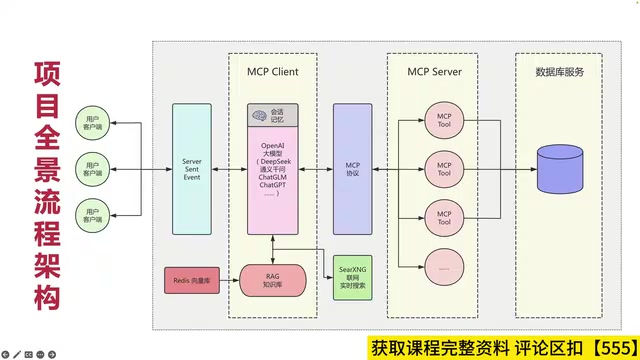
RAG (Retrieval-Augmented Generation) is a technical paradigm that combines external knowledge retrieval with large model generation. Its core process is: convert the user's question into a vector through an embedding model, retrieve the most relevant document fragments from a vector database, then inject these fragments as context into the large model's prompt to generate answers based on private knowledge. RAG effectively mitigates the problems of hallucination and outdated knowledge in large models, and is especially suitable for enterprise knowledge bases, customer service Q&A, and similar scenarios. Compared with fine-tuning, RAG does not require retraining the model, making knowledge updates more flexible and lower in cost.
MCP (Model Context Protocol) is an open protocol proposed by Anthropic, aimed at standardizing the way large models connect to external tools and data sources. It defines a client-server architecture that allows developers to encapsulate databases, APIs, file systems, etc. into MCP services, which large models can invoke through a unified protocol. The emergence of MCP solves the problem of fragmented tool invocation, enabling large models to operate external systems in a consistent manner, moving from "conversation" to "execution." In the Java ecosystem, Spring AI already provides support for MCP, making it easy for developers to integrate quickly.
Streaming Interaction: Why SSE Is a Key Link
The interaction between the client and the large model is implemented through SSE (Server-Sent Events) for streaming responses. This choice is pragmatic: compared with WebSocket, SSE is simpler to implement in server-push scenarios and has lower integration cost with the Spring ecosystem, making it suitable for the character-by-character output experience of conversational applications.
Streaming responses are not just an experience optimization. In RAG scenarios, there is a waiting window between retrieval and generation, and streaming output can significantly reduce the perceived latency for users. The course treats SSE as an independent technical point, indicating that its role is the project's basic communication layer, not an optional decoration.
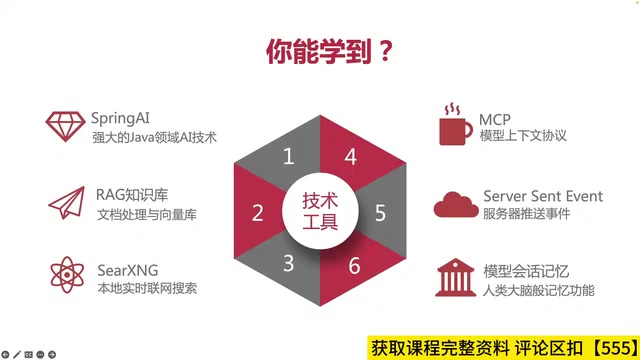
SSE (Server-Sent Events) is an HTTP-based server push technology that allows the server to continuously send events to the client in the form of a text stream. Unlike WebSocket, SSE is one-way communication (server to client), simple to use, requires no additional protocol upgrade, and naturally supports reconnection. In AI conversation scenarios, SSE is often used to push tokens generated by the large model one by one to the frontend, achieving a typewriter effect. Spring AI provides integrated support for SSE, and developers can easily implement streaming output through SseEmitter or reactive streams (such as Flux). It should be noted that under HTTP/1.1, SSE is limited by the browser's concurrent connection limit, but under HTTP/2 this limitation no longer exists.
MCP: The Leap from "Conversation" to "Operation"
The development of MCP services and tools is what distinguishes this course from ordinary RAG tutorials. Traditional RAG solves the problem of "answering accurately," while MCP solves the problem of "getting things done." After encapsulating database operations into MCP tools, the large model transforms from a passive responder into an agent capable of executing actions.
The course emphasizes that this project is "very versatile"—it can be used as a microservice component embedded in existing systems, or extended into an AI capability middle platform supporting multiple scenarios. This positioning is worth noting: it means what you learn is not a demo-level assembly, but a reusable architectural pattern. For enterprises that need to introduce AI capabilities without refactoring core systems, the engineering value of this incremental path is high.
Vector Database is a core component in the RAG architecture, used to store and retrieve high-dimensional vectors. Unlike traditional relational databases, vector databases use approximate nearest neighbor (ANN) algorithms (such as HNSW, IVF) to achieve efficient similarity search. When Redis is used as a vector database, the RedisSearch module is needed to provide vector indexing and KNN query capabilities. In Spring AI, it can be easily integrated through RedisVectorStore. The advantages of choosing Redis lie in its in-memory performance, mature operations system, and seamless connection with the existing Java technology stack, making it suitable for latency-sensitive small and medium-scale knowledge base scenarios. For scenarios with larger scale or higher recall requirements, specialized vector databases such as Milvus and Qdrant can be considered.
Technology Stack and Learning Threshold
The core technologies listed in the course include Spring AI, RAG knowledge base (including document processing and Redis vector store), Search Engine local real-time web search, MCP service and tool development, SSE, and model session memory. The project adopts a pure backend model, built on OpenJDK 21 and Maven, aligning with the current mainstream toolchain.
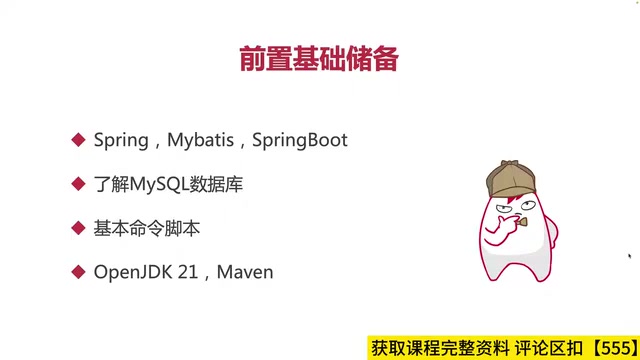
Prerequisites are Java fundamentals, understanding of Spring and Spring Boot, MySQL, and basic command-line operations. The course claims that even beginners can follow along, but from the perspective of technical density, Java engineers with Spring Boot development experience will learn most efficiently. The entire process includes hands-on coding, middleware installation, and server deployment demonstrations, along with complete project source code.

The course is produced to the standards of a Java architect system course, emphasizing enterprise-level development standards. For learners, standardized code organization and deployment processes may have long-term value no less than the specific technical points themselves.
Who It's For, and What to Keep in Mind
This content is best suited for three types of people: backend engineers who want to embed AI capabilities into existing Java systems, technical leads who need to quickly validate the feasibility of an AI middle platform, and mid-to-senior developers who wish to shift from feature development to architectural thinking.
It should be objectively noted that the course introduction mainly focuses on capability promises and lacks in-depth disclosure of specific business scenario difficulties, such as recall quality tuning for vector retrieval, failure handling for MCP tool invocation, and exception recovery in streaming responses. Additional supplementation may be needed during actual learning. In addition, the web search section emphasizes "local" and "privacy," but does not specify the concrete search engine implementation, so selection needs to be evaluated independently.
Overall, the combination of RAG + MCP + real-time search reflects a trend in AI application development: single-point model invocation is giving way to systematic orchestration of "model + tools + memory + retrieval." As an integration framework on the Java side, Spring AI lowers the entry barrier for this orchestration. For teams on the Java technology stack, this path is smoother than starting a separate Python technology stack, and is worth evaluating as a priority option for AI implementation.
One-line Summary
Spring AI integrates RAG, MCP, and real-time search to build a practical Java AI application architecture.
Paragraph Summary
This article dissects a Java large model integration course based on Spring AI. The course uses three major modules—RAG knowledge base, MCP tool invocation, and real-time web search—to build a closed-loop AI application skeleton covering model knowledge, action, and memory. The article analyzes the key role of SSE streaming interaction in reducing perceived latency, and how MCP moves large models from conversation to operation. The project is positioned as a microservice component that can be embedded in existing systems or an AI middle platform, adopting a pure backend model based on OpenJDK 21 and Maven. It is suitable for Java engineers with Spring Boot fundamentals, but engineering details such as vector retrieval tuning and tool invocation fault tolerance need additional supplementation.
Related articles

9 AI Subscription Plans Compared: The Real Cost Per 100M Tokens Revealed
Bilibili creator tests 9 AI subscription plans from Volcano, Alibaba, Tencent, Baidu, Zhipu, Xiaomi, MiniMax and more, converting them all to real cost per 100M tokens, breaking down fixed-quota vs. three-tier coefficient billing and how caching, time-of-day discounts, and window limits affect actual quota.

Vibe Coding for Beginners: Expressing Intent Instead of Handwriting Code
What is Vibe Coding? A 137-episode Bilibili course defines it: the core is expressing intent, not writing code. This article analyzes Vibe Coding's productivity logic, target audience, and entry expectations to help beginners decide if it's worth learning.

LangChain Beginner's Guide: An Agent Development Roadmap from LangGraph to Deep Agents
Clarify the encapsulation relationship among LangChain, LangGraph, and Deep Agents, and master the learning path and selection logic for agent development frameworks—suitable for beginners in large model development.