OpenAI Launches ChatGPT Ads: A New Business Model Inside AI Conversations

OpenAI launches visual ads in ChatGPT, backed by a full advertiser toolchain including measurement, attribution, and brand suitability.
OpenAI has announced visual ad formats for ChatGPT alongside measurement tools, third-party attribution partnerships, and brand suitability capabilities — marking a systematic push into ad monetization. Unlike traditional search or feed ads, conversational AI ads must align with user intent to preserve trust. The advertiser toolchain signals a serious long-term commitment, not a trial. This move puts OpenAI in direct competition with Google and Meta for ad budgets, and how it balances commercialization with user trust could define the monetization blueprint for the entire generative AI industry.
OpenAI Officially Enters the Advertising Business
OpenAI has announced the introduction of new visual ad formats within ChatGPT, along with expanded measurement tools, attribution partnerships, and brand suitability capabilities for advertisers. This marks the beginning of a systematic effort by the technology-focused company to explore ad monetization within conversational AI.
For a product that has long relied on subscription and API revenue, introducing advertising isn't just a supplement to its income mix — it's a reimagining of how people use AI. Unlike traditional search ads or social feed ads, ChatGPT's interactions are conversation-centric, which means ads must be embedded in a way that feels natural and aligned with user intent.
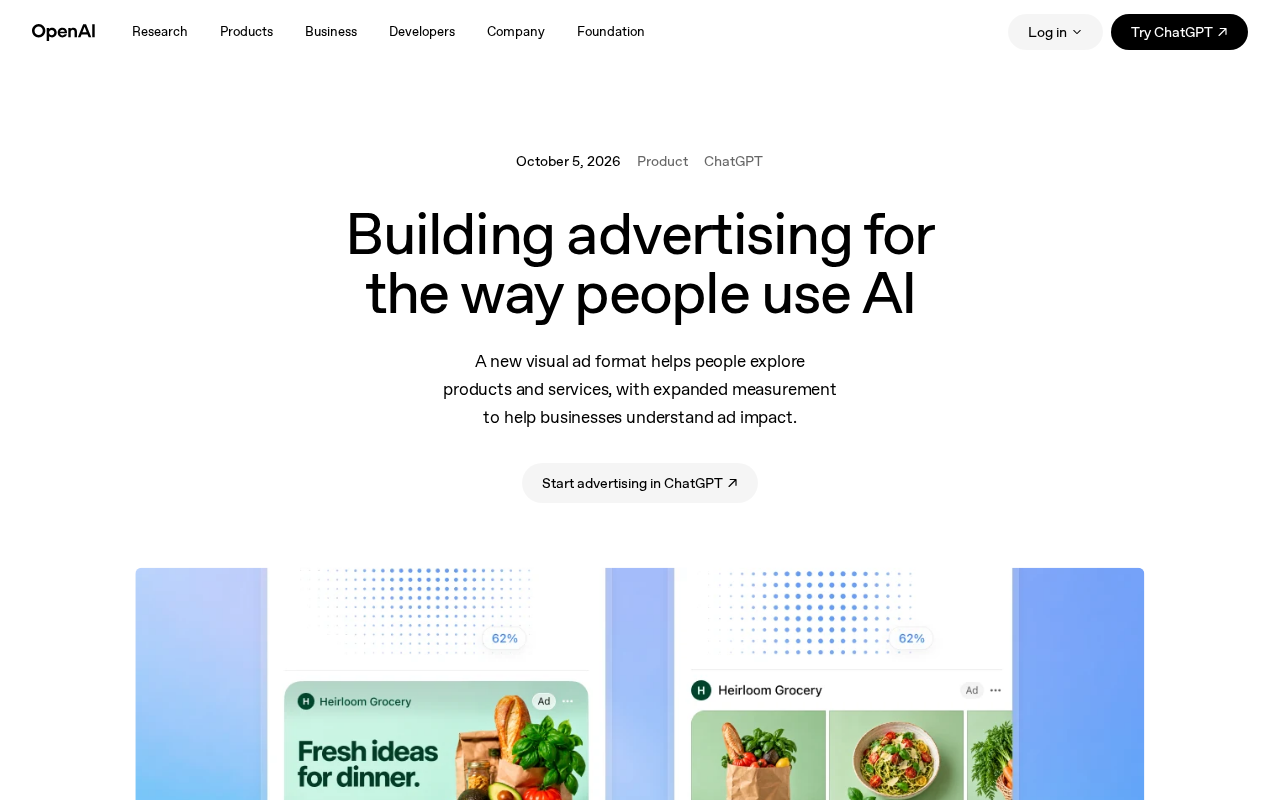
Ads Built for the Way People Use AI
The core principle OpenAI emphasizes is "advertising for the way people use AI." This reflects a critical insight: the logic of advertising in a conversational interface is fundamentally different from the web era.
In a traditional search engine, users type keywords and receive a list of links, with ads naturally appearing above or beside the results. In ChatGPT, users are typically asking complex questions, seeking advice, or completing a task. Ads inserted clumsily would easily disrupt the conversational experience and erode user trust — and trust is precisely the most valuable asset of a product like ChatGPT.
The new visual ad format must therefore strike a balance between commercial value and user experience. "Visual" means ads are no longer limited to plain-text recommendations — they can appear in richer formats. This raises both the expressive potential of advertising and the bar for relevance to the surrounding conversation.
A Complete Advertiser Toolchain
Beyond the ad format itself, OpenAI has also built out a supporting set of capabilities for advertisers, organized around three key areas:
Measurement Tools
Measurement is the foundation of any ad campaign. Advertisers need to know where their budget is going and what results it's producing. By expanding its measurement tools, OpenAI is attempting to provide quantifiable campaign feedback, enabling advertisers to evaluate the return on investment of this entirely new channel.
Attribution Partnerships
Attribution answers the question: "Which impression actually drove the conversion?" By establishing relationships with third-party attribution partners, OpenAI aims to integrate ChatGPT advertising into advertisers' existing measurement frameworks, reducing friction for those considering a new channel. This is critical for winning over mainstream ad budgets.
Attribution technology has been evolving for years in digital advertising, with major models including Last-Click Attribution, linear attribution, and data-driven attribution. Third-party attribution platforms (such as AppsFlyer, Adjust, and Branch) serve as neutral data arbiters, helping advertisers allocate conversion credit across multiple channels and preventing each channel from double-counting the same conversion. For a newer channel like ChatGPT — where user behavior occurs within a closed conversational interface — traditional cookie tracking or URL parameter methods are difficult to apply directly. Deep integration with attribution partners is therefore especially important. Only when advertisers can measure ChatGPT's performance using their existing tools will they include it in regular media plans rather than treating it as a one-off experimental budget.
Brand Suitability
Brand suitability ensures that ads don't appear in content environments that conflict with a brand's image. In the context of generative AI — where content is dynamically generated — brand safety becomes considerably more complex. OpenAI's proactive investment in brand suitability capabilities signals that it understands one of advertisers' core concerns.
Brand suitability is an extension and refinement of brand safety. While brand safety focuses on preventing ads from appearing alongside clearly harmful content (such as violence or hate speech), brand suitability goes further — requiring that the content environment aligns with the brand's values and audience positioning. A luxury brand, for example, might not want its ad appearing in a conversation about discount shopping, even if that conversation isn't "harmful." In traditional display advertising, this is addressed through keyword blocklists and content categorization. But in a generative AI context, every response is generated in real time and cannot be pre-classified, making brand suitability technically far more challenging to implement. OpenAI will need to build semantic understanding and content classification mechanisms at the model output level to deliver reliable suitability guarantees to advertisers.
Potential Impact on the Industry Landscape
OpenAI's entry into advertising will inevitably put it in competition with existing giants like Google and Meta. ChatGPT's large and active user base gives it natural potential as a new advertising gateway. If conversational ads can demonstrate strong conversion efficiency, a migration of ad budgets is only a matter of time.
That said, the challenges are equally apparent. Generative AI advertising is still in its early stages. Whether user trust in AI responses will be undermined by the introduction of commercial content is a question OpenAI must handle with great care. Once users feel that an AI's recommendations are influenced by advertising interests, the product's long-term value could suffer.
From a broader perspective, this move reflects the commercial pressures that AI companies universally face. Training and operating large models is expensive, and subscription revenue alone can't fully cover the costs. Advertising — a monetization model proven repeatedly throughout the internet era — naturally becomes a compelling option. How OpenAI navigates the path between monetization and user experience will determine the success or failure of its advertising business.
Looking at the history of search advertising, Google built a market worth hundreds of billions of dollars by tightly binding ads to user search intent. ChatGPT's conversational data carries equally strong intent signals — users often voluntarily reveal their needs, budget ranges, and decision-making stage within a conversation, making this data commercially even more valuable than traditional search keywords. However, the highly private nature of conversational content also creates data compliance challenges. How to use conversational context for ad targeting without violating user privacy will be a key focus for regulators and consumer advocates — particularly under the EU's GDPR framework, where the boundaries around processing conversational data have yet to be fully defined.
Conclusion
The launch of ChatGPT advertising marks a milestone in the commercialization of conversational AI. It is both a pragmatic move by OpenAI to diversify its revenue streams and an exploration of new advertising formats suited to AI interaction. Together, the visual ad format, measurement tools, attribution partnerships, and brand suitability capabilities form a relatively complete advertising infrastructure — a signal that OpenAI is not dabbling superficially but taking this business direction seriously.
The real test lies in execution: can ads serve commercial goals without eroding users' trust in AI? The answer matters not only for OpenAI's own trajectory, but could set a precedent for how the entire generative AI industry approaches monetization.
Related articles

LLaMA-Factory in Practice: A Complete No-Code Guide to Fine-Tuning Large Models
An introduction to LLaMA-Factory, the open-source fine-tuning tool: its 60.1K-star background, supported models and algorithms, local vs. cloud deployment, and CUDA setup steps.

Zeng Ming's Deep Retrospective: Why OpenAI May Not Be the Ultimate Winner — and Why the Corporate System Will Disappear
Zeng Ming's deep retrospective on the AI endgame: model companies are just infrastructure, OpenAI and Anthropic won't be the final winners; the next battle is the Agent entry point standard; the corporate system will disappear as AI restructures collaboration, and only mission-driven companies can survive the cycle.

OpenHands v1.28.0: OpenCode and PI Added as Built-in Agents, API Keys Requestable In-Conversation
OpenHands ships 5 releases in 21 days: v1.27.0 adds OpenCode and PI as built-in agents, v1.28.0 enables in-chat key requests. ACP integration, credential reuse, model list changes, and upgrade advice.