OpenAI Launches Persistent Agent 'dots', Anthropic Commits $518B to Compute

OpenAI launches persistent agent dots, Anthropic commits $518B to compute, and the US government deploys AI publicly.
On September 30, a wave of major AI developments pointed to a single core trend: AI is evolving from a one-off chat tool into always-on infrastructure. OpenAI unveiled persistent agent 'dots' at DevDay, capable of tracking and executing user goals across Slack and Teams. Reuters revealed Anthropic's $518B, 10-year compute commitment — 80% non-cancellable. The US launched America.gov, using Gemini to unify 29,000 federal websites. And the Trump administration signed a 'morally binding' AI safety agreement with tech firms.
September 30th brought a wave of major developments across the AI industry. From the persistent agent unveiled at OpenAI DevDay, to Anthropic's staggering compute commitment, to U.S. government AI deployments and safety agreements — the day's headlines collectively point to one overarching trend: AI is shifting from a "chat tool" to a "continuously task-executing infrastructure."
OpenAI DevDay Unveils Persistent Agent "dots"
OpenAI officially introduced a persistent agent called dots at DevDay in San Francisco. Unlike the traditional interaction model — start a conversation, call the model once, get an answer — dots is designed to continuously track user goals and execute work across collaboration apps like Slack and Teams.
These agents are reportedly built on models including GPT-6 and Astra. Rather than passively waiting to answer questions, they are capable of staying resident long-term and proactively driving tasks forward.

The significance of this shift is worth unpacking. For the past two years, the dominant use case for large language models has been "ask and answer" — model value concentrated in a single inference. Persistent agents represent an architectural pivot: AI's mode of existence transforms from "instantaneous call" to "always online," from "tool" to "colleague." For enterprise product lines, this also signals that OpenAI is expanding its battleground from consumer-facing chat to enterprise workflow automation.
Persistent Agents represent a major paradigm shift in AI engineering. Traditional LLM call patterns are stateless: once a conversation ends, the model retains no context or goals, and the next session starts from scratch. Persistent agents introduce the concept of persistent state — the agent can remember long-term goals, track task progress, and act continuously across multiple sessions and tools until the objective is complete.
The underlying technologies enabling this typically include: long-term memory storage (writing user goals and action history to external databases), tool use (allowing the model to read/write files, send messages, and call APIs), and task planning with retry mechanisms. Compared to single-call models, persistent agents introduce more complex engineering challenges — such as handling task interruptions, preventing errors from compounding indefinitely, and maintaining user authorization boundaries across multi-step executions.
Anthropic Reportedly Commits $518 Billion to Compute Over 10 Years
A document reviewed by Reuters reveals that Anthropic expects to commit at least $518 billion to AI infrastructure across six partners over the next decade.
What makes this particularly striking is the rigidity of the commitment: approximately 80% of the pledges are reportedly non-cancellable, meaning payment is required regardless of actual usage. This "take-or-pay" style lock-in lays bare a leading frontier lab's long-term bet on compute.

What makes these numbers significant is that they represent some of the most concrete frontier model scaling cost data available. The industry frequently discusses how expensive large model training is, but concrete figures are rarely cited. $518 billion. 10 years. Non-cancellable. These terms together sketch out how top labs are thinking about future compute demand: this isn't a bet on short-term fluctuations — it's a conviction that compute will remain scarce and high-growth for a long time. For the broader industry, this signals both confidence and an extraordinarily high capital barrier to entry.
"Take-or-Pay" is a long-term contract structure common in asset-heavy industries like energy and telecom, and has recently been adopted at scale in AI compute procurement. The core logic: the buyer commits to paying a fixed amount over the contract period regardless of actual usage, allowing the seller to confidently invest in infrastructure. For compute suppliers (such as cloud providers or dedicated data center operators), these terms provide stable revenue visibility, enabling them to confidently deploy billions into GPU clusters. For buyers like Anthropic, the trade-off is locking in massive fixed expenditures in exchange for priority access to scarce compute resources.
This contract structure also reflects frontier AI labs' conviction about compute scarcity — they believe that high-end GPUs required for training frontier models (such as NVIDIA's H100/H200/Blackwell series) will remain in undersupply for years to come, making early lock-in strategically superior to on-demand purchasing.
America.gov Launches, Gemini Powers Unified Search Across 29,000 Government Websites
The United States has officially launched America.gov, consolidating information from over 29,000 federal government websites into a single access point, with AI including Gemini enhancing search capabilities.
Users can now query government services like passports, Social Security, and Medicare directly in natural language — no longer needing to navigate across tens of thousands of scattered websites.
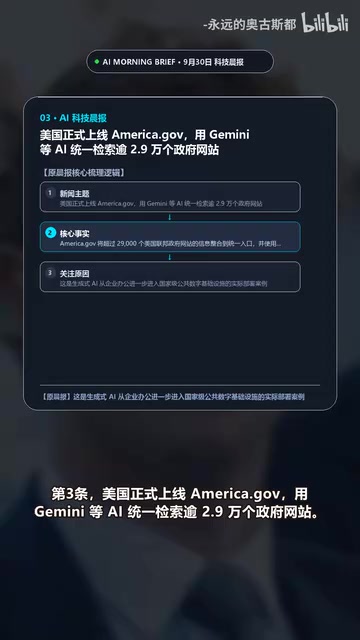
This marks a defining milestone. AI deployment has previously been concentrated in enterprise productivity contexts, but America.gov represents generative AI entering national-scale public digital infrastructure. When a government entrusts high-frequency public services like passport, Social Security, and Medicare lookups to AI-enhanced search, it means the technology is now being held to the reliability standards of public services — a far more stringent test of model accuracy, safety, and interpretability.
U.S. Government Signs Voluntary AI Safety Agreement with Tech Companies
President Trump, after meeting with several tech executives, announced that he had signed an AI-related document with industry representatives, describing it as "Morally Binding."
He also revealed that the government is considering forming a committee of approximately 10 people to oversee related work.

The phrase "morally binding" is notably nuanced — it carries no legal enforcement power, sitting instead in an intermediate space between voluntary commitment and legislation. Before formal legislation takes shape, the core ask of such agreements is for frontier labs to establish internal controls, external oversight, and shared safety norms. This reflects the regulator's balancing act between speed and caution: eager to quickly establish guardrails for rapidly advancing frontier AI, yet unable to formalize those constraints through law just yet.
"Voluntary Commitments" are a widely used transitional tool by governments in the early stages of AI regulation. The logic: formal legislation takes years, while AI capabilities iterate on a monthly basis. Before a legal framework is in place, politically endorsed voluntary agreements can quickly establish a baseline of safety norms between governments and frontier labs.
This mechanism has precedent in the Biden administration — in 2023, seven major AI companies signed White House-led voluntary commitments covering AI-generated content watermarking and safety test sharing. The Trump administration's use of "moral binding" language continues this mechanism while stepping back from the more prescriptive language of Biden's 2023 executive order, reflecting the new administration's policy orientation toward lighter-touch regulation and industry self-governance. Critics note that "moral binding" lacks enforceable penalties, and its real-world effectiveness depends heavily on voluntary corporate compliance.
Closing Thoughts: AI Is Becoming Persistent Infrastructure
Reading these four stories together, a clear thread emerges: AI is evolving from a one-off callable tool into always-on infrastructure.
OpenAI's dots keeps agents resident in workflows; Anthropic's $518 billion commitment keeps compute resident in long-term planning; America.gov keeps AI resident in public services; and the government's safety agreement attempts to build a governance framework for this increasingly persistent system. Technical capability, capital investment, public deployment, and regulatory norms are all advancing in parallel on the same timeline.
Related articles

Free Unlimited Claude Code Solution: Agnes AI + CC Switch Setup Guide
No paid subscription needed — pair the free AI platform Agnes AI with the open-source tool CC Switch to provide a backend for Claude Code, enabling unlimited free calls to text, image, and video models. This guide covers the full setup, test results, and usage boundaries.

A Complete Zero-Cost Guide to Getting Started with Claude Code for Beginners in China
A beginner's guide to Claude Code for users in China: two installation methods (command line and IDE plugin), full configuration steps for replacing the official API with the free domestic LongCat model, and a hands-on demo of building a small tool with natural language, plus tips.

When the NSA Gets Involved: The AI Supply Chain Crisis Behind Open-Source CVEs and API Key Hijacking
Multiple open-source projects disclosed severe CVEs in one day, PHP flaws alarmed the FBI, and Railway and OpenCode were breached with API keys stolen. This article breaks down the vulnerability window, AI-accelerated exploitation, and the AI supply chain crisis behind the API key black market, with a developer defense checklist.