OpenAI Launches Text Watermarking: A New Content Provenance Initiative in Response to the EU AI Act

OpenAI extends content provenance to text, driven by EU AI Act compliance, while acknowledging significant technical limitations.
OpenAI has announced an expansion of its content provenance capabilities from images and audio to text, planning to enable watermarking for eligible ChatGPT and Codex outputs in the EU within weeks to meet EU AI Act transparency requirements, while giving global API customers the option to enable text watermarking immediately. Text watermarking typically embeds statistically detectable patterns by adjusting word choice distributions, but paraphrasing, translation, and truncation can all destroy the signal, and short texts lack sufficient statistical space for reliable marking. OpenAI candidly acknowledges these limitations, positioning watermarking as an assistive tool rather than a definitive authentication mechanism — reflecting a broader industry shift from voluntary transparency to mandatory regulatory compliance.
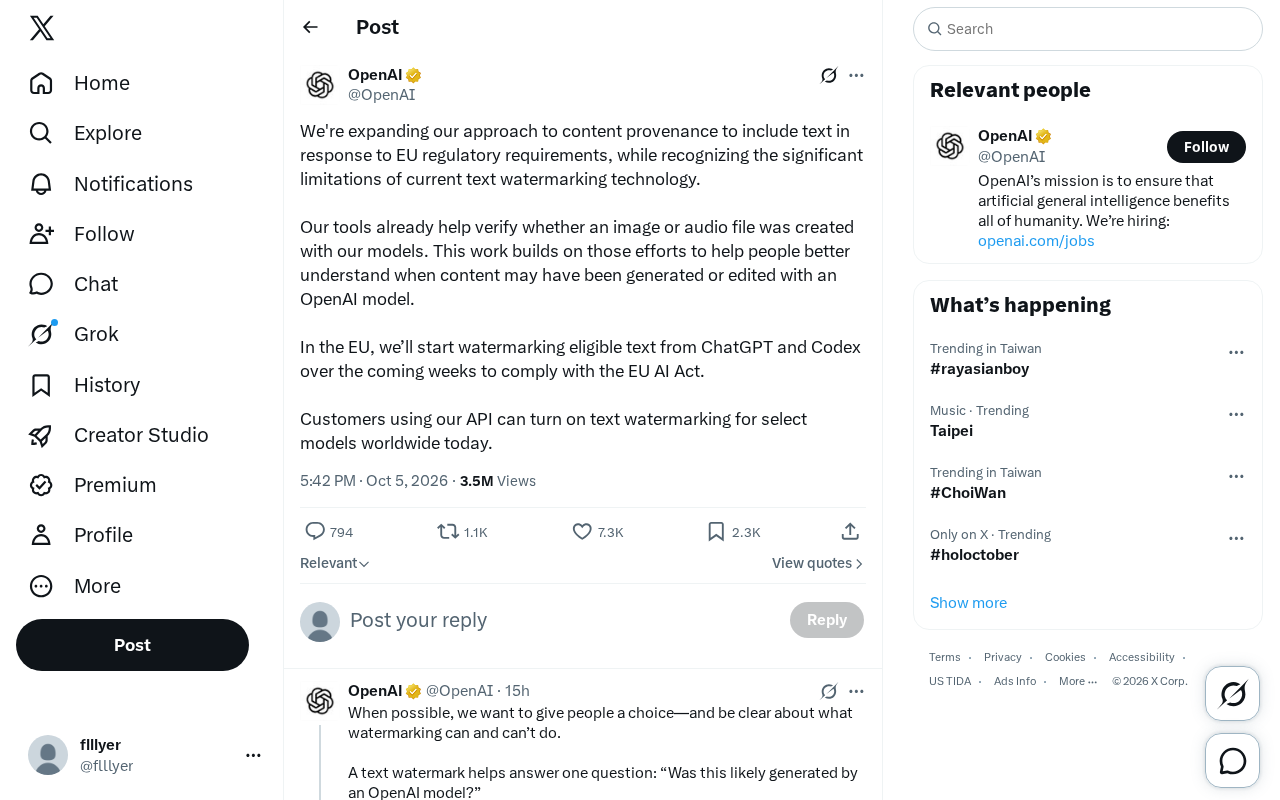
OpenAI has announced an expansion of its content provenance technology into the text domain, responding to EU regulatory requirements. The company plans to begin watermarking eligible text outputs from ChatGPT and Codex within the coming weeks to comply with the EU AI Act. At the same time, OpenAI openly acknowledges that current text watermarking technology has significant limitations.
From Images and Audio to Text: Extending Provenance Capabilities
OpenAI had already established content verification mechanisms for images and audio, allowing users to check whether a given image or audio clip was generated by an OpenAI model. Extending this approach to text means the content provenance system is now covering a broader range of generative output types.
The company's official statement frames this as a continuation of existing efforts, aimed at helping people better determine whether a piece of content was likely generated or edited by an OpenAI model. In other words, watermarking is not an isolated new feature — it is part of a broader trustworthy AI framework designed to preserve identifiable source signals as generated content circulates.
Notably, text is significantly harder to watermark than images or audio. Images and audio can embed imperceptible signals without meaningfully degrading the content itself, but text is a highly structured, information-dense medium where even minor alterations can easily erase or bypass any embedded markers. This is precisely why OpenAI proactively mentions the "significant limitations" of the technology.
A Tiered Rollout: EU First, Global API as Optional
OpenAI's deployment strategy reflects a clearly layered approach.
Mandatory Compliance in the EU
In the EU market, OpenAI will enable text watermarking for eligible outputs from ChatGPT and Codex within the next few weeks. This move directly corresponds to the regulatory framework of the EU AI Act, which sets explicit transparency requirements for generative AI content — stipulating that AI-generated content must be identifiable, in order to reduce the spread of misinformation and the risk of content misattribution. OpenAI's choice to fulfill this obligation through watermarking is a direct response to the EU's regulatory timeline.
The EU AI Act officially came into force in August 2024, making it the world's first comprehensive legislative framework specifically targeting artificial intelligence. It adopts a risk-based, tiered regulatory model. Generative AI — including large language models — falls under the category subject to transparency obligations, requiring providers to ensure that AI-generated text, images, audio, and video content can be machine-identified as AI-produced and clearly labeled for users. The Act sets steep fines for violations, up to 3%–7% of global annual turnover. This legislative momentum has directly pushed leading companies like OpenAI, Google, and Meta to accelerate the deployment of content provenance technologies, prioritizing compliance in the EU before gradually extending to other regions.
Opt-In for Global API Customers
In contrast to the mandatory EU approach, API customers using OpenAI's services can now manually enable text watermarking for select models on a global basis, effective immediately. This means that for developers and enterprise users, watermarking is a configurable capability rather than a default constraint. This design satisfies compliance needs while preserving product flexibility, allowing customers across different use cases to decide whether to enable it based on their own requirements.
The Technical Reality and Challenges of Text Watermarking
In an unusually candid move, OpenAI's announcement proactively acknowledges that current text watermarking technology has "significant limitations" — a statement worth examining closely.
Text watermarking typically works by adjusting the probability distribution of word choices in model outputs, embedding statistically detectable patterns without noticeably affecting readability. However, this approach faces several fundamental challenges: routine editing operations such as paraphrasing, translation, and truncation can all destroy the watermark signal; short texts lack sufficient statistical space to carry reliable markers; and users intent on evading detection have multiple available workarounds.
Text watermarking should therefore be understood as an "assistive judgment tool" rather than an absolute authentication mechanism. OpenAI's transparency about these technical boundaries is valuable — it helps prevent inflated expectations about watermarking capabilities. It can improve content source transparency, but it cannot eliminate AI content forgery or misuse.
Two relatively mature text watermarking approaches exist in academic and industry research. The first is vocabulary distribution shifting: during the generation phase, the vocabulary is divided into "green" and "red" groups, with the model guided to preferentially sample from green tokens. Detection then involves statistically measuring the proportion of green tokens to determine whether a watermark is present. The second is semantic-layer watermarking, which encodes hidden information through sentence structure patterns or synonym substitution. The former approach has been proposed and validated by research teams at Stanford, the University of Maryland, and other institutions, and represents one of the most prominent implementations today. Both methods share a common weakness: the shorter the text and the greater the degree of paraphrasing, the harder it becomes to reliably detect the watermark signal. This also explains why OpenAI specifically refers to "eligible text" — not all outputs are suitable for watermark embedding.
An Industry Signal Driven by Regulation
This initiative reflects a clear trend: AI content transparency is shifting from a voluntary corporate practice to a mandatory regulatory requirement. The EU AI Act, as one of the world's earliest comprehensive AI legislative frameworks to take effect, is materially shaping product decisions at leading AI companies.
OpenAI's choice to proceed with regional differentiation — mandatory in the EU, optional elsewhere — is both a pragmatic compliance strategy and a signal that, as more jurisdictions introduce similar regulations, text watermarking may gradually become standard practice for generative AI products. For content creators, platform operators, and general users alike, understanding the capabilities and limitations of these provenance mechanisms will become increasingly important.
Summary
OpenAI's expansion of content provenance to text is the result of both technical capability development and regulatory compliance pressure. Enabling text watermarking for ChatGPT and Codex outputs in the EU first, while offering an opt-in watermarking feature for global API customers, reflects a flexible, tiered deployment approach. The company's candid acknowledgment of technical limitations also serves as a reminder to the industry and the public: watermarking is a useful tool for improving transparency, but it is still far from fully resolving the challenge of trustworthy AI content.
Related articles

GitHub Daily · October 23: Agent Runtimes and Skill Libraries Surge on the Same Day
NVIDIA open-sources OpenShell, a Rust security runtime for autonomous agents; Claude-Red turns security methodology into SKILL.md skills; VoxCPM2 drops the tokenizer.

Build an AI Super Employee System at Zero Cost: A Full Breakdown of Automated Agent Workflows
A deep breakdown of the AI super employee system demoed on Bilibili: agent orchestration, digital human voiceovers, map and enterprise lead generation, 24/7 customer service, and legal modules. We analyze the business logic and compliance risks behind zero-cost signup to help entrepreneurs judge the real ROI of this AI digital employee system.

The Essential Difference Between Chatbots and AI Agents: Crossing from Conversation to Execution
What's the difference between a chatbot and an AI agent? Based on the MCP series on the Learn Tech channel, this article uses examples like booking flights and summarizing notes to explain: a chatbot only gives answers, while an agent actually completes tasks through a think-act-observe loop. It breaks down the four core components—model, tools, memory, and goal—as well as MCP's role as a bridge, and discusses agents' applicable boundaries and permission risks.