OpenAI Merges Quotas, DeepSeek Open-Sources Agent Architecture: Six Key AI Shifts Today

OpenAI merges quotas, DeepSeek open-sources an Agent, Figma launches Weave, WISE security warning, $3T compute spend, Anthropic obligations near $900B.
Six key AI changes emerged in the past day: OpenAI merged ChatGPT and Codex into a unified token quota where reasoning depth and context length drive consumption; DeepSeek Karna open-sourced DS SuperAgent with Router scheduling and isolated Workers; Figma launched Weave embedding node-based AI pipelines into the design canvas; WISE called October a "Black October" for AI platforms with at least nine providers breached; five giants committed over $3T to compute; and Anthropic's off-balance-sheet obligations approach $900B.
OpenAI Merges Quotas, DeepSeek Open-Sources Agent Architecture: Six Key AI Shifts Today
Over the past day, several noteworthy developments have emerged across the AI landscape—from product experience to infrastructure to capital. Drawing on a roundup by Bilibili creator "AI Change Observer" and public information, this article distills six key trends and adds analytical perspective to help you understand the logic behind these changes.
OpenAI Adjusts Paid Quota Model: ChatGPT and Codex Merged
According to an update to OpenAI's official help documentation cited by Bilibili creator "AI Change Observer," starting in December, the web-based ChatGPT and the Codex coding tool in Plus and Pro plans will be fully merged into a unified token quota model. This change directly affects usage habits for all paid subscribers.
The core rule can be summarized as: the deeper the reasoning, the longer the thinking, and the longer the context, the more quota is deducted. The good news is that Instant chat mode remains unlimited, and the previously community-protested reduction plan has been fully integrated rather than executed separately.
For heavy users who write long code and chat frequently, quota consumption will accelerate noticeably. This reflects a broader trend: OpenAI is bringing the compute costs of different products into a unified metering system, with pay-as-you-go pricing logic replacing the old subscription model segmented by product line. Users need to reassess their usage scenarios, especially developers who rely on both conversation and code generation.
Token quota model: A token is the basic unit of text processed by large language models—typically one English word corresponds to about 1–2 tokens, and Chinese to more. In pay-per-use APIs, the number of input and output tokens determines cost. OpenAI's shift from subscription to a unified token quota means users no longer pay by "product" but by "compute consumption"—the intermediate thinking steps a model generates during inference (such as chain-of-thought) also count as tokens, so long-context, deep-reasoning conversations or code generation will significantly accelerate quota consumption. This metering approach is closer to actual inference costs, but it also makes usage costs less transparent, requiring users to monitor via usage dashboards or third-party tools.
DeepSeek Open-Sources Dual-Layer Agent Architecture: DS SuperAgent
Open-source developers and software engineering teams have a major new tool. According to the same source, the DeepSeekAd Karna team has officially open-sourced a dual-layer coding agent system called DS SuperAgent.
The architecture uses an event-driven model in which a front-end Router handles scheduling and dispatch, while multiple isolated Workers in the back end execute concurrently. It supports listening directly to requests from GitHub and Feishu and automatically generates execution tickets. This means a single repository can finally run a truly autonomous matrix of AI engineers, with multiple Workers processing tasks in parallel in isolated environments, reducing the risk of mutual interference.
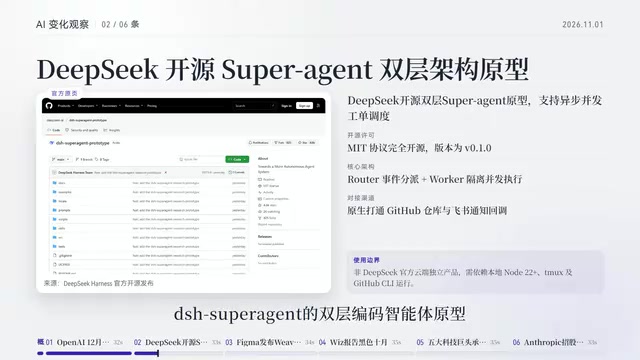
That said, note that this plugin is currently a technical validation prototype and requires manually enabling automation permissions and providing your own local development environment. For teams eager to try it, it's advisable to test first in non-production repositories and observe Worker scheduling stability and permission boundaries.
Agent and isolated Workers: An Agent refers to an AI program that can autonomously perceive its environment, plan steps, and call tools to execute tasks. In multi-agent systems, "isolated Workers" means each subtask runs in a separate process or container with its own file system, network, and permission boundaries, preventing errors or malicious actions in one task from affecting others. Event-driven mode means the system triggers tasks by listening for events (such as GitHub issue creation or Feishu messages) rather than polling. The challenges of this architecture lie in the stability of the Router, the overhead of inter-Worker communication, and the implementation of the principle of least privilege—the very security risks highlighted in the WISE report.
Figma Weave: Connecting the Design Canvas with AI Pipelines
Productivity tools for digital creative and design teams are also evolving. Figma has officially launched Figma Weave, a new multimodal creation platform that fully connects node-based AI creation pipelines with design frames.
Designers can freely chain image and video generation, multi-model quality comparison, split masking, and fine color-grading nodes in a visual canvas, and package them into custom tools for the entire team to reuse with one click. This breaks the fragmented experience of repeatedly switching between design files and external AI image-generation tools, embedding AI generation capabilities directly into the design workflow.
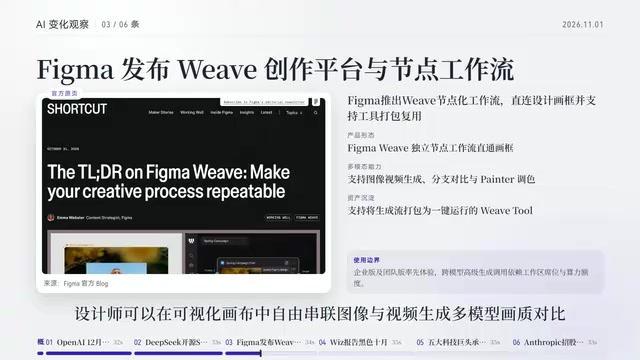
Advanced community templates and multi-model calls still consume team creation credits. From a product design perspective, Figma is bringing the "node-based" interaction paradigm common in AI art tools into professional design software, reducing repetitive work in team collaboration.
WISE Security Report: A "Black October" for AI Developer Platforms
A warning bell sounds on the security front. Global cloud security firm WISE has released a new in-depth research report characterizing the past October as a "Black October" for AI developer platforms. The report discloses that at least nine service providers, including well-known AI infrastructure companies, suffered successive credential theft, malicious Agent cluster attacks, and reverse distillation of core models.
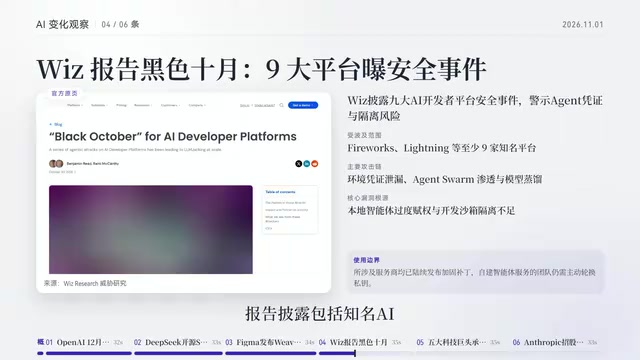
The report points out that automated agents possessing extremely high system privileges yet lacking rigorous isolation are the core root cause of this chain of security breaches. All teams should immediately audit their API key permissions and sandbox access boundaries. Given the rollout of DeepSeek's open-source Agent architecture, this warning is especially timely: when agents begin autonomous scheduling and concurrent execution, permission isolation must be designed in upfront, not patched afterward.
Credential theft and model reverse distillation: Credential theft refers to attackers gaining unauthorized access to cloud resources and model services through leaked API keys, OAuth tokens, or environment variables; in Agent scenarios, a single stolen key can let an attacker control an entire Agent cluster. Model reverse distillation (Model Extraction/Distillation) refers to attackers training a replica model by querying a target model's inputs and outputs extensively to replicate its capabilities, thereby bypassing paywalls or stealing intellectual property. Both types of attacks trended upward in 2023–2024; defenses include short-lived tokens, request-rate anomaly detection, output watermarking, and sandbox isolation.
The Compute Arms Race: Five Giants Commit Over $3 Trillion
The intensity of underlying compute investment continues to climb. According to Bloomberg statistics, five tech giants—Microsoft, Google, Meta, Amazon, and Oracle—have committed to investing more than $3 trillion (about 20 trillion RMB) in AI data centers and other compute infrastructure over the coming years.
Among them, Google's compute spending commitment exceeds $1 trillion, while Oracle has become the first giant to see negative free cash flow due to frenzied compute procurement.
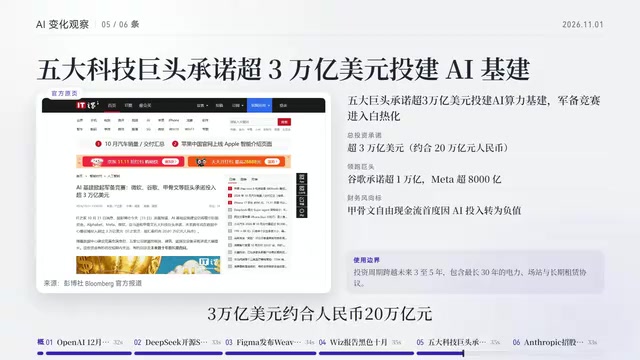
Compute infrastructure has entered a decisive phase of no-holds-barred spending, but capital markets are deeply divided over the payback period for such massive investment. This division is not unfounded: when depreciation cycles don't match the pace of model iteration, the book value of infrastructure may face revaluation pressure.
Anthropic's Capital Test: Off-Balance-Sheet Obligations Approach $900 Billion
The capital situation of the world's leading large-model unicorn also deserves attention. According to public IPO prospectus documents cited by Bilibili creator "AI Change Observer," Anthropic has accumulated long-term off-balance-sheet contractual obligations approaching $900 billion across power procurement, data center leases, and cloud GPU purchases to support continuous model iteration.
The company does not hold hundreds of billions in cash reserves on its books, yet rigid, high compute spending is forcing leading model vendors to monetize at extremely rapid speed. This data echoes the giants' compute investment mentioned above: the industry's capital structure is shifting from asset-light to asset-heavy, and whether revenue growth can keep pace with rigid spending will be the core suspense for some time to come.
Off-balance-sheet contractual obligations: These refer to long-term commitments a company has signed but not yet listed as liabilities on the balance sheet—typically multi-year data center leases, power purchase agreements (PPAs), and long-term GPU procurement contracts. Under accounting standards, operating leases and some procurement commitments need only be disclosed in notes and are not included in the debt ratio, so "off-balance-sheet" understates a company's actual leverage. For AI companies, these obligations are rigid—they must be paid regardless of revenue—and if commercialization falls short, they could trigger a liquidity crisis. When analyzing such companies, investors need to assess off-balance-sheet obligations together with book cash and operating cash flow.
Summary
Today's six changes correspond to product pricing, open-source tools, design collaboration, security governance, compute infrastructure, and capital structure. They are not isolated events: OpenAI's quota merger is a productized manifestation of cost pressure, DeepSeek's open-source Agent is an attempt to push capabilities downstream, and the WISE warning reminds us that the stronger the capability, the tighter the isolation must be. For developers and enterprise teams, the most pragmatic action right now is to re-examine your API permissions, quota usage patterns, and Agent deployment boundaries.
One-line Summary
OpenAI merges quotas, DeepSeek open-sources an Agent, Figma launches Weave, WISE issues a security warning, giants invest $3 trillion in compute, and Anthropic's off-balance-sheet obligations approach $900 billion.
Paragraph Summary
Six key changes emerged in AI over the past day: OpenAI merged ChatGPT and Codex into a unified token quota where reasoning depth and context length directly affect consumption; the DeepSeek Karna team open-sourced DS SuperAgent, a dual-layer coding agent with front-end Router scheduling and back-end isolated Worker concurrency, supporting GitHub and Feishu events; Figma launched Weave, embedding node-based AI creation pipelines into the design canvas; a WISE report characterized October as a "Black October" for AI developer platforms, with at least nine providers suffering credential theft and Agent cluster attacks, rooted in insufficient permission isolation; Microsoft, Google, Meta, Amazon, and Oracle committed over $3 trillion in compute investment; and Anthropic's off-balance-sheet contractual obligations approach $900 billion. Together these events point to cost pressure, capabilities moving downstream, security governance, and an asset-heavy shift in capital structure.
Related articles

9 AI Subscription Plans Compared: The Real Cost Per 100M Tokens Revealed
Bilibili creator tests 9 AI subscription plans from Volcano, Alibaba, Tencent, Baidu, Zhipu, Xiaomi, MiniMax and more, converting them all to real cost per 100M tokens, breaking down fixed-quota vs. three-tier coefficient billing and how caching, time-of-day discounts, and window limits affect actual quota.
Vibe Coding for Beginners: Expressing Intent Instead of Handwriting Code
What is Vibe Coding? A 137-episode Bilibili course defines it: the core is expressing intent, not writing code. This article analyzes Vibe Coding's productivity logic, target audience, and entry expectations to help beginners decide if it's worth learning.

LangChain Beginner's Guide: An Agent Development Roadmap from LangGraph to Deep Agents
Clarify the encapsulation relationship among LangChain, LangGraph, and Deep Agents, and master the learning path and selection logic for agent development frameworks—suitable for beginners in large model development.