OpenAI Misalignment Reports: The Hidden Signals for AI Agent Operations

OpenAI's misalignment report framework doubles as a practical incident response template for AI agent operations teams.
This article reframes OpenAI's model misalignment report as a portable incident response template for engineering teams deploying tool-calling AI agents. It breaks down three core mechanisms: incident intake (treating model anomalies as production incidents), severity classification (low/medium/high based on real-world impact), and evidence-led disclosure (requiring full call traces, not just post-hoc recollection). The central argument is that safety governance should be built into operational workflows from day one — not treated as a post-launch compliance checkbox.
From Safety Policy to Operational Template
OpenAI's model misalignment report framework looks, on the surface, like a policy document aimed at safety and compliance. But if you're building or deploying AI agents with tool-calling capabilities, its value extends well beyond that — at its core, it's a reusable incident handling template.
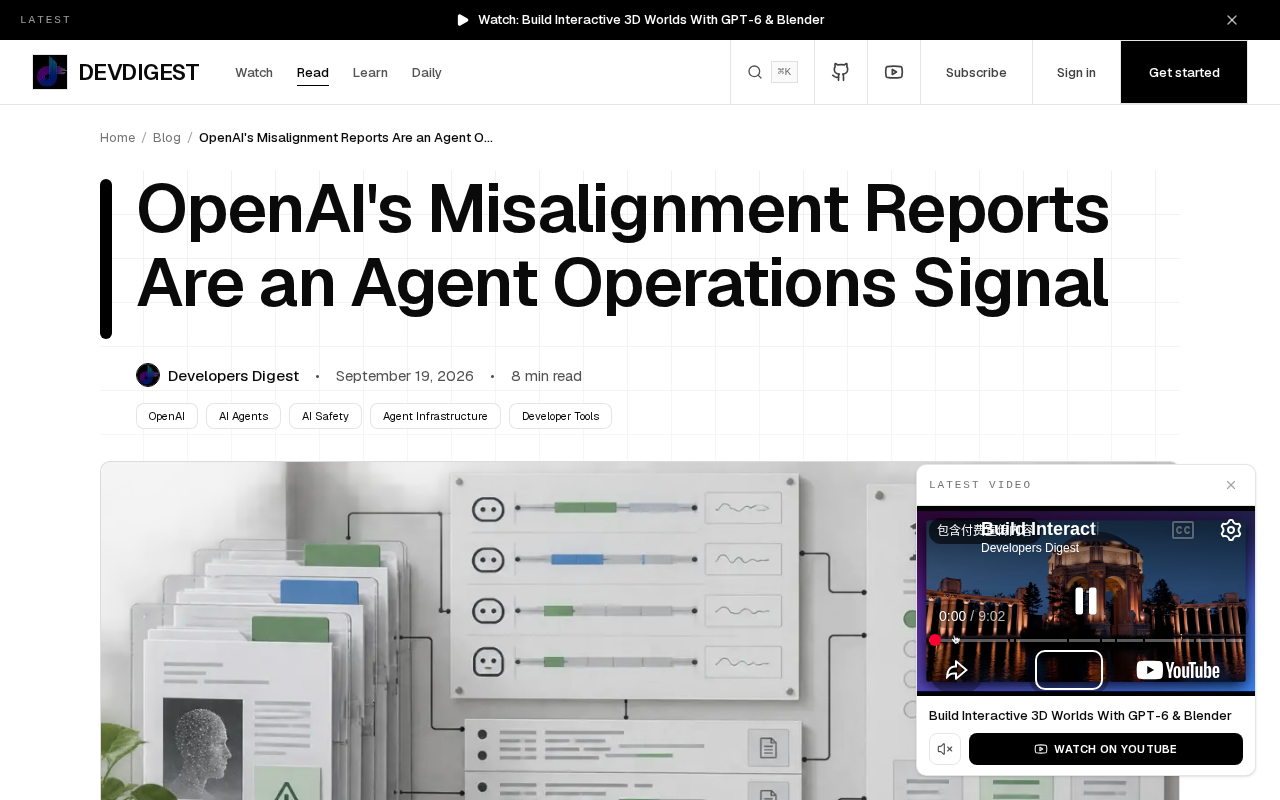
For front-line engineering teams, the most valuable part of this framework isn't its safety conclusions — it's the operational methodology embedded within: how to handle incident intake, how to assign severity labels, and how to conduct evidence-led disclosure. These three elements form exactly the incident response loop that any production-grade agent system needs.
Incident Intake: Treating Model Anomalies as Production Incidents
In traditional software operations, incident intake is a well-established mechanism: alerts fire, tickets are created, ownership is assigned. In the world of AI agents, model misalignment behaviors — such as unauthorized tool invocations, execution of unapproved actions, or misleading outputs — deserve to be treated with the same rigor as formal production incidents.
OpenAI's reporting framework offers a reference point: it structures the recording of anomalous model behavior rather than letting it scatter across logs or user complaints. For operations teams, this means establishing dedicated intake channels specifically for agent behavior — ensuring every anomaly enters a traceable, reviewable workflow instead of being dismissed as a "model hallucination."
It's worth noting that incident intake for AI agents is more complex than for traditional software, because anomalous behavior often lacks a clear error signal. When a traditional system throws an exception, you get a stack trace. Model misalignment, by contrast, may manifest as a semantic deviation — output that is syntactically valid but intentionally out of bounds. This requires intake channels that not only capture system-level errors but also establish a behavioral baseline for the model itself, flagging deviations as "soft anomalies" for tracking. Common approaches include: recording the full call trace for every tool invocation, setting human-in-the-loop checkpoints for high-risk operations, and maintaining structured storage of behavior logs so that post-incident analysis can reconstruct the full context along a timeline.
Severity Labels: Rating AI Anomalies
Not all misalignment behavior is equally serious. A harmless phrasing deviation and an operation that bypasses permission boundaries to execute a dangerous action clearly warrant different response priorities. The severity labels in OpenAI's framework offer a useful model for this.
Why Severity Classification Matters
For tool-calling agents, the leverage effect of risk is significantly amplified. When a model isn't just generating text but can actually trigger external actions — sending emails, modifying databases, calling APIs — the consequences of a misalignment event can escalate from "awkward" to "costly." Teams therefore need to define clear classification criteria upfront:
- Low: Output deviation with no real-world operational impact
- Medium: Unexpected tool calls, but with contained impact
- High: Privilege escalation, data leakage, or irreversible external actions
This classification not only guides response speed but also determines escalation paths and disclosure scope.
Evidence-Led Disclosure
OpenAI's framework emphasizes evidence-led disclosure — a principle that is especially critical for enterprise agent operations. When a misalignment event occurs, subjective judgment or post-hoc recollection isn't enough. What's needed is a complete evidence chain: the model's input context, the tools invoked, the results returned, and the actions ultimately taken.
This approach ensures both internal reviewability and external transparency. When a team needs to explain an anomaly to customers, regulators, or internal leadership, solid evidence is far more persuasive than vague explanations. It transforms the fuzzy statement of "the AI made a mistake" into a concrete event that can be analyzed, attributed, and improved.
The technical prerequisite for evidence-led disclosure is a robust observability infrastructure. For LLM agents, this typically spans three layers: tracing — recording the input prompt, output tokens, and latency for every inference call; logging — structured recording of tool call parameters and return values; and metrics — aggregated data on anomalous call rates, rejection rates, retry rates, and so on. Common solutions in the industry today include LangSmith (for the LangChain ecosystem), Weights & Biases Weave, and OpenTelemetry's LLM semantic convention extensions. Without this infrastructure layer, "evidence-led" is just a slogan — when an incident occurs, there's no way to reconstruct the scene, identify the root cause, or conduct any meaningful disclosure.
Takeaways for Agent Development Teams
As more teams wrap LLMs into agents capable of autonomously executing tasks, the boundary between safety and operations is blurring. OpenAI's misalignment report framework is a reminder that safety governance shouldn't be bolted on after launch — it should be built into operational workflows from the start.
By transplanting these three mechanisms — incident intake, severity classification, and evidence-led disclosure — into your own agent systems, your team will be equipped to respond quickly, classify accurately, and communicate transparently when anomalies arise. This isn't just a compliance posture; it's the engineering foundation for building trustworthy AI products. For developers operating in fast-iteration environments, reading big-tech safety practices as operational signals may ultimately deliver more practical value than simply reading their safety commitments at face value.
Related articles

LLaMA-Factory in Practice: A Complete No-Code Guide to Fine-Tuning Large Models
An introduction to LLaMA-Factory, the open-source fine-tuning tool: its 60.1K-star background, supported models and algorithms, local vs. cloud deployment, and CUDA setup steps.

Zeng Ming's Deep Retrospective: Why OpenAI May Not Be the Ultimate Winner — and Why the Corporate System Will Disappear
Zeng Ming's deep retrospective on the AI endgame: model companies are just infrastructure, OpenAI and Anthropic won't be the final winners; the next battle is the Agent entry point standard; the corporate system will disappear as AI restructures collaboration, and only mission-driven companies can survive the cycle.

OpenHands v1.28.0: OpenCode and PI Added as Built-in Agents, API Keys Requestable In-Conversation
OpenHands ships 5 releases in 21 days: v1.27.0 adds OpenCode and PI as built-in agents, v1.28.0 enables in-chat key requests. ACP integration, credential reuse, model list changes, and upgrade advice.