OpenAI Open-Sources Codex Security CLI: An AI-Powered Code Security Scanning Tool

OpenAI open-sources Codex Security CLI, bringing AI-powered security scanning to developer command-line workflows.
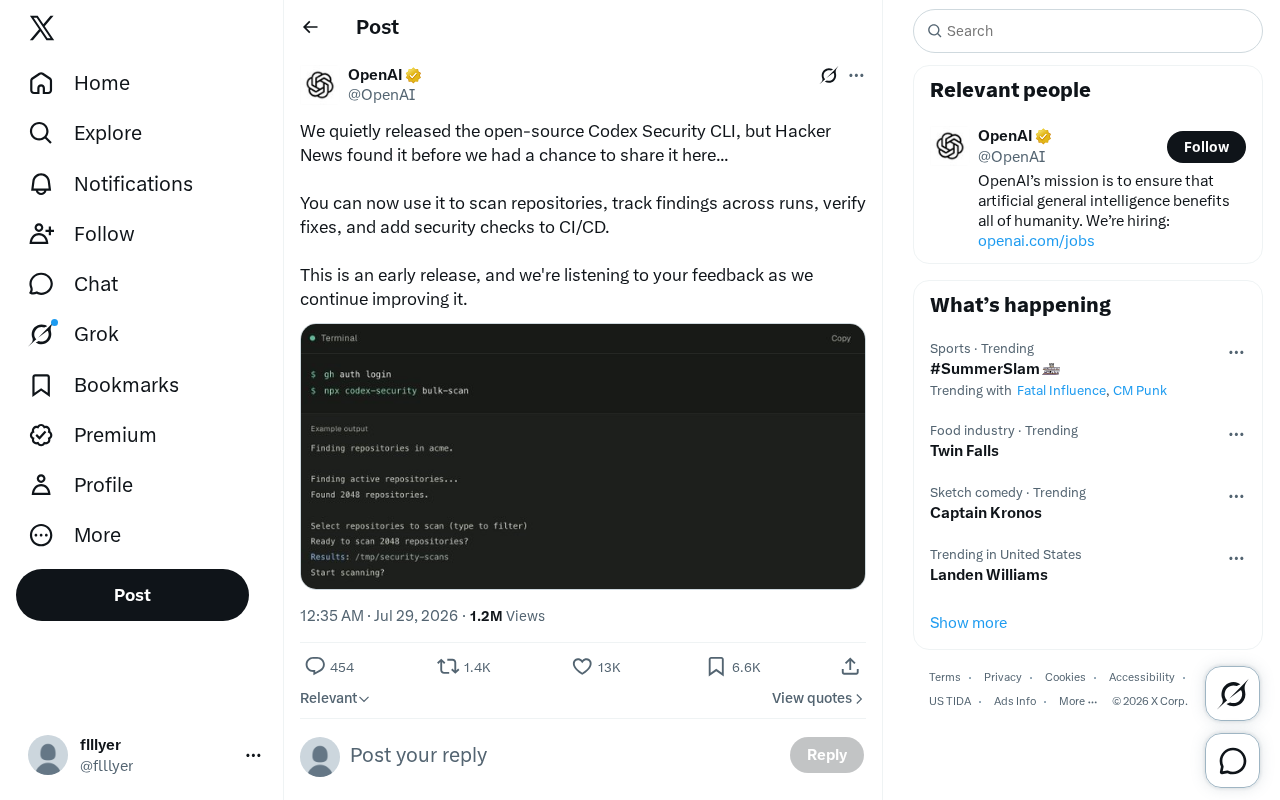
OpenAI has quietly open-sourced Codex Security CLI, an early-release tool that brings AI-driven security capabilities directly to developers' command lines. It offers repository scanning, cross-run finding tracking, fix verification, and CI/CD pipeline integration, enabling shift-left security practices. The tool leverages LLM semantic understanding to complement traditional SAST tools, reducing false positives and lowering security knowledge barriers for development teams.
An "Accidentally Early" Open-Source Release
OpenAI recently quietly released the open-source Codex Security CLI tool. Before the team even had a chance to formally announce it on social media, the Hacker News community had already discovered and hotly discussed it. This "discovered" style of release isn't uncommon in the open-source world — high-quality tools often spread organically through GitHub activity feeds, package manager updates, and other channels before any official promotion.
According to OpenAI's official statement, this is an early release, and the team has explicitly stated they are actively collecting user feedback and will continue to iterate and improve. This means that while the current features are functional, the tool is still in a phase of rapid evolution, and developers should exercise caution when using it in production environments.
Codex Security CLI: Core Features Explained
The positioning of Codex Security CLI is crystal clear — it brings AI-powered security checking capabilities directly into developers' command-line workflows. According to the official introduction, the tool provides the following key capabilities:
Scan Repositories
The tool can perform security scans across entire code repositories, identifying potential vulnerabilities and risk points. Compared to traditional Static Application Security Testing (SAST) tools, the Codex model-based scanning capability demonstrates stronger performance in understanding code semantics and identifying complex logic vulnerabilities.
Traditional SAST tools (such as SonarQube, Checkmarx, Fortify, etc.) primarily rely on predefined rule pattern matching and data flow analysis to discover vulnerabilities. Their strengths lie in broad coverage and fast execution, but their limitations are also apparent: rule databases require continuous manual maintenance, they have limited ability to detect complex business logic vulnerabilities, and false positive rates are typically high — developers often spend significant time filtering out genuine security issues. LLM-based security scanning tools compensate for these shortcomings through deep semantic understanding, judging whether a piece of code poses a real security risk based on understanding the code's intent, rather than simply matching dangerous function call patterns.
Track Findings Across Runs
This is a highly practical feature. Security scanning is rarely a one-time activity — it needs to be performed repeatedly at different stages of a project. The CLI can track security findings across multiple runs, helping teams understand which issues are newly discovered, which have existed previously, and which are being addressed, thereby avoiding redundant work and information loss.
This cross-run state tracking capability is extremely important in practical security governance. Without this mechanism, every scan generates a complete report, and developers must manually compare results to identify incremental changes — virtually infeasible in large codebases. Codex Security CLI persists finding identifiers and states, upgrading security governance from "point-in-time detection" to "continuous monitoring." This reflects the "continuous assurance" philosophy emphasized in Security Operations (SecOps), now embodied in development tooling.
Verify Fixes
Discovering problems is only the first step — confirming that issues are truly fixed is equally critical. The tool supports verification of fix results, creating a closed-loop design that makes security governance more complete. After developers submit a fix, they can use the CLI directly to confirm whether the vulnerability has been effectively resolved.
This fix verification capability addresses a common pain point in security governance: developers believe they've fixed an issue, but the fix may actually be incomplete (for example, handling one code path while missing another), or the fix itself may introduce new security problems. AI models can judge from a semantic level whether a fix truly eliminates the root cause of a vulnerability, rather than merely checking whether specific lines of code have been modified.
CI/CD Pipeline Integration for Shifting Security Left
Perhaps most notably, Codex Security CLI supports integrating security checks directly into CI/CD pipelines. This design aligns with the "Shift Left Security" philosophy that has been emphasized in the software engineering field in recent years — moving security detection as early as possible in the development process, rather than waiting until just before deployment or even after going live to discover issues.
Shift Left is a core concept in the DevSecOps movement. Its name derives from the timeline representation of the software development lifecycle — if you arrange the development process from left to right (Requirements → Design → Coding → Testing → Deployment → Operations), traditional security testing typically sits on the right side during testing and deployment phases. According to research data from the IBM Systems Sciences Institute, the cost of finding and fixing defects during the design phase is only 1/100th of the cost of discovering issues in production. Therefore, moving security detection forward to the coding phase fundamentally reduces the time and financial cost of security remediation.
By embedding automated security checks in CI/CD pipelines, teams can automatically trigger scans on every code commit or merge. Once critical vulnerabilities are discovered, the process can be blocked, fundamentally reducing the probability of security risks reaching production. In terms of technical implementation, CLI tools are naturally suited for pipeline integration — they can communicate pass/fail status to platforms like GitHub Actions, GitLab CI, and Jenkins through exit codes, generate structured report formats like SARIF through standard output, and run stably in containerized environments without requiring a graphical interface. This automated, orchestratable capability is the inherent advantage of command-line tools over graphical products.
A New Industry Trend in AI Code Security Tools
From an industry perspective, OpenAI's release of Codex Security CLI reflects a clear trend: large model capabilities are extending from code generation into deeper scenarios like code security and code auditing. In the past, Codex was primarily known for its code completion and generation abilities (it was one of the technologies behind the early versions of GitHub Copilot). Applying the same model capabilities to security detection is a natural and valuable expansion.
It's worth looking back at the evolution of the Codex model itself, which demonstrates OpenAI's strategic deepening in the code intelligence domain. The original Codex model was released in 2021, fine-tuned from GPT-3 for code tasks, serving as the core engine of GitHub Copilot's first-generation product. With the release of GPT-4 and subsequent models, code understanding and generation capabilities achieved a qualitative leap. The recently revived "Codex" brand has evolved from a pure code generation tool into a broader software engineering AI agent platform, capable of autonomously executing coding, testing, and debugging tasks in sandboxed environments. The release of Security CLI marks the Codex brand's further extension toward code quality and security assurance, forming a complete capability chain from "writing code" to "reviewing code" to "protecting code."
For development teams, AI-powered security tools offer several significant advantages:
- Strong semantic understanding: Able to understand code context, reducing false positives from traditional rule engines
- Lowering the security knowledge barrier: Explaining vulnerability causes and fix recommendations in natural language
- Continuous self-evolution: Detection capabilities improve continuously with model iterations, eliminating the need to manually maintain large rule databases
It's important to note that AI security tools are not meant to completely replace existing security toolchains. Current enterprise application security systems typically encompass multiple layers: SAST (static analysis), DAST (Dynamic Application Security Testing, which discovers vulnerabilities by actually running the application), SCA (Software Composition Analysis, used to detect known CVE vulnerabilities in open-source dependencies), and IAST (Interactive Application Security Testing). AI-powered tools are better suited as a complementary layer — for example, SCA discovers dependency vulnerabilities through deterministic CVE database matching, where AI offers no clear advantage. However, when detecting business logic vulnerabilities, insecure API call patterns, and context-dependent permission issues, AI's semantic understanding can uncover "unknown unknown" risks that rule engines struggle to cover.
Of course, as an early release, the actual detection accuracy, coverage scope, and compatibility with existing security toolchains still need to be validated by the community in real-world scenarios. OpenAI's "low-key release, open feedback" approach also indicates the team's desire to leverage the open-source community's power to collectively refine this tool.
Summary
The open-sourcing of Codex Security CLI is another important signal of AI programming tools extending into the security domain. It integrates repository scanning, finding tracking, fix verification, and CI/CD integration into a unified command-line tool, providing developers with a complete closed-loop code security governance solution.
Although it's still an early release, its open-source nature and OpenAI's technical backing make it worthy of continued attention from developers and security professionals. For teams looking to introduce AI security capabilities into their development workflows, now is a great time to try it out and participate in providing feedback.
Related articles
AI Programming at Xiamen University: A Full Breakdown from Textbook to Teaching
Xiamen University's Lin Ziyu shares how he built an AI programming course — covering three coding eras, Claude Code's production-ready milestone, three methodologies, and a fully free, reproducible curriculum design.

A DeepSeek Researcher's Confession: The AI He Trained Is About to Replace Him
DeepSeek V4.1 kernel engineer Liu Shengyu admits the AI he trained will surpass his own skills within a year—yet he keeps pushing forward. Here's why.
n8n Automation in Practice: How AI Workflows Help SMBs Cut Costs and Boost Efficiency
Learn how SMBs use n8n and AI tools to automate multi-platform messaging, AI customer service replies, and bulk exam data entry — real-world workflows for cutting costs.