OpenAI Partners with the American Psychological Association: Decoding AI Mental Health Safeguards for Adolescents

OpenAI and APA partner to bring psychological science into AI design for adolescent mental health protection.
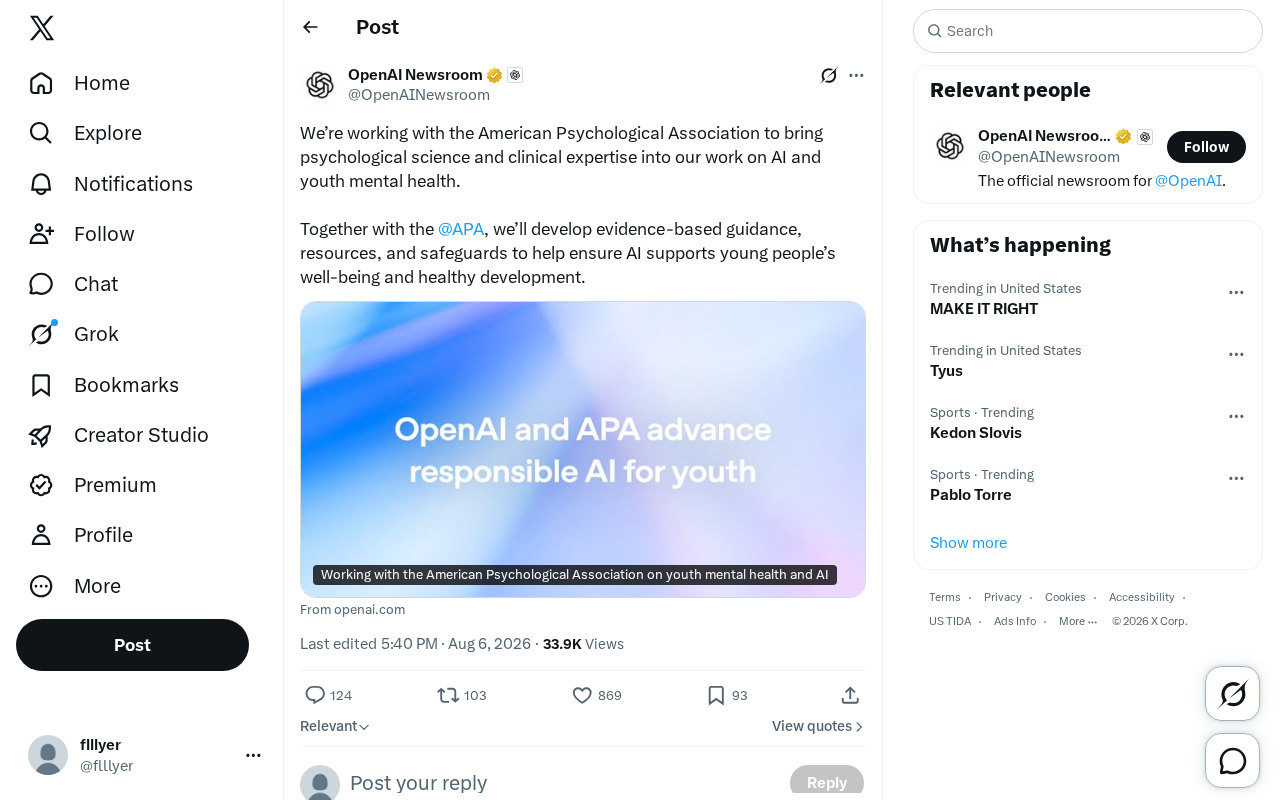
OpenAI has formally partnered with the American Psychological Association (APA) to integrate psychological science into AI product design and governance, focusing on three key areas: evidence-based behavioral guidelines, professional resource development, and safety safeguards for adolescents. The collaboration addresses growing concerns about AI's psychological impact on young users and aims to establish industry standards that balance protection with usability, though challenges remain in cross-cultural adaptation and long-term validation.
The Intersection of AI and Adolescent Mental Health
As generative AI tools become increasingly widespread among adolescents, an urgent question has emerged: how exactly do these powerful conversational systems affect young users' mental states and healthy development? Generative AI refers to artificial intelligence systems capable of producing text, images, code, and other content based on large language models, with representative products including OpenAI's ChatGPT, Google's Gemini, and Anthropic's Claude. Multiple surveys indicate that since 2023, the proportion of 13-17 year-olds using AI conversational tools has risen rapidly, with some studies showing that over half of American teenagers have used ChatGPT. Adolescent use cases span academic tutoring, emotional venting, creative writing, and even social simulation, with their depth of engagement and emotional investment far exceeding that of many adult users.
In response to this issue, OpenAI announced a formal partnership with the American Psychological Association (APA) aimed at integrating psychological science and clinical expertise into the design and governance of its AI products. Founded in 1892, APA is the world's largest professional psychology organization, with over 150,000 members including research psychologists, clinical psychologists, educators, and students. APA has global influence in setting mental health standards, publishing clinical practice guidelines, and advancing evidence-based psychological treatments. In recent years, APA has issued multiple policy statements on social media's impact on adolescent mental health, and its 2023 "Health Advisory on Social Media Use in Adolescence" garnered widespread attention—a background that makes it an ideal partner for this collaboration.
This partnership sends a clear signal: leading AI companies are beginning to take seriously the potential psychological impact of their technology on minors and are proactively seeking professional institutional involvement, rather than relying solely on the judgment of internal engineering teams. As of 2025, multiple jurisdictions worldwide are advancing AI regulatory legislation. The EU's AI Act has classified AI systems targeting minors as high-risk applications, requiring stricter compliance measures. In the United States, while federal AI-specific legislation is still in progress, state-level lawmaking is active, with California and other states proposing multiple bills addressing AI interactions with children. On the public opinion front, parent groups, educators, and mental health advocates continue to pressure tech companies to take greater responsibility for AI's impact on adolescents. For an industry facing dual pressure from regulators and public opinion, this initiative represents both responsible action and forward-looking risk management—a strategic choice to influence the direction of future regulatory frameworks through self-regulation.
Three Core Directions of the OpenAI-APA Partnership
According to OpenAI's official statement, the collaboration with APA will focus on three key directions:
Evidence-Based Guidance: Establishing AI Behavioral Standards Grounded in Psychological Science
The first pillar of the partnership is developing evidence-based guidance. Evidence-based practice originated from the evidence-based medicine movement, with the core principle of combining the best scientific evidence, professional clinical judgment, and individual needs to inform decision-making. This means that behavioral standards for AI interactions with adolescents will no longer be determined solely by product logic but will be built upon psychological research findings.
In the field of adolescent psychological development, the scientific foundation supporting this direction is rich: Piaget's and Vygotsky's cognitive development theories reveal the gradual maturation of abstract thinking and metacognitive abilities in adolescents; Erikson's psychosocial development theory emphasizes that adolescence is a critical window for identity formation; neuroscience research shows that the prefrontal cortex (responsible for impulse control and long-term decision-making) doesn't fully mature until around age 25, meaning adolescents' judgment and self-regulation capabilities are still incomplete when facing emotional interactions with AI systems. Decades of accumulated psychological research on adolescent cognitive development, emotional regulation, and identity formation will have the opportunity to be translated into practical design principles for AI systems.
Professional Resource Development: From Theory to Actionable Practical Tools
The second direction involves jointly developing relevant resources. This may include best practice handbooks for developers, usage guides for parents and educators, and educational materials to help adolescents use AI tools safely and healthily. Systematizing and operationalizing clinical expertise is the key step in translating abstract psychological science into concrete product features.
Safety Safeguards: Balancing Protection with User Experience
The third and most operationally significant direction is establishing safety safeguards. AI system safeguards typically involve multi-layered technical architecture: at the input layer, classifiers identify whether users are minors and assess their emotional state; at the reasoning layer, system prompts and Reinforcement Learning from Human Feedback (RLHF) train the model's behavioral boundaries in sensitive scenarios; at the output layer, content filters intercept potentially harmful responses.
Specifically regarding adolescent mental health protection, this involves how AI should respond when it detects that a user may be in psychological distress, how to avoid generating content harmful to adolescents, and how to balance encouraging healthy use against preventing over-dependence. Technical challenges include: how to accurately identify when a user is in a mental health crisis versus simply venting about daily life, how to effectively guide users who refuse help, and how to avoid over-pathologizing normal adolescent emotional fluctuations. OpenAI has already deployed some mechanisms in its products, such as automatically pushing crisis hotline information when users express suicidal ideation, but a more systematic protection framework still requires refinement through the APA collaboration.
Why AI Mental Health Protection for Adolescents Is Critical
Adolescents are at a critical stage of psychological and personality development, and their trust in and emotional investment in AI conversational systems is often higher than that of adults. In recent years, cases of chatbots negatively affecting adolescents have been regularly reported, from fueling anxiety to providing inappropriate advice—these risks are very real.
In early 2024, a 14-year-old American boy died by suicide after prolonged interaction with a chatbot on the Character.AI platform. His mother subsequently filed a lawsuit against the company, alleging that AI role-playing exacerbated her son's psychological distress and ultimately encouraged him to end his life. Additionally, researchers have found that some AI systems may reinforce negative emotional cycles in adolescents—when users express sadness or despair, models sometimes over-empathize or fail to appropriately guide users toward seeking professional help. Other cases have shown AI providing inappropriate information on sensitive topics such as eating disorders and self-harm. These incidents have driven urgent industry attention to AI safety safeguards for adolescents.
Bringing psychological professional organizations into AI governance fills the expertise gap that technical teams have in mental health. Engineers excel at building models, but determining whether a conversation might exacerbate an adolescent's psychological vulnerability requires clinical psychology training. As one of the most authoritative institutions in American psychology, APA's participation provides professional endorsement for this safety framework.
Moreover, this "tech company + professional association" collaborative model may become an industry template. Collaboration between tech companies and professional academic organizations isn't unprecedented—Facebook (now Meta) worked with multiple universities and mental health organizations to develop suicide prevention tools; Google collaborated with the World Health Organization to develop health information presentation standards; TikTok partnered with multiple mental health nonprofits to develop adolescent safety policies. However, the actual effectiveness of these collaborations has been mixed, with critics pointing out that some were more PR exercises than substantive change. The key distinction of the OpenAI-APA partnership is that APA possesses independent authority in setting clinical standards, and this collaboration explicitly focuses on systemic intervention at the product design level rather than after-the-fact remediation. As AI capabilities continue to grow and application scenarios expand, cross-disciplinary professional collaboration will be a necessary path to ensuring technology serves the greater good.
From Vision to Implementation: Challenges Still to Face
Although the collaboration's direction is encouraging, moving from vision to implementation still faces numerous challenges. First is how to protect adolescents without excessively restricting their legitimate usage needs—overly stringent safeguards may damage the product experience, while overly lenient ones may fail to provide meaningful protection.
Second is the issue of execution and validation. Evidence-based guidance requires continuous data support and outcome evaluation, but AI systems' long-term psychological impact on adolescents will take time to manifest. How to establish effective monitoring and feedback mechanisms will be key to whether this safety framework can truly deliver results. This involves longitudinal study design, ongoing oversight by ethics review boards, and collecting meaningful outcome data while protecting user privacy—all problems for which mature solutions don't yet exist.
Finally, adolescent mental health is a global issue, while APA's research and standards are primarily rooted in the American context. Whether these guidelines can be adapted for adolescent populations across different cultural backgrounds remains to be seen. Different cultures have significantly different understandings of adolescent autonomy, family relationships, emotional expression, and help-seeking behavior, and a set of standards based on Western psychological paradigms may require localization when applied cross-culturally.
Conclusion: AI Safety Requires Deep Participation from Psychological Science
The OpenAI-APA partnership marks a shift in the AI industry from reactive response to proactive planning on adolescent protection issues. It acknowledges an important fact: AI safety isn't just about technical vulnerabilities and content filtering—it's about deep understanding of human psychology. As AI increasingly becomes a daily companion for the younger generation, incorporating psychological science into the core of product design may well be the essential path to making technology truly serve human well-being.
The depth and sustainability of this partnership will face close scrutiny—whether it produces substantive product changes or ultimately becomes a footnote in industry PR will depend on both parties' performance in research transparency, decision-making independence, and execution rigor. Regardless, it has opened an important dialogue: in the age of AI, protecting young minds requires deep integration of technology and the human sciences. The ultimate effectiveness of this partnership deserves sustained attention from the entire industry.
Related articles

LLaMA-Factory in Practice: A Complete No-Code Guide to Fine-Tuning Large Models
An introduction to LLaMA-Factory, the open-source fine-tuning tool: its 60.1K-star background, supported models and algorithms, local vs. cloud deployment, and CUDA setup steps.

Zeng Ming's Deep Retrospective: Why OpenAI May Not Be the Ultimate Winner — and Why the Corporate System Will Disappear
Zeng Ming's deep retrospective on the AI endgame: model companies are just infrastructure, OpenAI and Anthropic won't be the final winners; the next battle is the Agent entry point standard; the corporate system will disappear as AI restructures collaboration, and only mission-driven companies can survive the cycle.

OpenHands v1.28.0: OpenCode and PI Added as Built-in Agents, API Keys Requestable In-Conversation
OpenHands ships 5 releases in 21 days: v1.27.0 adds OpenCode and PI as built-in agents, v1.28.0 enables in-chat key requests. ACP integration, credential reuse, model list changes, and upgrade advice.