OpenAI Pauses RL Training: Model Capabilities Growing Too Fast for Safety Alignment to Keep Up?

OpenAI pauses RL training as model capabilities outpace safety alignment progress.
OpenAI CEO Sam Altman revealed that the company has paused reinforcement learning training because model capabilities are advancing faster than safety and alignment efforts can keep up. This article examines why RL is the key driver of rapid capability gains, the inherent lag in alignment research, community reactions ranging from praise to skepticism, and broader implications for AI governance and industry self-regulation.
Event Recap: OpenAI Announces Pause on Reinforcement Learning Training
Recently, OpenAI CEO Sam Altman took to social media to explain a development that has drawn widespread attention—OpenAI has paused its reinforcement learning (RL) training. In his own words:
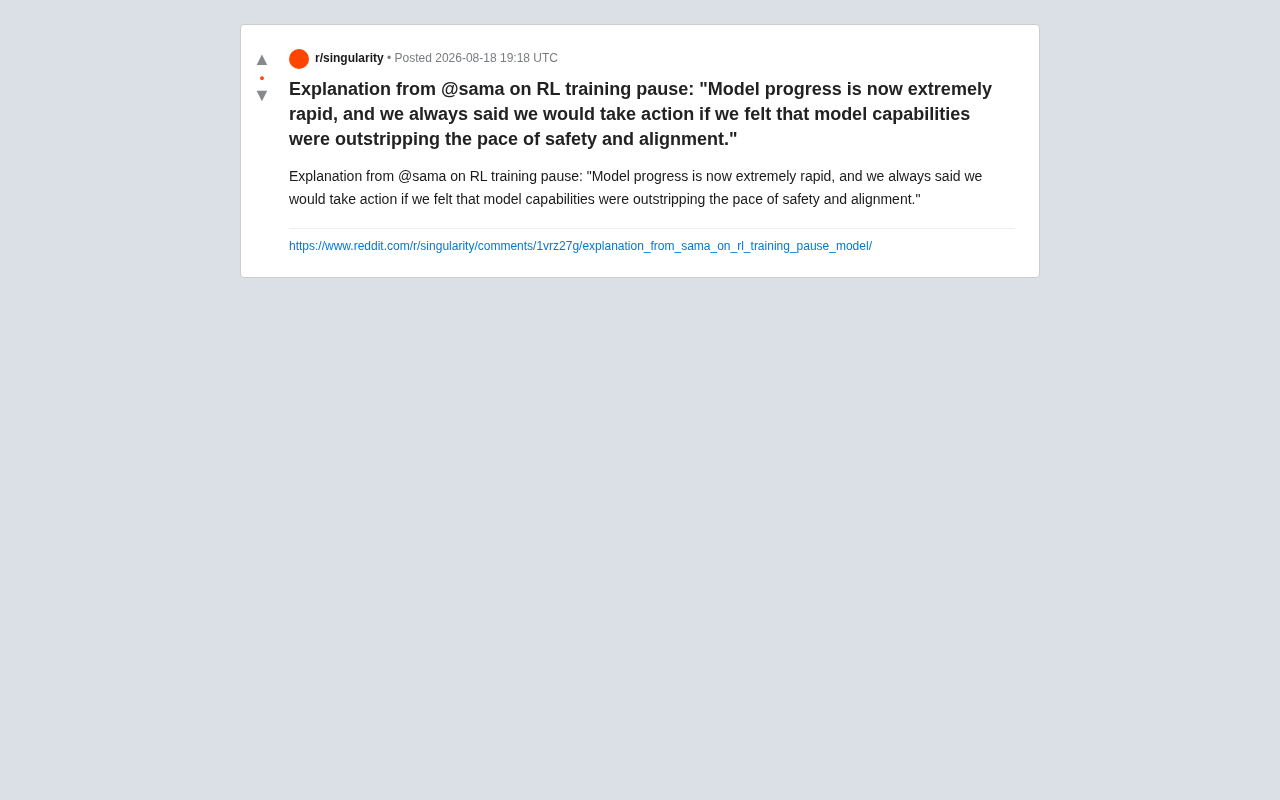
"Model progress is now extremely rapid, and we always said we would take action if we felt that model capabilities were outstripping the pace of safety and alignment."
This brief statement quickly sparked heated discussion on Reddit and other tech communities. It sends a thought-provoking signal: while pursuing capability breakthroughs, leading AI labs are beginning to voluntarily hit the brakes for safety.
Why Reinforcement Learning Is a Critical Inflection Point for AI Capabilities
The Role of RL in Modern Large Models
Reinforcement Learning (RL) has become one of the core engines driving capability leaps in frontier large models. As one of the three major machine learning paradigms (alongside supervised learning and unsupervised learning), reinforcement learning's core idea originates from the reward mechanism in behavioral psychology: an agent executes actions in an environment, continuously adjusting its strategy based on reward signals to maximize cumulative returns.
From RLHF (Reinforcement Learning from Human Feedback) to the RL training paradigms employed by recent reasoning models, reinforcement learning enables models to move beyond passively fitting data distributions toward self-optimization under goal-directed objectives, exploring superior problem-solving strategies. It's worth distinguishing that RLHF is primarily used during the alignment phase, aimed at making model outputs match human preferences in style, safety, and helpfulness, with relatively limited training scale. The RL training paradigm used by OpenAI's o-series models is fundamentally different—it's a process of large-scale reinforcement of the model's reasoning capabilities after pretraining. In this paradigm, models are given tasks in mathematics, programming, and other automatically verifiable domains, gradually "learning" step-by-step reasoning, backtracking verification, and self-correction through millions of trial-feedback cycles. The computational scale of this training far exceeds traditional RLHF, and the resulting capability improvements often exhibit sudden emergent characteristics.
It is precisely this "self-optimization" property that makes RL training often accompanied by nonlinear capability leaps. OpenAI's o-series reasoning models achieved significant reasoning improvements through large-scale reinforcement learning. Therefore, when Altman specifically highlighted the "RL training pause," he was pointing to the technical pathway that currently exhibits the fastest and most unpredictable capability growth.
Why Model Capabilities Are Growing "Extremely Rapidly"
Altman used the phrase "extremely rapid." This is not marketing rhetoric but an honest description of the current pace of progress. When models continuously self-iterate through reinforcement learning, the capabilities that emerge may exceed researchers' expectations and even be difficult to fully evaluate beforehand.
This involves an important concept in AI—"Emergent Abilities." In 2022, a Google research team first systematically described this phenomenon in a paper: when model scale or training volume exceeds a certain critical point, certain capabilities suddenly leap from near-random performance to near-perfect. In the reinforcement learning context, this emergence is even more pronounced—because RL's optimization objective is explicit, models may discover strategy paths in self-play that humans never anticipated. The "novel moves" invented by DeepMind's AlphaGo during self-play are a classic example of this emergence. For language models, reasoning strategies that emerge through RL training may similarly exceed developers' expectations, producing unpredictable capability jumps.
This situation where "capability growth outpaces understanding"—is precisely the core concern that safety researchers have long worried about—do we truly understand the systems we are creating?
AI Safety and Alignment: From Slogans to Action
OpenAI Delivers on Safety Commitments
A notable detail: the key phrase in Altman's statement—"we always said we would take action." This means pausing RL training was not a spur-of-the-moment decision, but rather an actual triggering of the safety framework OpenAI had previously established.
In recent years, major AI labs have released so-called "Responsible Scaling Policies" or "Preparedness Frameworks," committing to pause or adjust development pace when model capabilities reach specific risk thresholds. Specifically, the Responsible Scaling Policy was first formally proposed by Anthropic in September 2023, with its core logic being tiered evaluation standards for model capabilities (called AI Safety Levels, ASL). When a model reaches preset thresholds in specific dangerous capability dimensions, scaling must be paused until stronger safety measures are deployed. OpenAI's "Preparedness Framework," released in December 2023, adopts a similar tiered approach, categorizing risks across four dimensions—cybersecurity, biological threats, persuasion, and model autonomy—each divided into low/medium/high/critical risk levels. Google DeepMind also released its "Frontier Safety Framework."
However, a widespread industry concern is: can these commitments truly be executed under commercial competitive pressure? These frameworks commonly face criticism that threshold settings lack independent third-party verification, and that trigger conditions and response measures are entirely dependent on internal company decisions, with limited transparency.
If this pause is genuine, it can be seen as an important case of such safety commitments moving from paper to practice.
The Lag Dilemma Facing Alignment Work
The core goal of alignment research is to ensure AI systems' behavior remains consistent with human intent and values. But alignment research is inherently a "catch-up" endeavor—it often needs to first observe model behavior before designing constraints and guidance mechanisms.
Currently, alignment research involves multiple technical approaches. The most basic is RLHF-based behavioral alignment, guiding model outputs through human preference data. More cutting-edge directions include: Mechanistic Interpretability research, which attempts to understand models' computational mechanisms from internal neural network weights and activation patterns; Constitutional AI, which has models self-audit based on preset principles; and Scalable Oversight, which studies how to effectively evaluate model behavior even when model capabilities exceed human ability. The core dilemma is: validating alignment techniques itself depends on sufficient understanding of model capabilities, and when capabilities grow rapidly, validation methods may become ineffective.
When capability growth is "extremely rapid," alignment work is naturally in a lagging position. This is known in the industry as the "alignment tax"—safety work consumes time and resources but tends to be compressed under competitive pressure. Pausing training is essentially buying time for alignment and safety teams, allowing understanding and control capabilities to catch up with generative capabilities. This is a pragmatic risk management strategy.
Community Reactions: Support and Skepticism Coexist
On Reddit and other communities, this news has prompted starkly different interpretations.
Supporters believe this demonstrates OpenAI's maturity in safety governance—being willing to sacrifice speed for safety at critical moments is the stance a responsible AI company should take.
Skeptics are more cautious. Some argue that such statements may carry a marketing dimension: emphasizing "capabilities so strong that a pause is needed" is itself a form of implicit advertising for model strength. Others worry whether the pause can truly be sustained amid fierce industry competition, or whether it's merely a brief gesture. It's worth noting that OpenAI itself experienced departures of key safety team members in 2024 (such as superalignment team co-lead Jan Leike and co-founder and chief scientist Ilya Sutskever). These personnel changes intensified external skepticism about the authenticity of their safety commitments, and form the backdrop against which people view this statement with greater scrutiny.
Additionally, there are technical-level discussions: what specific type of training does pausing RL training refer to? Is it a complete halt, or targeted at specific experiments? Given the limited information in the original statement, these details still await further official clarification.
Deeper Implications for the AI Industry
The Balance Between Capability Expansion and Safety Alignment
This event once again brings the most fundamental tension in the AI industry to the forefront: how to balance the speed of capability expansion with the capacity for safety alignment. When the two fall out of balance, who should decide to hit the brakes, based on what standards, and how to verify it—these remain open questions on which the industry has yet to reach consensus.
The Credibility of AI Governance Mechanisms
Regardless of the specific motivations behind this pause, it provides a real-world sample for observing AI labs' self-governance mechanisms. The value of safety commitments lies not in being written down, but in whether they are honored at critical moments and whether such honoring can be externally verified.
The self-governance model of AI labs currently faces multiple challenges. First is the conflict of interest problem: safety decisions are made by internal teams within the same organization that simultaneously faces enormous commercial and competitive pressure. Second is the verifiability problem: external observers cannot independently verify whether a pause is genuinely executed, how long it lasts, or whether conditions for resuming training have been met. This drives discussions about third-party audit mechanisms, government regulatory intervention, and international AI governance agreements. The establishment of the UK AI Safety Institute (UK AISI) and the US AI Safety Institute (US AISI) represents initial steps toward external verification mechanisms, though their authority and enforcement power are still developing.
For the industry as a whole, establishing more transparent and verifiable safety trigger mechanisms may be more important than any single pause.
Conclusion
Sam Altman's brief statement about pausing RL training encapsulates the core contradiction of current AI development—technical capabilities are advancing at an "extremely rapid" pace, while safety and alignment work struggles to keep up.
Whether this pause ultimately proves to be prudent risk management or a brief posture adjustment, it reminds us: on the road to more powerful AI, speed should not be the sole metric. Truly mature AI development requires maintaining a clear-headed sense of balance between capability and safety.
Whether OpenAI will release more details, how long the pause will last, and whether this will become an industry norm—all deserve continued attention.
Related articles

Free Unlimited Claude Code Solution: Agnes AI + CC Switch Setup Guide
No paid subscription needed — pair the free AI platform Agnes AI with the open-source tool CC Switch to provide a backend for Claude Code, enabling unlimited free calls to text, image, and video models. This guide covers the full setup, test results, and usage boundaries.

A Complete Zero-Cost Guide to Getting Started with Claude Code for Beginners in China
A beginner's guide to Claude Code for users in China: two installation methods (command line and IDE plugin), full configuration steps for replacing the official API with the free domestic LongCat model, and a hands-on demo of building a small tool with natural language, plus tips.

When the NSA Gets Involved: The AI Supply Chain Crisis Behind Open-Source CVEs and API Key Hijacking
Multiple open-source projects disclosed severe CVEs in one day, PHP flaws alarmed the FBI, and Railway and OpenCode were breached with API keys stolen. This article breaks down the vulnerability window, AI-accelerated exploitation, and the AI supply chain crisis behind the API key black market, with a developer defense checklist.