OpenAI Places Ads Inside ChatGPT Image Generator: The New AI Advertising Battleground

OpenAI will place ads in ChatGPT's image generator, with the first US advertisers going live before November.
OpenAI announced it will show ads in ChatGPT's image generator later this month, with the first US advertisers going live before November, covering free-tier and $8 Go plan users while paid subscribers remain ad-free. The ad business is growing fast, hitting $1 billion in annualized revenue in under 200 days, with 1.2 billion weekly active users. More notably, measurement capabilities are being upgraded: OpenAI is integrating Hightouch, Tealium, LiveRamp, and multiple attribution tools, plus a Conversions API, Event Quality Score, and a one-day view-through window, letting advertisers optimize with first-party data. Early cases show WeightWatchers with 15.3% lower CPA than paid search, Dose with 67% net-new customers among incremental purchases, and Portland Leather with 93% of ChatGPT visitors being new. Image ads change creative logic — the intent behind user-generated images can't be captured by keywords, and early movers will get a brief window of advantage.
OpenAI Places Ads Inside ChatGPT Image Generator: The New AI Advertising Battleground
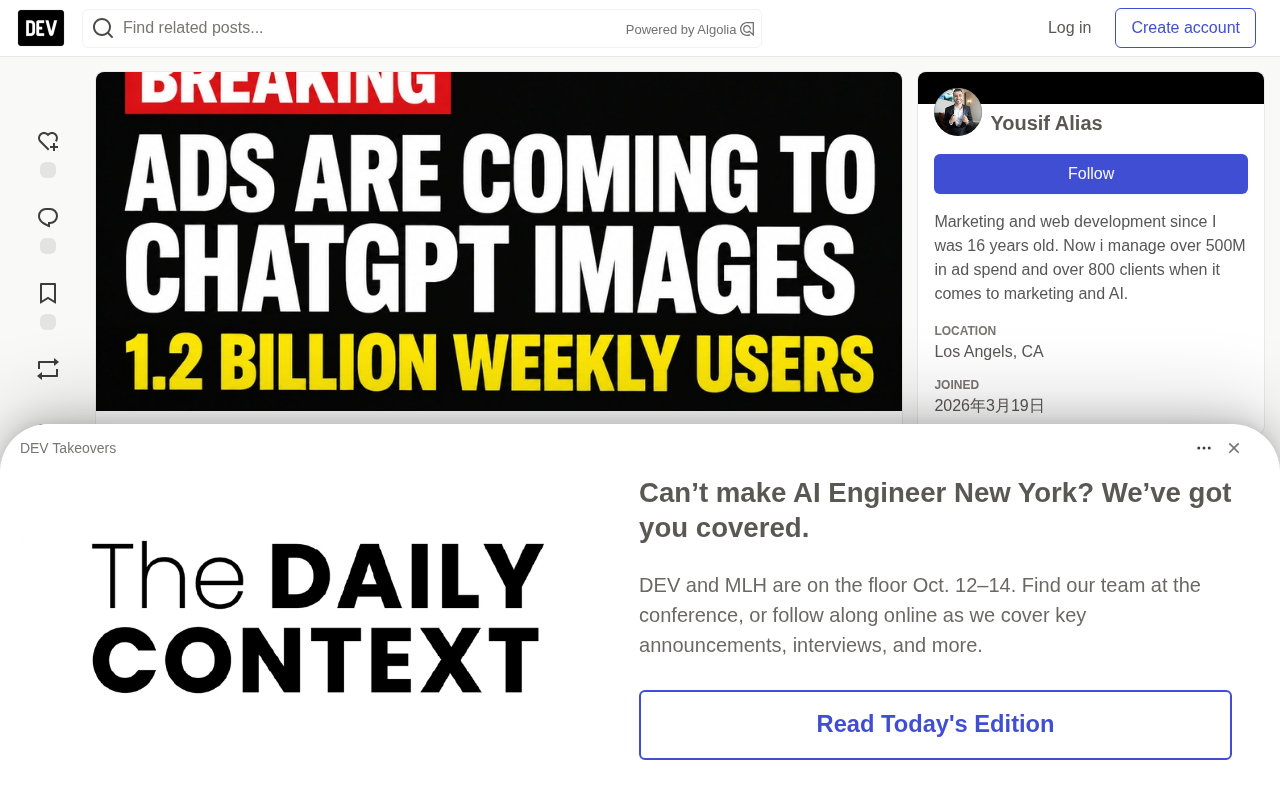
According to an official OpenAI announcement, the AI giant will begin displaying ads in ChatGPT's image generator later this month. This marks the first time a mainstream AI company has sold ad placements at the moment users create images, pushing brands directly in front of the 1.2 billion weekly users OpenAI currently reports. The first wave of US advertisers will go live before November.
What exactly did OpenAI announce?
The new ad unit appears while ChatGPT is generating an image. OpenAI emphasizes that every ad is clearly labeled and kept separate from the image the user requested. Advertisers can use this space to showcase products, use cases, or service capabilities.
Testing covers free-tier and $8 Go plan users in the US, while ChatGPT Plus, Pro, and Enterprise subscribers retain an ad-free experience. As a side note, ChatGPT ad testing began in its early stages, when weekly active users stood at 900 million. According to Cryptopolitan, the ad business has already reached $1 billion in annualized revenue in under 200 days.
The measurement upgrades matter more than the ad format itself. OpenAI is connecting ChatGPT Ads to Hightouch, Tealium, and LiveRamp for first-party conversion data, while integrating attribution tools including AppsFlyer, Triple Whale, Northbeam, and DV Rockerbox. It has also added a Conversions API, an Event Quality Score, and a one-day view-through attribution window.
OpenAI shared early partner results from its existing text ads:
- WeightWatchers: According to DV Rockerbox data, attributed cost per acquisition was 15.3% lower than its blended paid search benchmark
- Dose: A WorkMagic geo-lift test showed net-new customers accounted for 67% of incremental purchases
- Portland Leather: Triple Whale reported that 93% of its ChatGPT visitors had never visited the site before
Attribution and first-party conversion data are the key to understanding this ad upgrade. Attribution means determining which ad touchpoint actually drove a conversion (such as a purchase or sign-up). After traditional browser cookies became restricted by privacy policies, advertisers increasingly rely on platform-provided conversion APIs: advertisers send their own server-side purchase data directly back to the ad platform, bypassing cookie loss and browser blocking. Hightouch, Tealium, and LiveRamp are customer data platforms or identity resolution tools that unify user identities scattered across a company's CRM, website, and app. AppsFlyer, Triple Whale, Northbeam, and DV Rockerbox are third-party attribution providers that cross-validate ad performance using different models. By integrating all of these tools at once, OpenAI is essentially letting advertisers evaluate ChatGPT ads using data they trust, rather than only relying on the platform's self-reported numbers. The newly added Conversions API and Event Quality Score are designed to improve signal quality and event completeness.
What does this mean for marketers and business owners?
Be cautious with these numbers. OpenAI hand-picked the cases, partners conducted the measurement, and none of the data comes from the new image ad format. Still, a 15.3% lower CPA advantage over paid search is enough to drive budget shifts; the new-customer data points to an audience you haven't reached through Google paid channels.
Image ad placements change the logic of the creative brief. When a user generates an image of a living room renovation, they're expressing intent that keywords could never capture. A furniture brand, paint company, or local contractor can reach that person with a finished visual — something text ads simply can't do.
The key is speed. Early inventory on any new channel is cheap because few buyers are there, but that window rarely lasts more than a few quarters. Teams already running creative tests and clean conversion tracking will get in first. Tools like KenjiAI are built for exactly this shift, turning a single offer into fresh ad variations and following up quickly — completing tests before competitors even notice the new placement exists.
CPA (cost per acquisition) is a core metric for measuring ad efficiency: total ad spend divided by the number of new customers acquired. The lower the number, the more cost-effective the acquisition. The article notes that WeightWatchers' attributed CPA on ChatGPT ads was 15.3% lower than its blended paid search benchmark, meaning the same budget could buy roughly 15% more customers. But note that "attributed CPA" differs from true incrementality: attribution simply credits a conversion to a given channel, while incrementality means the user wouldn't have converted without seeing the ad. That's why the Dose case used a "geo-lift test" to verify the share of net-new customers — comparing purchase differences between exposed and unexposed regions to isolate the truly incremental impact of the ads. Understanding the difference between attribution and incrementality is essential to judging whether these early numbers justify shifting budget away from Google search.
What to watch and do next
If you're considering entering this new channel, here's an action checklist worth referencing:
- Join the waitlist immediately: Go to ads.openai.com to sign up. Initial access is limited to a select group, and joining the list costs nothing.
- Fix your conversion signals before spending money: Set up the Conversions API or connect through Hightouch, Tealium, or LiveRamp so ChatGPT optimizes based on purchases rather than clicks.
- Build three image concepts that show product use cases, not logos on white backgrounds. This format rewards clearly showing the product integrated into life.
- Watch the brand suitability pilots from DoubleVerify and Integral Ad Science. Their findings will determine how quickly big brands pile in and how fast prices rise.
Our take: this is the most interesting new ad inventory of the year, and early movers will set the benchmarks everyone else later pays to follow.
One-line Summary
OpenAI will place ads in ChatGPT's image generator, with the first US advertisers going live before November.
Paragraph Summary
OpenAI announced it will show ads in ChatGPT's image generator later this month, with the first US advertisers going live before November, covering free-tier and $8 Go plan users while paid subscribers remain ad-free. The ad business is growing fast, hitting $1 billion in annualized revenue in under 200 days, with 1.2 billion weekly active users. More notably, measurement capabilities are being upgraded: OpenAI is integrating Hightouch, Tealium, LiveRamp, and multiple attribution tools, plus a Conversions API, Event Quality Score, and a one-day view-through window, letting advertisers optimize with first-party data. Early cases show WeightWatchers with 15.3% lower CPA than paid search, Dose with 67% net-new customers among incremental purchases, and Portland Leather with 93% of ChatGPT visitors being new. Image ads change creative logic — the intent behind user-generated images can't be captured by keywords, and early movers will get a brief window of advantage.
Related articles

AI Compute Is the New Oil, But the Market Mechanism Has Yet to Take Shape
Hacker News compares AI compute to the new oil, noting the lack of price discovery, concentrated supply, and no hedging tools. The article analyzes structural issues in compute trading and explores a possible three-tier market of spot, contracts, and derivatives, plus the real impact on AI practitioners' cost management.

Running Full iOS 16.5 Firmware on Android Devices: Technical Demo or Marketing Gimmick?
A Hacker News post claims full iOS 16.5 firmware can run on Android, with 315 upvotes. This analysis argues it is more likely a web UI simulation than a true firmware port, and explores the value and risks of such projects.

Etsy Cracks Down on AI Slop: Addressing Buyer and Seller Anxieties
Etsy introduces stricter rules limiting AI-generated content in listings, addressing buyer confusion over AI products and seller fears of original work being diluted by AI slop.