OpenAI Pro Quota Slashed in Half: $200 Gets You Half of What It Used To

OpenAI's Pro subscription is back at the same price but with half the quota — the AI subsidy era is ending.
OpenAI relaunched its $200/month Pro subscription after a three-week hiatus, keeping the price unchanged while cutting quota in half — dropping from 20× to 10× the Plus tier in API terms. Four official reasons were given: removal of the 5-hour limit, rising model inference costs, alignment with real API pricing, and some quota-exempt new features. Restoring the original usage now requires upgrading to the $500 Pro 500 or $1,500 Ultra Fast tier. The change signals the end of the subsidized AI subscription era, prompting developers to reassess their compute budgets and regularly compare subscription vs. direct API costs.
Pro Subscription Returns — With Half the Quota
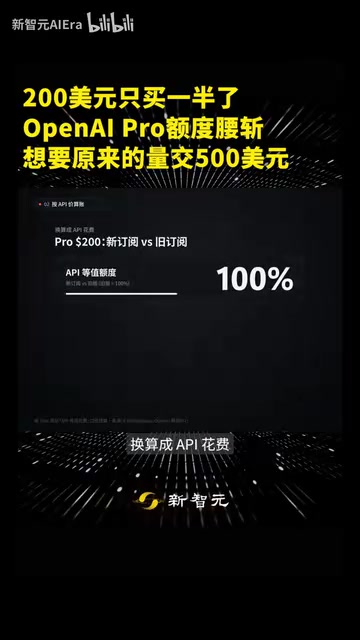
OpenAI's Pro subscription, which had been pulled from sale for three weeks, is back — but at the same price with quietly reduced value. According to a breakdown by Bilibili creator Xinzhiyuan, the $200/month Pro plan now comes with half the quota it previously offered. Translated into API consumption terms, the new Pro is equivalent to just 50% of the old version — where it once offered roughly 20× the usage of the Plus tier, it now delivers only 10×.
The bottom line: the price hasn't dropped a cent, but the capacity has been cut in half. For developers who rely heavily on Codex and run long coding tasks, this amounts to a stealth price hike.
OpenAI's Four Official Reasons
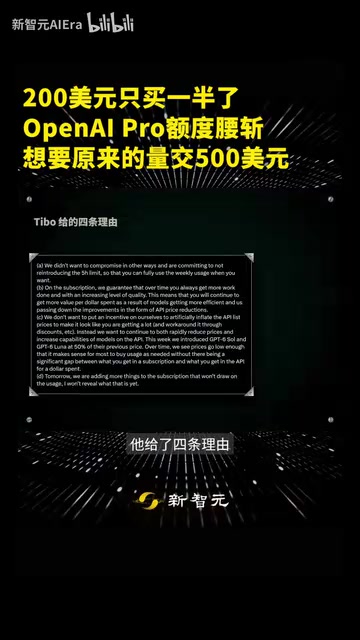
The head of Codex personally walked through the math and explained the logic behind the change. It boils down to four points:
- No more 5-hour limit: The old subscription had a hard cap on usage time. The new version removes this restriction, giving users more flexibility in how they schedule tasks.
- Models are getting "deeper": As reasoning depth and capability improve, the compute cost per task is rising. OpenAI says quota levels need to reflect this reality.
- No inflated API value claims: The company wants subscription quotas to align with real API pricing — avoiding the impression that subscriptions are dramatically cheaper than they actually are.
- Some new features don't count against quota: Certain newly launched features are exempt from quota consumption, which partially offsets the reduction.
Reading between the lines, there's a clear signal here: OpenAI is aligning subscription pricing with the true cost of API usage, rather than continuing to subsidize access with below-cost pricing.
The "reasoning depth" mentioned here refers to the number of internal computation steps a model performs before generating a response. "Reasoning models" — exemplified by OpenAI's o-series — engage in extensive self-verification, branch searching, and step-by-step derivation before producing output, consuming far more tokens than traditional conversational models. For the same coding problem, a reasoning model can use several times to over ten times the compute of GPT-4o. Codex is built on this kind of reasoning architecture, so when OpenAI says models are getting "deeper," they're offering a technical justification for higher per-unit costs: the compute budget required to complete a single coding task is now significantly higher than it was a year ago. This is why the quota was cut in half rather than trimmed by a token amount.
Want the Same Usage as Before? Pay More
If you're used to the old Pro quota and want to maintain the same usage levels, OpenAI's answer is simple: pay more.
New higher-tier plans have launched on the developer platform (DevJ):
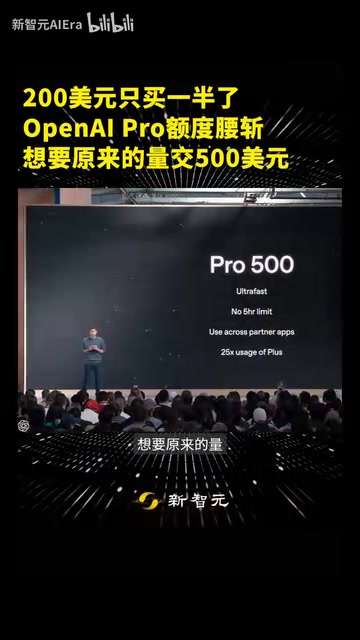
- Pro 500: $500/month, offering approximately 25× the Plus tier's usage — roughly restoring access to what the old Pro plan provided.
- Ultra Fast: $1,500/month, targeting users with extreme speed and throughput requirements.
In other words, what $200 used to buy now costs closer to $500. The pricing ladder has been recalibrated, and the real cost for heavy users has risen substantially.
7,000 Comments and a Lot of Anxiety
The announcement post attracted massive attention — 15 million views and over 7,000 comments. Sentiment in the developer community has been mixed: appreciation for the removal of the 5-hour cap and the addition of quota-free features, alongside frustration over the halved quota and steeper pricing tiers.
This controversy reflects a broader trend: the era of subsidized AI subscriptions is coming to an end. Vendors previously priced compute well below true cost to capture users and market share, and users benefited from those implicit subsidies. Now, as model inference costs rise and the competitive landscape stabilizes, pricing is returning to commercial reality.

The Subsidy Is Gone — Every Dollar Is Priced at API Rates
The message this change sends to the industry is straightforward: model pricing shifts week to week, and subscription quotas will follow. Going forward, every dollar users spend will essentially be priced at real API rates. The arbitrage window — where a subscription was significantly cheaper than direct API usage — is closing fast.
For developers and businesses, several things now need to be reassessed:
- The true monthly cost of heavy API usage scenarios may rise significantly and will require revised budgets;
- The cost-efficiency balance between subscription tiers and direct API calls will shift with each pricing change — worth recalculating regularly;
- Quota-exempt features are worth exploring as a cost-optimization lever, migrating high-frequency, lightweight tasks to free features where possible.
As the subsidies recede, rationally evaluating every compute dollar spent will become a fundamental skill for anyone working with AI.
The "subscription vs. direct API" cost comparison has long been a central concern for developers. In the past, Pro subscriptions appealed to heavy users precisely because of their implied subsidy: subscription pricing was far below the market rate for equivalent API usage, meaning OpenAI was essentially trading margin for user retention and scale. This change marks a reversal of that logic — the company has explicitly stated it wants subscription quotas to "align" with real API pricing. For developers spending $200–$500/month on API calls, the most practical response is to periodically multiply actual call volume by the current API unit price and compare that against the corresponding subscription tier. For use cases with volatile, peak-heavy call patterns, pay-as-you-go API access often offers more flexibility than a fixed monthly plan.
Related articles

LLaMA-Factory in Practice: A Complete No-Code Guide to Fine-Tuning Large Models
An introduction to LLaMA-Factory, the open-source fine-tuning tool: its 60.1K-star background, supported models and algorithms, local vs. cloud deployment, and CUDA setup steps.

Zeng Ming's Deep Retrospective: Why OpenAI May Not Be the Ultimate Winner — and Why the Corporate System Will Disappear
Zeng Ming's deep retrospective on the AI endgame: model companies are just infrastructure, OpenAI and Anthropic won't be the final winners; the next battle is the Agent entry point standard; the corporate system will disappear as AI restructures collaboration, and only mission-driven companies can survive the cycle.

OpenHands v1.28.0: OpenCode and PI Added as Built-in Agents, API Keys Requestable In-Conversation
OpenHands ships 5 releases in 21 days: v1.27.0 adds OpenCode and PI as built-in agents, v1.28.0 enables in-chat key requests. ACP integration, credential reuse, model list changes, and upgrade advice.