OpenAI Python SDK v3.19.1 Released: Fixes Tool Iteration and Header Merging Issues

OpenAI Python SDK v3.19.1 fixes tool iterator exhaustion and HTTP header case-sensitivity merging bugs.
OpenAI's official Python SDK v3.19.1 patch release addresses two bugs: tool iterables being unexpectedly exhausted in single-pass Chat calls (now materialized into a list on first traversal), and HTTP headers not being merged in a case-insensitive manner per RFC 7230. The release also clarifies the `seed` parameter's value range for Chat Completions and restricts PR submissions to collaborators only. Overall, this is a low-risk maintenance upgrade recommended for all active users of the library.
OpenAI's official Python SDK has received a v3.19.1 patch release. As a core open-source project with over 31,000 stars and 7,000 forks on GitHub, openai-python is one of the most widely used ways for developers to access OpenAI's model capabilities. While this is a minor version bump, it addresses several real-world development issues that engineers actively using the library should be aware of.
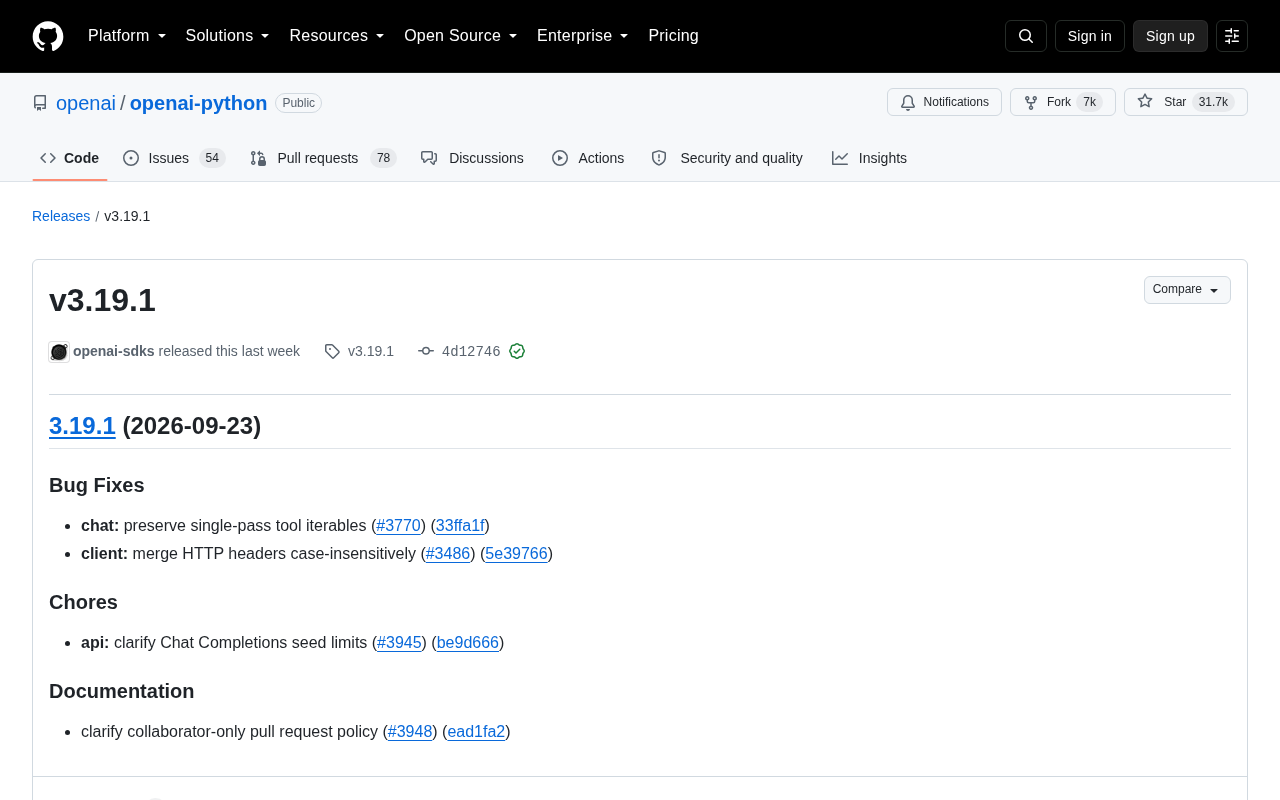
Key Fixes in This Release
According to the official changelog, v3.19.1 is a typical bug-fix release focused on two key issues.
Preserving Tool Iterables in Single-Pass Calls
The first fix (#3770) targets the Chat module and resolves an issue where tool iterables were unexpectedly consumed or lost during single-pass requests. As Function Calling / Tool Calling becomes an increasingly mainstream pattern, developers frequently pass a set of tool definitions to the model. When these tools are provided as generators or one-shot iterators, previous versions could exhaust them during processing, leaving subsequent logic unable to retrieve the complete tool list. This fix ensures that tool iterables are correctly preserved throughout a single call, improving stability in Tool Calling scenarios.
In Python, generators and iterators are "one-time" data structures — once fully traversed, iterating them again yields nothing. Unlike lists, generators cannot be reset or re-read. When developers supply tool definitions dynamically via a generator expression like (tool for tool in tool_list) or a yield-based function, the SDK internally iterating over that object more than once in its processing pipeline would produce an empty collection on the second pass. This is especially easy to trigger in Streaming mode or during certain internal validation steps, and the resulting errors typically manifest as "tool not called" or "model doesn't recognize the provided function" — symptoms that are notoriously difficult to debug. After the fix, the SDK materializes the iterable into a list on first traversal, ensuring downstream processes always have access to the complete set of tool definitions.
Case-Insensitive HTTP Header Merging
The second fix (#3486) operates at the client layer and resolves improper handling of HTTP header merging when header names differ only in case. Per the HTTP specification, header field names are inherently case-insensitive — Content-Type and content-type should be treated as the same field. The previous implementation could result in duplicate headers being added or incorrect overrides when header names differed only by case. After the fix, the client merges headers in a case-insensitive manner, preventing unexpected behavior when custom headers conflict with the SDK's default headers.
The HTTP/1.1 specification (RFC 7230) explicitly states that header field names are case-insensitive — Authorization, authorization, and AUTHORIZATION are semantically identical. However, Python's standard dict performs case-sensitive key comparisons, meaning {"Content-Type": "application/json", "content-type": "text/plain"} would be treated as two distinct entries. When the SDK merged its default headers with developer-supplied custom headers without normalizing case, the same field could end up being sent twice (producing undefined server-side behavior) or the custom value might fail to properly override the default. This fix introduces case-insensitive merging logic — typically by normalizing all keys to lowercase before merging — aligning with how modern HTTP client libraries like httpx handle this.
Documentation and Maintenance Improvements
Beyond the functional fixes, this release also includes several miscellaneous (chores) and documentation-level changes.
First, the API documentation has been updated to clarify the valid value range for the seed parameter in the Chat Completions API (#3945). The seed parameter is used to make model outputs as reproducible as possible, which is important for testing and evaluation workflows that require deterministic results. Documenting its constraints helps developers use it correctly.
Second, the documentation now explicitly states a policy that only collaborators may submit Pull Requests (#3948). This update is directed at community contributors and signals that the team is tightening the external PR submission process, likely to better maintain code quality and review consistency.
What This Means for Developers
For teams using openai-python in their day-to-day work, this is a low-risk maintenance upgrade. Both bug fixes address edge cases — they only trigger when using one-shot tool iterators or when custom HTTP headers clash with default headers in case. But precisely because these issues are hard to diagnose, upgrading proactively can help you avoid subtle, hard-to-trace failures down the road.
Upgrading is straightforward with the standard package manager command:
pip install --upgrade openai
The release cadence makes it clear that OpenAI actively maintains its official SDK, with frequent minor version patches. For production systems built on top of it, staying current with SDK updates means getting bug fixes promptly and being first to access new API capabilities. It's good practice to review the CHANGELOG before upgrading, confirm whether the fixes are relevant to your use case, validate in a test environment, and then roll out to production.
Related articles

Bilibili's Hit Dify Tutorial: A Practical Guide to Building 20+ AI Apps from Scratch
A distilled guide to Bilibili's top-rated Dify tutorial: Windows + Docker deployment, MySQL connection, five app types, model integration strategy, and publishing.

Agent Skills Beginner's Guide: From Concepts to Multi-Agent Collaboration in Practice
A comprehensive guide to Agent Skills: core concepts, components, the importance of Description, standardization, beginner learning paths, and multi-agent collaboration.

One Neuron Detects Both Cats and Cars? We Reproduced It and Found a New Explanation
The cat-car neuron reinterpreted: researcher Cammarata argues it distinguishes pointy from round, not cats from cars. We reproduced the experiment and found the new explanation holds on most inputs—but cars are the exception. The interpretability debate continues on language models.