OpenAI Python SDK v3.22.0 Released: Beta Agents Gain Computer Use Capabilities
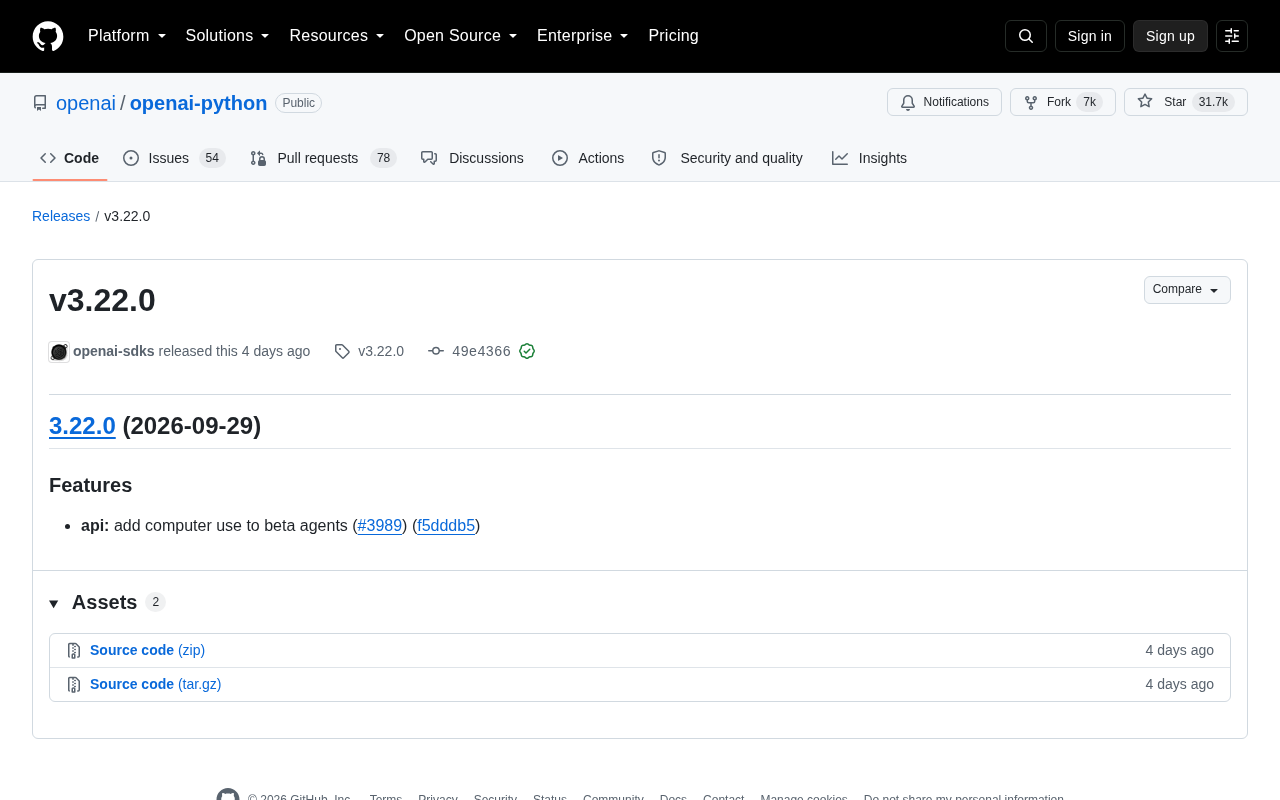
OpenAI Python SDK v3.22.0 adds computer use capabilities to beta agents, enabling AI to control GUIs directly.
OpenAI's official Python SDK v3.22.0 introduces "computer use" for beta Agents, enabling AI agents to view screens, move mice, click buttons, and type text to complete complex cross-application tasks. The update packages these capabilities behind a standardized SDK interface, significantly lowering the integration barrier. The feature remains in beta, so production use is not recommended. This release continues OpenAI's broader strategy of equipping agents with real-world interaction tools — from function calling and code execution to GUI operation — reflecting the industry's growing demand for reliable AI automation.
OpenAI Python SDK v3.22.0 Released: Beta Agents Gain Computer Use Capabilities
The official OpenAI Python SDK has received a v3.22.0 update, with the headline change being the addition of "computer use" capabilities to beta Agents. This seemingly brief update entry actually represents another meaningful expansion of what AI agents can do.
What's New in This Release
According to the official GitHub release notes, v3.22.0 centers on a single API update: adding computer use support to beta agents (corresponding to PR #3989). This is a typical incremental feature release — no sweeping architectural changes, just an additional dimension of tool-calling capability layered on top of the existing Agent framework.
As one of the most important official client libraries in the OpenAI ecosystem, openai-python currently has around 31.7k stars and 7k forks on GitHub, making it the primary entry point for developers integrating with OpenAI's models and services. Each version update closely tracks the pace at which new capabilities are opened up on the OpenAI platform side — SDK updates are essentially the packaging and exposure of new backend API features.
What Is Computer Use?
"Computer use" refers to the ability for an AI agent to operate a computer interface the way a human would — including viewing the screen, moving the mouse, clicking buttons, and typing text. This type of capability frees agents from being limited to pure text-based conversations or function calls; they can instead directly take over GUI interactions and complete complex cross-application tasks.
Bringing this capability into beta agents means developers building agentic applications can now dispatch "operating a computer" as one of an agent's available tools. For example, an agent could autonomously fill out web forms, scrape data, or configure software — tasks that previously required manual clicking. This is a pivotal step in AI's evolution from "able to answer" to "able to act."
This concept first attracted widespread industry attention when Anthropic launched Claude Computer Use in October 2024 — one of the earlier cases of a major LLM provider opening up this class of capability. The underlying technology relies on a "screenshot + action output" loop: the model receives a screenshot of the current screen as visual input, then outputs structured action commands such as mouse coordinates and keyboard keystrokes, which an execution layer actually triggers in the operating system. The fundamental difference from traditional RPA (Robotic Process Automation) tools is that AI models possess semantic understanding and contextual reasoning, enabling them to handle scenarios where the interface layout is variable or judgment is required — rather than merely replaying a pre-recorded fixed action script.
What This Means for Developers
For developers using the Python SDK, this update lowers the barrier to accessing computer use capabilities. Previously, giving an agent GUI interaction abilities typically required stitching together low-level APIs or relying on third-party toolchains. Now, developers can call this functionality directly through the official SDK's standardized interface.
It's worth noting that this feature is still in beta, meaning the interface may change in future versions. Deep reliance on it in production environments is not recommended. Developers experimenting with it should be prepared for interface changes and keep a close eye on updates to the official documentation.
The Continuing Expansion of the Agent Tool Ecosystem
From a broader perspective, the addition of computer use continues OpenAI's strategic approach to building out Agents — steadily equipping agents with the tool capabilities needed to interact with the real world. From early function calling, to retrieval and code execution, and now to computer operation, the toolbox available to agents is becoming increasingly complete.
This trend also reflects the industry's strong demand for "AI automated execution." As the reasoning capabilities of models themselves mature, the competitive focus is gradually shifting toward "how to enable models to safely and reliably execute tasks in real-world environments." Continuous SDK-level updates are the concrete engineering manifestation of this evolutionary path.
Function Calling, introduced by OpenAI in June 2023, allows developers to pre-define structured function signatures so that the model can decide during a conversation when to call which function and generate properly formatted parameters. This was the starting point for agents moving from "pure text output" to "programmable actions." Subsequently, the Code Interpreter enabled models to run Python code in a sandboxed environment, while retrieval tools connected to external knowledge sources. Today's computer use is a further extension along this path — the earlier capabilities addressed "data processing and knowledge acquisition," while computer use solves the "GUI interaction" last-mile problem that previously required human intervention, making fully unsupervised automated workflows increasingly feasible from a technical standpoint.
Conclusion
While v3.22.0 is a relatively small release in scope, the arrival of computer use in beta agents sends a clear signal: OpenAI is pushing agent execution capabilities deeper into system-level operations. For engineers focused on AI Agent development, this is a direction worth following closely and experimenting with hands-on. It's recommended to consult the GitHub releases page and official documentation for the latest interface details and usage examples.
Related articles

Uber Deploys ChatGPT Work Company-Wide: AI in the Workplace Enters the Scaled Implementation Phase
Uber deploys ChatGPT Work to 30,000+ employees, extending it from engineering to all roles. We analyze its expert-engineer pairing, end-to-end automation, and questions of AI control and power concentration—insights for scaling AI in the workplace.

Shift at Midnight Hands-On: When "ID Verification" Becomes Alien Hunting
Shift at Midnight blends ID verification with horror survival in a four-player co-op game. We break down its inspection mechanics and chaotic humor.

Zelensky Recounts the Outbreak of War: I Need Ammunition, Not a Ride
Zelensky recalls the first day of war in a YouTube interview: farewell to family, rejecting Biden's evacuation offer with "I need ammunition, not a ride," and how Bucha shaped his stance on compromise and peace talks.