OpenAI Releases GPT-6.2 Dual Models: Why Are Early Reviews Split?

OpenAI's dual models face divided reviews as Google expands reach with free task AI and quota resets.
The article covers four stories from the large model race. OpenAI released GPT-6.2's Astra and Sol models for complex professional projects and efficient everyday work, integrated into ChatGPT Work, Codex, and the API. Early reviews were divided: Altman admitted the models are smart but usability needs improvement, while Tibo explained the models still changed significantly three or four days before release, so some early reviews weren't re-tested. Meanwhile, Google rolled out Gemini Tasks free to six countries with cloud task execution, and DeepMind's Anti-Gravity reset all model quotas for its first anniversary, with Carbon's first meta-response speed improved to 1.5x. The article argues OpenAI faces tension between capability and usability, while Google trades scale and developer experience for usage habits.
OpenAI launched two models on the same day — Astra and Sol — yet failed to win unanimous praise. Early testers' feedback was noticeably divided, prompting CEO Sam Altman and team member Tibo to respond in turn. Meanwhile, Google stepped up its efforts in both task-oriented AI and the developer ecosystem. The four stories in this briefing piece together a cross-section of the current large model race.
GPT-6.2 Dual Models: One for Heavy Lifting, One for Everyday Work
The two GPT-6.2 models OpenAI released have clear positioning: Astra targets complex professional projects, while Sol focuses on efficiently completing everyday work. Both are now available in ChatGPT Work, Codex, and the API for eligible paying users.
This "one hard, one soft" dual-track strategy isn't new, but applied to GPT-6.2, it shows OpenAI wants the same generation of models to cover the full spectrum from deep reasoning to everyday office work. For developers, simultaneous access via Codex and the API means they can choose models based on task complexity rather than forcing one large model to handle every scenario.
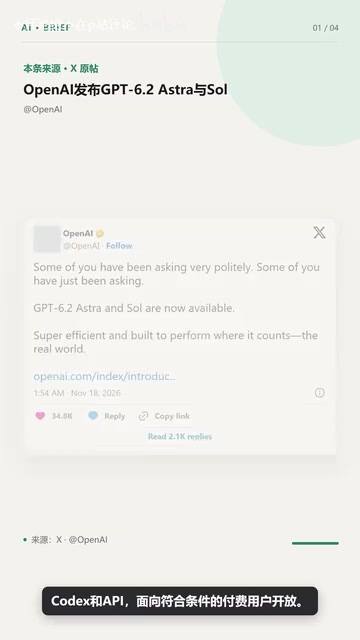
Codex is OpenAI's product line for coding scenarios. It originally referred to the code generation model released in 2021, and later evolved into a set of programming assistant capabilities integrated into development workflows. Unlike general chat models, Codex-style tools emphasize directly reading and writing code, performing refactoring, and debugging tasks within IDEs, command lines, or APIs. The article mentions that Astra and Sol are both integrated into Codex, meaning developers can switch models based on task difficulty in coding scenarios — Astra for complex architecture design, Sol for everyday completion and script writing.
Tiered API access refers to the same generation of models being offered through interfaces, where developers can choose different tiers based on parameters such as token billing, rate limits, and context windows. The significance of this approach is that it turns "model selection" into an explicit developer decision rather than something uniformly dictated by the platform.
Where the Negative Reviews Come From: The Gap Between Smart and Usable
The first wave of reviews after launch was not uniform. Some early testers gave negative reviews, and Altman's response was: while the new models are smart, usability still needs improvement. That statement carries a lot of information — it implicitly acknowledges that there is tension between "strong capability" and "smooth onboarding" at the current stage.
OpenAI's Tibo offered a more specific explanation: three or four days before release, the models underwent significant changes, and some early reviews may not have been re-tested. In other words, some negative reviews may have been aimed at snapshots of older versions. This both explains part of the reason for the divided reviews and exposes the lag in the review ecosystem under a rapid iteration cadence.

From a product perspective, the fact that the models were still changing on the eve of release shows the team compressed the final adjustment window very tightly. The upside is that what ships is the latest version; the cost is that external reviewers struggle to keep up, and credibility is easily diluted amid information asymmetry. Tibo said the team will continue to listen to feedback, which at least keeps the disagreement out in the open.
Gemini Tasks Expands: Task-Oriented AI Reaches Free Users
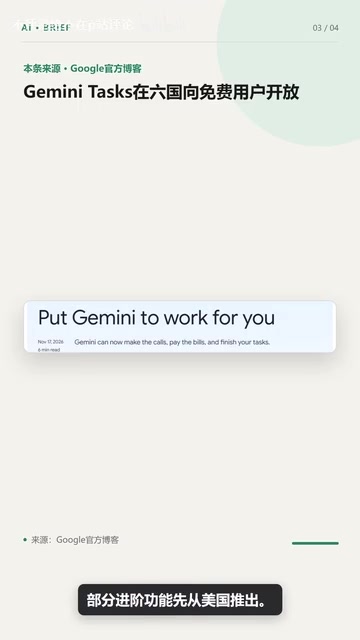
Google's move is more about diffusion. Gemini Tasks announced a gradual free rollout to users in the United States, Japan, South Korea, Canada, Australia, and India. Its key capability: taking on tasks and executing them in the cloud, with some advanced features launching first in the US.
"Tasks" and "conversation" are two different product forms. The former means the model isn't just giving suggestions in a chat box, but taking on a goal and driving execution in the cloud. The choice of six countries for the free rollout is also noteworthy — covering major markets in North America, East Asia, South Asia, and Oceania, indicating Google wants to use scale to build usage habits first, then talk about monetization.
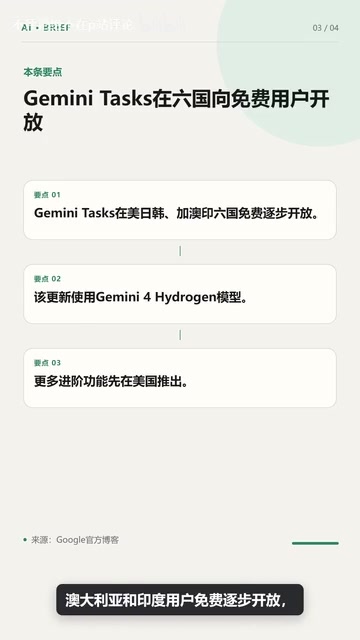
Task-oriented AI (agentic AI) differs from conversational AI in its core execution loop: conversational models finish once they output text, while task-oriented models need to break down goals, invoke tools, run continuously in the cloud, and return results upon completion. Such systems typically rely on sandboxed environments, tool-calling protocols (such as function calling), and long-term memory mechanisms. Gemini Tasks letting models "take on tasks and execute them in the cloud" is precisely an embodiment of this form.
Choosing six countries for the free rollout is also related to the cost structure of task-oriented products: cloud execution consumes more compute than single-turn inference, and the free period is essentially using subsidies to obtain real task distribution data for optimizing scheduling and failure recovery strategies.
Anti-Gravity's First Anniversary: Quota Reset and Performance Improvements
Google DeepMind's Warren Mohan announced celebrating Anti-Gravity's first anniversary by resetting all model quotas for all users. He also mentioned that Carbon's first meta-response speed in Anti-Gravity increased to 1.5x the original, with related optimizations for Argon to follow.
Quota resets often have more practical significance for developers than marketing significance — they lower the cost of trial and error. And metrics like a 1.5x response speed improvement point to experience competition in the developer toolchain — when model capability gaps narrow, speed and ample quotas become the means to retain users.
Model quotas are limits that developer platforms place on call volume or total tokens within a given time period, usually divided by free/paid tiers. Resetting quotas means developers can regain previously consumed allowance, directly lowering costs during experimentation and prototyping. For toolchain products that rely on high-frequency calls, quota generosity often affects retention more than model benchmark scores.
The Carbon and Argon mentioned in the article are likely codenames for different models or inference paths within the Anti-Gravity platform. "First meta-response speed" refers to the latency from when a user initiates a request to when the first valid response is received — this metric is particularly critical for interactive development experiences: fast first response means the tool "feels responsive," while total throughput affects batch tasks.
Two Paths, One Problem
Looking at the four stories together: OpenAI is being held back by usability while polishing model capabilities, while Google is expanding reach through free access and quota resets. One side is "stronger but harder to tame," the other is "get people using it first."
For users, the short-term judgment criteria are actually quite simple: no matter how smart a model is, if reviews are disconnected from actual experience and onboarding costs are high, its reputation will be hard to stabilize. Tibo's remark that "the models underwent significant changes three or four days before release" may be the key footnote to understanding this round of divided reviews.
One-line Summary
OpenAI's dual models face divided reviews as Google expands reach with free task AI and quota resets.
Paragraph Summary
The article reviews four stories from the large model race within the same time window. OpenAI released GPT-6.2's Astra and Sol dual models, targeting complex professional projects and efficient everyday work respectively, integrated into ChatGPT Work, Codex, and the API. But early testers' reviews were divided: Altman acknowledged the models are smart but usability needs improvement, while Tibo explained that the models still underwent significant changes three or four days before release, and some early reviews were not re-tested. On Google's side, Gemini Tasks gradually rolled out free to six countries, supporting task-taking and cloud execution; DeepMind's Anti-Gravity reset all model quotas for its first anniversary, with Carbon's first meta-response speed improved to 1.5x. The article argues that OpenAI faces tension between capability and usability, while Google is trading scale and developer experience for usage habits.
Related articles

Build a Professional Website with Claude Code in Minutes: A Five-Step Practical Guide
Learn how to build a professional website with Claude Code in minutes: the complete five-step process from planning prompts and precise iteration to MCP image generation, design redos from reference images, and one-click deployment.

Cursor vs Claude Code: Which Writes Better Code? The Real Difference Is Architecture
The difference between Cursor and Claude Code isn't the model but the architecture: editor-first Cursor suits deep focus and code review, terminal-agent-first Claude Code suits batch refactoring and CI/CD automation.

AgentRoboCritic: Capabilities and Bottlenecks of Frontier Agents in Direct Robot Control
AgentRoboCritic proposes an intent-anchored critic framework for action-level analysis of frontier multimodal agents' direct robot control across 12 manipulation benchmarks, revealing closed-loop recovery and semantic anchoring capabilities while identifying physical execution bottlenecks such as grasp alignment; the open-source Muse-Glimmer-30B critic raises failure-mode accuracy from 32.58% to 74.24%.