OpenAI Reopens Codex Pro $200 Tier: Usage Algorithm Changes and 7 AI News Highlights

AI subscriptions go retail as vendors shift focus from unit price to per-task cost efficiency.
This AI roundup covers two parallel industry trends. First, subscriptions and compute are going retail — Tmall's AI storefront and carrier bundle plans are lowering access barriers, though token counting and model quality vary widely. Second, competitive focus is shifting from unit price to per-task cost: Claude Sonnet 5.5 holds its price but cuts per-task costs by up to 30%, even outperforming flagship Opus 5.5 in coding benchmarks. OpenAI's reopened Codex Pro $200 tier halves the effective quota but removes the 5-hour hard limit. Meanwhile, Doubao, Google, xAI, and Meta each make moves targeting personal assistants, developer compute, cloud distribution, and enterprise markets respectively.
OpenAI Reopens Codex Pro $200 Tier with Quietly Revised Usage Mechanics
The Codex team has announced that the $200 Pro tier subscription will reopen — but the underlying usage algorithm has been overhauled. According to the newsletter, the new effective quota is roughly half of what the old plan offered, though in exchange, the previously enforced 5-hour usage limit has been dropped.
For heavy users, this represents a real trade-off: a smaller quota limits output per unit of time, but removing the hard time window gives users more flexibility to schedule long-running tasks without being chopped up by 5-hour intervals. For teams that have embedded Codex into their daily development pipelines, this change requires a reassessment of cost structures — workflows previously planned around time windows now need to be budgeted around total quota.
It's worth noting that one observer (Teebo) suggested this reset would happen on Tuesday, but signs of the reset remain unclear and the situation is still being monitored. The opacity of subscription algorithms is precisely what makes high-price tiers prone to controversy.
AI Subscriptions Enter the "Retail Era"
A clear trend is emerging: tokens are being sold like ordinary consumer goods. Tmall has launched an "AI Space Station" storefront featuring five major LLM subscriptions, with China Telecom offering a plan at ¥9.91/month that includes 10 million tokens.

This "sell compute like fast-moving consumer goods" approach marks a shift from early adopters experimenting with LLM services to mass-market consumption. When subscriptions appear on e-commerce shelves and carriers start bundling them, the barrier for everyday users drops dramatically — but so does pricing transparency, as the token counting methodology and model quality vary widely across plans. More options are good for consumers, but close scrutiny of each plan's tokenization method and model tier is still essential.
Claude Sonnet 5.5 Released: Same Price, Up to 30% Lower Per-Task Cost
The Claude lineup also has news. Sonnet 5.5 has launched with unchanged per-token pricing (¥2/¥10), but per-task costs are reduced by up to 30%. In coding benchmarks, Sonnet 5.5 even surpassed Opus 5.5.
"Same unit price, lower total cost" is a highly competitive strategy — rather than grabbing attention through price cuts, it wins through efficiency gains that make each task cheaper. For developers, this kind of "hidden price reduction" is more meaningful than a nominal rate cut, since it directly impacts actual API costs. Sonnet outpacing the flagship Opus in coding tasks also reinforces the point that "bigger isn't always better" — purpose-optimized mid-tier models are becoming increasingly formidable.
Additionally, Claude Code has been updated to 2.1.284, with the default model switched to Sonic 5.5, support for million-token context windows, and enterprise gateway usage now displayed in USD — further strengthening cost transparency for enterprise customers.
Three AI Coding Tools Worth Watching
This edition also highlights several practical coding tools:
- Web Combine: Spin up a local dashboard with a single command. It queues multiple coding agents and gives you a real-time view of what each one is doing and what it has changed. Excellent for multi-agent collaborative development.
- Vault DIY: An open-source full-stack AI app generator. Describe your requirements in plain language and it runs the project directly in your browser.
- Screenshot to Code: Drop in a screenshot or design mockup, and it outputs working front-end code.
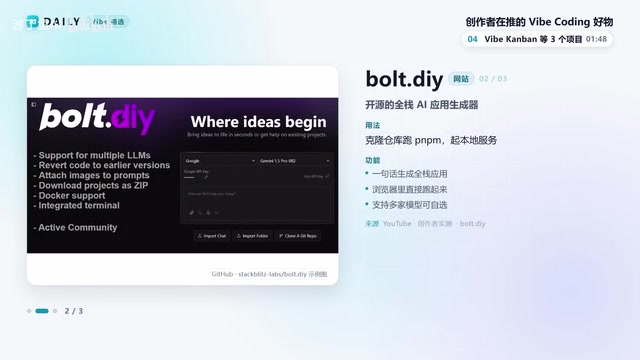
These three tools address three high-frequency pain points — multi-agent orchestration, full-stack generation, and design-to-code — representing the current trajectory of AI coding tools evolving from "writing code" to "running entire projects."
Multi-Agent Orchestration refers to breaking a complex task into subtasks, assigning them to different AI agents running in parallel or in series, while a coordination layer monitors progress and merges results. This architecture can significantly boost development efficiency on complex projects, but also introduces new challenges: context sharing between agents, error propagation, and resource conflicts all need careful management. Web Combine's visual dashboard is designed specifically to reduce this cognitive overhead, giving developers real-time visibility into each agent's status. Screenshot to Code, on the other hand, relies on multimodal visual understanding to map layout, color, and interactive elements from an image into executable front-end code. Current leading solutions achieve high fidelity for static pages, but complex interactive logic still typically requires manual correction.
Big Players: Doubao, Google, xAI, and Meta
Beyond the above products, several major players have new developments:
- Doubao is reportedly preparing to launch a personal assistant product, internally codenamed Spell. It has been in internal testing since April, is planned to compete with similar popular overseas products, and is reportedly required to deliver a demo version by end of the month.
- Google has added new benefits to its AI subscriptions. Eligible users can receive Colab compute units to access higher-performance GPUs and run long tasks even after closing the browser.
- xAI's Grok 4.7 has launched on Amazon Bedrock, supporting 500K context, with four adjustable reasoning intensity levels, and a coding index 9 points higher than the previous generation.
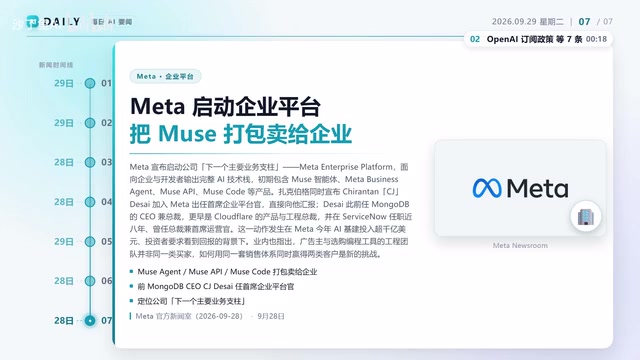
- Meta has launched an enterprise platform, packaging agent and coding capabilities for business customers, and has hired former MongoDB CEO Dev Ittycheria as its first Chief Enterprise Platform Officer.
A clear division of strategy emerges from these moves: Google is strengthening developer compute benefits, xAI is expanding distribution via cloud platforms, Meta is pushing hard into enterprise, and Doubao is filling in the personal assistant gap in the domestic market.
Subscription Value-for-Money Rankings
The newsletter also provides a subscription value reference:
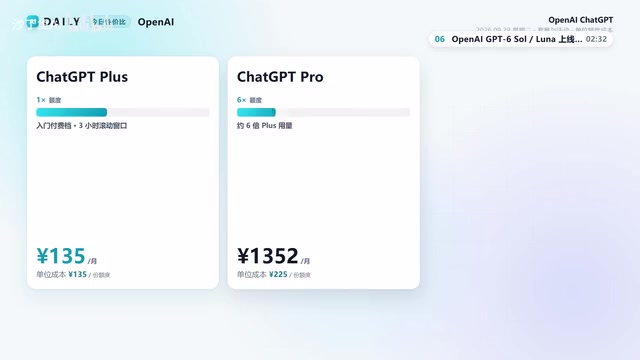
OpenAI's new GPT model (Luna) has launched on ChatGPT Plus at ¥135/month, with the lowest per-quota cost across the entire product line. Codex paired with this model runs approximately ¥3 per task and has been dubbed the "best-value agent setup" — roughly 4x cheaper than the most capable option.
Among international tiers, Claude Max 20X is considered the most capable, while Copilot Pro lands at the bottom due to multiplier issues. For users with sufficient budget who want maximum capability, going straight to Max is the more straightforward choice; cost-conscious users should look at the ChatGPT Plus + Codex combination.
Summary
This edition of the newsletter reflects two core trends playing out in the AI industry. First, subscriptions and compute are rapidly "retailizing" — from e-commerce shelves to carrier bundles, the barrier to access continues to fall. Second, competitive focus is shifting from "unit price" to "per-task total cost," with efficiency optimization becoming the primary battleground for hidden price competition. Whether you're a developer or an everyday user, understanding how these metering rules are changing will have a direct impact on what you actually spend.
Background Notes
A token is the basic unit of text measurement for large language models, roughly corresponding to one Chinese character, one English word, or one punctuation mark — though tokenization rules differ across vendors, making it difficult to directly compare "10 million tokens" across plans. Input tokens (content sent by the user) and output tokens (the model's generated response) are typically billed separately, with output usually priced higher. So when evaluating plan value, simply comparing total token counts isn't sufficient — you also need to consider conversation turn limits, model version, and your specific use case. Low-price carrier bundle plans often correspond to lightweight or rate-limited models; heavy users should check the model specifications and concurrency limits in the fine print.
Related articles

Free Unlimited Claude Code Solution: Agnes AI + CC Switch Setup Guide
No paid subscription needed — pair the free AI platform Agnes AI with the open-source tool CC Switch to provide a backend for Claude Code, enabling unlimited free calls to text, image, and video models. This guide covers the full setup, test results, and usage boundaries.

A Complete Zero-Cost Guide to Getting Started with Claude Code for Beginners in China
A beginner's guide to Claude Code for users in China: two installation methods (command line and IDE plugin), full configuration steps for replacing the official API with the free domestic LongCat model, and a hands-on demo of building a small tool with natural language, plus tips.

When the NSA Gets Involved: The AI Supply Chain Crisis Behind Open-Source CVEs and API Key Hijacking
Multiple open-source projects disclosed severe CVEs in one day, PHP flaws alarmed the FBI, and Railway and OpenCode were breached with API keys stolen. This article breaks down the vulnerability window, AI-accelerated exploitation, and the AI supply chain crisis behind the API key black market, with a developer defense checklist.