OpenFlow: A Unified Data Plane for Agent Orchestration?

OpenFlow seeks to decouple multi-agent scheduling and execution via a neutral orchestration layer, but ecosystem risks and missing benchmarks keep it in the watch phase.
OpenFlow, positioned on Hacker News as "ultimate agent orchestration," advocates making agent orchestration an independent data plane by decoupling scheduling logic from execution logic, so as to neutrally host agents built on LangGraph, CrewAI, AutoGen, and other frameworks. The article sees core value in observability and MCP/A2A compatibility, but also flags ecosystem risks: upper-layer frameworks may resist ceding scheduling control, and the extra hop adds latency. With only 3 points and 0 comments at launch and no performance benchmarks, it is better treated as an observation window than a production solution.
Multi-agent systems are moving from demos to production, but the orchestration layer remains fragmented. The OpenFlow project, which appeared on Hacker News, tries to sell itself as "ultimate agent orchestration" and sparked a small round of community discussion.
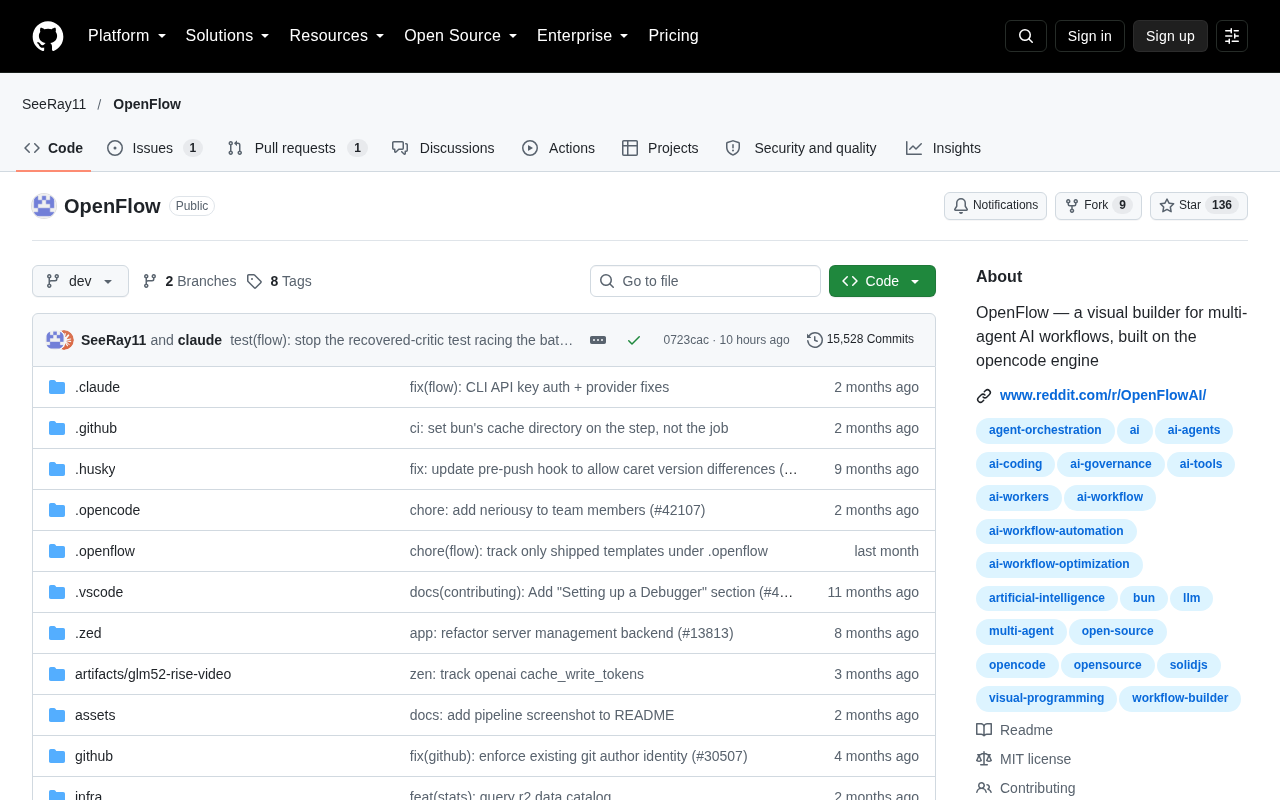
The shift from "framework" to "orchestration layer"
Over the past two years, frameworks such as LangGraph, CrewAI, and AutoGen have solved the question of "how to get multiple agents to collaborate," but each goes its own way: every framework has its own runtime, state model, and communication protocol. Once developers pick a framework, migration costs are extremely high.
OpenFlow positions itself one layer lower—as the "data plane" of agent orchestration. The name borrows a classic concept from networking: the control plane makes decisions, while the data plane handles actual forwarding. In the agent context, this means decoupling the scheduling logic of "who calls whom" from the execution logic of "how messages are transmitted and how state is stored."
The value of this approach lies in its neutrality. The orchestration layer is not tied to a specific framework and can theoretically host agents built on different frameworks at the same time. For teams already running multiple agent technology stacks in production, this is more attractive than introducing yet another framework.
Differences among LangGraph, CrewAI, and AutoGen: Although all three are multi-agent frameworks, their design philosophies differ. LangGraph defines agent workflows with a graph structure, explicitly passing state between nodes, making it suitable for scenarios that require fine-grained control over loops and branches; CrewAI emphasizes role-playing and task delegation, with higher-level collaboration abstractions built in—quick to get started, but with relatively less room for customization; AutoGen is driven by conversation, with agents negotiating tasks through message exchanges—highly flexible, but state management must be handled by the developer. These differences make the runtimes and state models of the frameworks incompatible, which is precisely the fragmentation OpenFlow tries to resolve with a neutral orchestration layer.
Community focus: observability and protocol compatibility
Although the Hacker News discussion had very few comments (only 3 points and 0 comments at the time of posting), the project's name and positioning suggest the two issues developers care about most.
The first is observability. The orchestration layer is naturally a traffic aggregation point—all messages between agents pass through it—so tracing, logging, and latency metrics can be collected centrally here, without the need to duplicate instrumentation in every framework. This is a horizontal capability that framework layers struggle to provide.
The second is protocol compatibility. MCP (Model Context Protocol) is becoming the de facto standard for tool invocation, and agent-to-agent communication protocols such as A2A are also advancing. If an orchestration layer can speak these "dialects" at the same time, it can act as a translator between different ecosystems. If OpenFlow can achieve breadth in protocol adaptation, it will build more of a moat than simple feature stacking.
What MCP and A2A are: MCP (Model Context Protocol), proposed by Anthropic, defines how LLM applications discover and invoke external tools and data sources in a standardized way. It can be likened to a "USB-C interface for the AI world," aiming to let tool integrations be written once and reused in many places. A2A (Agent-to-Agent Protocol) focuses on direct communication between agents, specifying task delegation, capability discovery, and message formats so that agents from different vendors can collaborate across platforms. One addresses "models connecting to tools," the other "agents connecting to agents," and together they form the protocol stack that an orchestration layer needs to be compatible with. If OpenFlow can support both, it can act as a hub between the tool ecosystem and the agent ecosystem.
Why the orchestration layer is a natural anchor for observability: In a multi-agent system, a single user request often triggers chained calls across multiple agents. If instrumentation is done separately inside each framework, tracing data is scattered and inconsistent in format, making it difficult to reconstruct the full call chain. The orchestration layer sits on the必经 path of all messages, so it can uniformly inject Trace IDs, collect cross-agent latency and error rates, and output telemetry data that conforms to standards such as OpenTelemetry. This horizontal capability cannot be provided by a single framework, because a framework only sees the agents it hosts. For production teams, this means a substantial reduction in troubleshooting costs.
What to view with caution
The word "Ultimate" itself is worth being wary of. The core challenge of an orchestration layer is not technical implementation but ecosystem position: will upper-layer frameworks be willing to hand over scheduling authority to it, and will lower-layer infrastructure be willing to provide standard interfaces for it? Historically, most projects that tried to be a "middle layer" failed by pleasing neither side—frameworks saw them as a threat, and users found them an extra layer of complexity.
Another practical issue is latency. Any additional orchestration hop introduces overhead, and whether this abstraction is worth it for latency-sensitive agent chains requires empirical data. So far, no performance benchmarks have been seen in public information.
A direction worth watching
For teams building multi-agent systems, OpenFlow represents a direction worth paying attention to: rather than constantly switching frameworks, it may be better to consolidate orchestration capabilities into an independent infrastructure layer. But to judge whether it is truly "ultimate," three things still need to be seen—whether it is open source and provides clear extension interfaces, whether there are real cross-framework hosting cases, and how it actually performs in high-concurrency multi-agent scenarios.
A project with only 3 points on Hacker News is usually still very early. Treating it as an observation window rather than a production solution to adopt immediately is the more prudent judgment.
One-line Summary
OpenFlow tries to decouple multi-agent scheduling and execution with a neutral orchestration layer, but ecosystem-position risks and missing performance data keep it in the observation stage.
Paragraph Summary
OpenFlow, positioned on Hacker News as "ultimate agent orchestration," advocates pushing agent orchestration down into an independent data plane, decoupling the scheduling logic of "who calls whom" from the execution logic of "how messages are transmitted and how state is stored," so as to neutrally host agents built on different frameworks such as LangGraph, CrewAI, and AutoGen. The article argues that its core value lies in observability and compatibility with MCP/A2A protocols, but also points out ecosystem-position risks: upper-layer frameworks may be unwilling to give up scheduling authority, and the extra hop will introduce latency. At launch, the project had only 3 points and 0 comments and lacked performance benchmarks, so it is better treated as an observation window than a production solution.
Related articles

Is the Agent Harness Dead? Cursor's Early Engineer Breaks Down the Real Architecture of AI Coding Agents
Cursor early engineer Jediah breaks down the real architecture of the agent harness: why "the harness is dead" is only half right, how the data flywheel lets the harness obsolete itself, and how Grokbot, software factories, and primitive design open new frontiers for agents.
Python Visitor Pattern and Better Alternatives Explained
A deep dive into Python's visitor pattern and four alternatives: method pattern, pattern matching, dictionary mapping, and functools.singledispatch. Choose the best decoupling design by change frequency.

357 Days of Deep Experience: Why Omarchy Made Me Stop Distro-Hopping
A 357-day deep dive into Omarchy: 59-second install, out-of-the-box audio and GPU support, the Quattro QuickShell rewrite migration pains, and why Arch users should try it.