OpenHuman: Building a Local-First Personal AI Super Brain with Rust

OpenHuman is a Rust-built open-source project creating a local-first personal AI with memory, agent orchestration, and deep research.
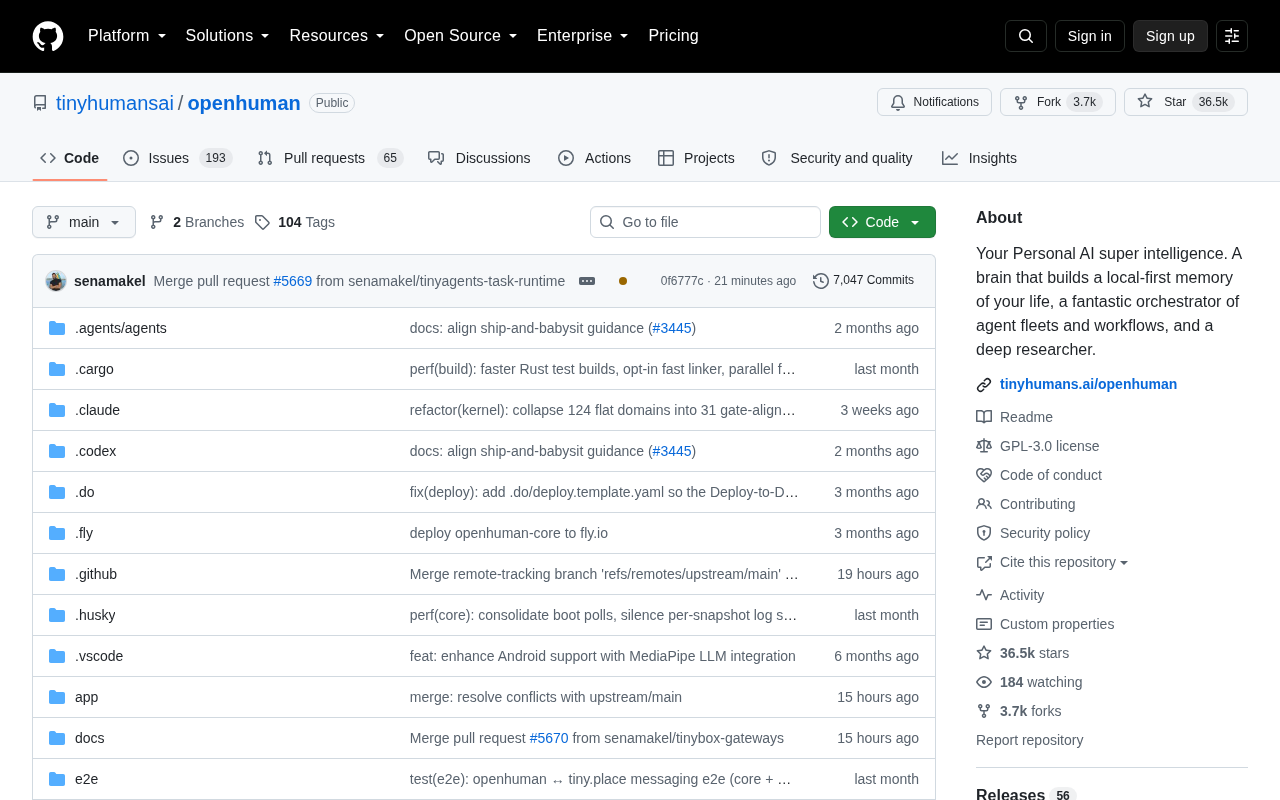
OpenHuman is a fast-rising GitHub project (36,500+ stars) built with Rust that positions itself as a personal AI super intelligence. It features three core capabilities: a local-first memory system that continuously learns about you, a multi-agent orchestrator for complex workflows, and a deep research assistant. By keeping personal data on local devices rather than the cloud, it addresses growing privacy concerns while leveraging modern AI capabilities.
An Open-Source Project Drawing Serious Attention
On GitHub, a project called OpenHuman (tinyhumansai/openhuman) is rapidly climbing the charts. The project has already accumulated over 36,500 stars, more than 3,600 forks, and is gaining 51 new stars per day. Built with Rust, it's attempting to answer a question that's gaining increasing attention: Can we truly own a personal AI that's local-first?
OpenHuman positions itself with an ambitious tagline — "Your Personal AI super intelligence." It's built around three core capabilities: a brain that continuously builds a memory of your life, an orchestrator that coordinates agent fleets and workflows, and a deep research assistant.
Core Philosophy: A Local-First Memory Brain
Why Emphasize "Local-First"
OpenHuman's most distinctive feature is its local-first memory architecture. Unlike mainstream cloud-based AI assistants, it advocates keeping your life's memory data on local devices, under your own control. This design directly addresses the core pain point of current AI applications — privacy.
Local-first is a software design philosophy first systematically articulated by the Ink & Switch lab in their 2019 paper "Local-first software: You own your data, in spite of the cloud." Its core principles include: data stored on local devices, offline availability, multi-device synchronization through technologies like CRDT (Conflict-free Replicated Data Types), and full user control over data. This philosophy stands in stark contrast to the Web 2.0 era's "everything in the cloud" model, and has regained widespread attention in recent years as privacy regulations (such as GDPR and CCPA) have tightened and user privacy awareness has grown.
When you entrust your schedule, notes, conversations, and habits to an AI assistant, that data typically gets uploaded to third-party servers. The local-first approach takes the opposite direction: the model can leverage cloud computing for inference, but your personal memory bank always remains in your own hands. This "data sovereignty" concept is precisely the direction the open-source AI community has been repeatedly discussing in recent years.
A Long-Term Memory System That "Remembers You"
The project description mentions that OpenHuman "builds a local-first memory of your life." This means it's not just a one-shot Q&A chatbot, but a long-term memory system that continuously accumulates context. In theory, the more you use it, the better it understands you — remembering your preferences, past decisions, and ongoing projects, enabling it to deliver responses more aligned with your personal context in future interactions.
From a technical implementation perspective, AI systems' long-term memory typically relies on vector databases (such as ChromaDB, Qdrant, Milvus, etc.) to store and retrieve semantically encoded memory fragments. The working principle involves converting text into high-dimensional vectors through embedding models, then using Approximate Nearest Neighbor (ANN) search to quickly find memories most relevant to the current query. Unlike the limited context window of large language models, vector databases can store virtually unlimited memory fragments and precisely retrieve the most relevant context to inject into prompts when needed — a technical approach commonly known as RAG (Retrieval-Augmented Generation). For a project emphasizing local execution, choosing a lightweight embedded vector database solution is particularly critical.
Agent Orchestration and Deep Research Capabilities
Multi-Agent Collaboration: Orchestrating an "Agent Fleet"
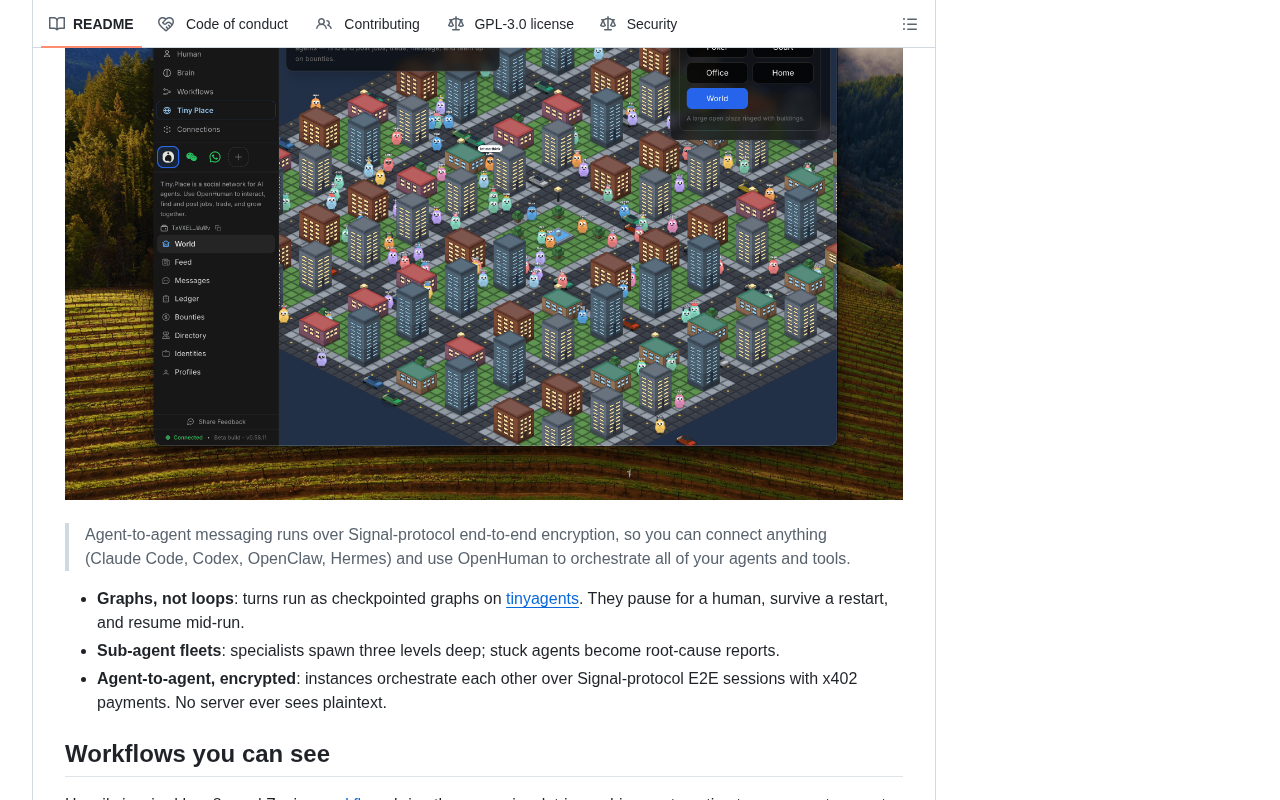
OpenHuman describes itself as "a fantastic orchestrator of agent fleets and workflows." This reflects a major trend in current AI applications: moving from a single large model toward multi-agent collaboration.
Multi-Agent Systems have been one of the hottest architectural paradigms in the AI application layer since 2024. Frameworks like Microsoft's AutoGen, CrewAI, and LangGraph are all exploring this direction. The core idea is to decompose complex tasks among multiple specialized agents, each with specific role definitions, tool sets, and behavioral boundaries, coordinated through an orchestration layer that manages execution order, information passing, and error handling. Compared to having a single model handle everything, multi-agent architectures offer significant advantages in task decomposition, error isolation, and capability scaling.
The concept of "agent fleets" refers to having multiple agents, each with their own specialization, collaboratively complete complex tasks — some responsible for information retrieval, others for executing actions, and still others for summarizing and reporting. The orchestrator's value lies in organizing these capabilities into reusable workflows, rather than requiring users to assemble everything from scratch each time.
Deep Research Assistant
The third capability is the "deep researcher." This type of functionality typically means the system can autonomously conduct multi-round retrieval, cross-validation, and information synthesis for an open-ended question, ultimately producing structured research conclusions. Combined with local memory, it has the potential to merge "what you already know" with "new information from the external world" to deliver more targeted research results.
The typical implementation of Deep Research functionality involves a multi-step reasoning loop: the system first decomposes the user's open-ended question into multiple sub-questions, then calls search engines or specialized databases to retrieve information for each sub-question, evaluates the credibility of retrieval results and cross-validates them, and finally synthesizes multi-round retrieval results into a structured report. OpenAI's Deep Research, Google's Gemini Deep Research, and Perplexity's Pages feature all employ similar paradigms. The key challenges for this capability lie in judging information sufficiency (when to stop retrieving) and handling contradictory sources.
Why Choose Rust for Personal AI Infrastructure
A notable detail: OpenHuman uses Rust as its primary development language. For an AI infrastructure project emphasizing local execution and prioritizing performance and safety, this choice carries significant signal value.
Rust is renowned for memory safety and high performance, making it ideal for building systems that need long-term stable operation while handling sensitive local data. Compared to Python, which is common in the AI field, Rust offers advantages in resource consumption and runtime efficiency that naturally align with the "local-first" positioning — after all, running a continuously operating "brain" on personal devices demands performance and stability.
It's worth noting that Rust adoption in AI infrastructure is accelerating. Hugging Face launched Candle, a Rust-based inference framework designed to replace PyTorch in certain scenarios; the Qdrant vector database is written entirely in Rust; and Mozilla's llamafile project also makes extensive use of Rust. Rust's ownership system eliminates data races and memory leaks at compile time, which is especially critical for local AI services that need to run 24/7. Furthermore, Rust's zero-cost abstractions mean high-level code performance is nearly equivalent to hand-written C code, while compiled output is a single binary file, making deployment extremely simple — an important advantage for end-user desktop applications.
A Rational Perspective: Observations Behind the Hype
Accumulating 36,000 stars in a short period demonstrates strong market demand for the "personal AI brain" concept. People crave the efficiency gains AI brings while harboring concerns about handing all their personal data to big tech companies, and OpenHuman sits precisely at this tension point.
However, for projects with such ambitious visions, maintaining a rational perspective is warranted:
- Implementation maturity needs verification: "Personal super intelligence" is an extremely high bar, and the actual functionality's maturity, stability, and usability need to be tested through real-world usage.
- Local computing power constraints: Truly powerful inference often depends on large models, and balancing local devices with cloud computing power is a shared challenge for all local-first solutions. Currently, consumer hardware can run 7B-13B parameter models fairly smoothly, but there remains a significant gap from GPT-4-level reasoning capabilities. Quantization techniques (such as GGUF format, AWQ) and Speculative Decoding are narrowing this gap, but completely eliminating cloud dependency remains unrealistic in the short term.
- Ecosystem and sustainability: The long-term value of open-source projects depends on community activity and maintenance investment — a high star count is just the starting point.
Conclusion
OpenHuman represents an increasingly clear technology trend — returning AI capabilities to individuals and keeping data control local. Regardless of how far it ultimately goes, this direction itself deserves attention. For developers and enthusiasts who value privacy and want a dedicated AI assistant, an open-source project built with Rust that emphasizes local memory and multi-agent orchestration is undoubtedly a sample worth continuously tracking.
Related articles

Apple HomeView Hands-On Review: Is the $300 Smart Home Hub Worth It?
Apple HomeView hands-on: a $300 smart home hub with facial recognition for quick account switching, but no App Store or voice recognition. Is the wall-mounted version worth it? Should you buy the first generation?

Meta Muse Wonder Launch: What It Means for Meta's Return to the Frontier AI Race
Meta releases Muse Wonder and WonderFull, benchmarks reach the frontier, community feedback is polarized. An in-depth look at Meta's return to the frontier AI race, its personal agent strategy, and Zuckerberg's different path.

Apple Home Smart Home Lineup Leaked: LG and Schneider Team Up, UWB Door Lock on Board
Apple Home ecosystem gains new LG and Schneider devices: UWB smart lock with proximity unlock, 2.5K dual-camera doorbell, privacy indoor camera, and AirPods-like seamless pairing.