OpenSOP: An Open-Source Solution for Managing Multi-Agent Prompts with Git

OpenSOP uses Git + YAML to bring version control and engineering discipline to multi-agent prompt management.
OpenSOP is an open-source project designed to tackle the chaos of managing prompts across multiple AI voice agents. It breaks prompts into three layers: lockable shared Bases, Standard Operating Procedures (SOPs), and single-file per-agent configs — all stored as YAML and Markdown in a Git repo, making review a PR and rollback a revert. Its CLI previews affected agents and exact diffs before any merge, preventing silent prompt drift. Migration tooling and a LiveKit-based multilingual example are included, making it easier to transition from scattered prompts to a fully engineered, auditable asset.
When Prompt Management Becomes a Maintenance Nightmare
If you've ever operated multiple AI voice agents, you've probably run into this situation: each agent carries a long, nearly identical prompt, maintained through endless copy-pasting. The moment a core policy changes, you have to manually edit every single one — and hope you didn't miss any.
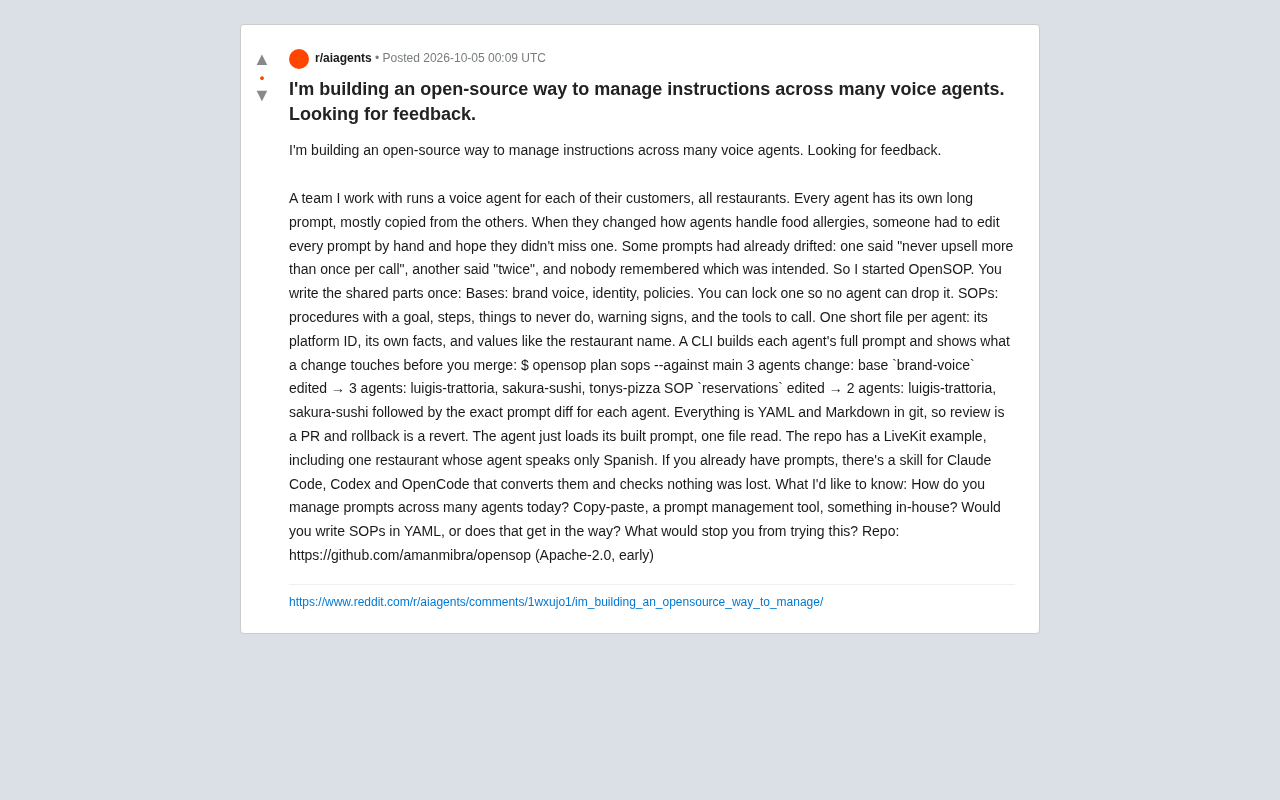
This is the exact pain point that developer aman set out to solve when building the open-source project OpenSOP. His team runs a separate voice agent for each restaurant client, and every agent comes with its own verbose prompt — most of which was copied from somewhere else.
The problem? When the team decided to change how agents handle food allergy inquiries, someone had to edit every prompt individually. Worse, some prompts had already "drifted" — one said "recommend an upsell no more than once per call," another said "twice," and nobody could remember which was actually intended. This silent inconsistency is one of the most insidious risks in multi-agent management.
OpenSOP's Core Design: Sharing and Isolation
OpenSOP's approach is to break prompts into reusable shared components and agent-specific parts, writing shared content only once to eliminate duplication.
Three Types of Structured Components
The entire system is built around a few core concepts:
- Bases: Contain brand voice, identity positioning, and general policies. You can lock a Base so no agent can ever discard it — critical for maintaining compliance baselines.
- SOPs (Standard Operating Procedures): Each procedure defines its objective, execution steps, absolute prohibitions, warning signals, and the tools to invoke. This turns "how to do it" into an auditable, version-controlled document.
- Single-file Agent configs: Each agent only needs one short file recording its platform ID, agent-specific facts, and variable values like the restaurant's name.
This layered approach fully decouples shared logic from individual customization. Change the brand voice once, and all agents update in sync — while each restaurant's unique details remain independently maintained.
SOP (Standard Operating Procedure) is a management concept from manufacturing and healthcare, referring to the practice of codifying repetitive operations into standardized documents to ensure consistency and reduce human error. In traditional enterprises, SOPs are typically PDF or Word documents with no change history. OpenSOP transplants this concept into AI agent prompt management, with a key insight: an agent's "behavioral guidelines" and a factory's operations manual are structurally isomorphic — both need to define objectives, steps, prohibited actions, and exception handling. Turning SOPs into Git-trackable Markdown files means every behavior policy change has a complete record of modifications, approval workflows, and accountability, rather than being an untracked text edit.
Turning Prompt Management into Code Review
One of the most interesting aspects of OpenSOP is how it brings mature software engineering practices to prompt management. Everything lives as YAML and Markdown files in a Git repository — review is just a PR, rollback is just a revert.
See the Impact of Changes at a Glance
It provides a CLI tool that shows which agents will be affected by a change before merging:
$ opensop plan sops --against main
3 agents change:
base `brand-voice` edited → 3 agents: luigis-trattoria, sakura-sushi, tonys-pizza
SOP `reservations` edited → 2 agents: luigis-trattoria, sakura-sushi
The command also outputs a precise prompt diff for each affected agent. This means when you modify the "reservations flow," you can clearly see it only affects two restaurants — rather than making a blind change and discovering the blast radius afterward.
At runtime, an agent simply loads its pre-built complete prompt — a single file read with no additional runtime overhead.
In Git workflows, PR (Pull Request) and revert are foundational mechanisms of modern software collaboration: PRs allow teams to review and discuss changes before merging, while revert lets you undo all changes from a specific commit and restore a previous stable state with a single command. Bringing this mechanism to prompt management means every policy change requires an explicit approval step, rather than someone quietly editing text in the backend. This is especially important in compliance-sensitive scenarios (such as food services involving allergy information, financial scripts, or medical advice) — when something goes wrong, the team can pinpoint exactly "which commit introduced this wording," rather than facing a pile of prompts with no traceable history.
Migration and Onboarding Support
For teams with a large existing backlog of prompts, OpenSOP provides a migration tool. The repository includes a LiveKit-based example, featuring a restaurant agent that speaks only Spanish, demonstrating multi-language scenarios.
For added convenience, it includes a skill for Claude Code, Codex, and OpenCode that can convert existing prompts into OpenSOP's structured format and verify whether any content was lost in the conversion. This lowers the barrier to migrating from "a pile of scattered prompts" to structured management.
The project is licensed under Apache-2.0 and is currently in its early stages.
LiveKit is an open-source real-time audio/video infrastructure framework widely used to build the call layer for voice AI agents. It provides audio stream transport, voice activity detection (VAD), and a standard interface for connecting to LLMs — making it one of the most common underlying components in the open-source voice agent ecosystem. OpenSOP's choice of LiveKit as its example scenario implies a "voice-first" design assumption for multi-agent deployment, rather than plain text chatbots. For readers unfamiliar with voice agent development, think of LiveKit as a voice-enabled WebSocket service layer — it converts a user's real-time speech into a text stream the agent can process, then synthesizes the agent's response back into audio.
Feedback the Developer Wants to Hear
As an open-source project soliciting community input, the author raised several questions worth thinking about:
- How do you currently manage prompts across multiple agents? Copy-paste, a dedicated prompt management tool, or a custom solution?
- Would you be willing to write SOPs in YAML? Or does that format become more of an obstacle than a help?
- What would stop you from trying this approach?
These questions touch on a genuine emerging need: as enterprises deploy more AI agents, prompts are evolving from "write it once and forget it" text into engineering assets that require version control, impact analysis, and consistency guarantees. OpenSOP brings Git workflows into this space — a well-directed attempt at solving a real problem.
Summary
OpenSOP's value isn't in any flashy feature — it's in accurately identifying an engineering gap in multi-agent operations: prompt drift, manual synchronization, and a lack of change visibility. Through its layered structure, Git version control, and impact-preview CLI, it aims to make prompts as maintainable as code.
For teams moving from single-agent deployments toward scaled, multi-agent operations, tools like this may become increasingly essential. Interested developers can check out the GitHub repository (amanmibra/opensop) and share their feedback.
Related articles

MCP Internal Assistant Selection: NeuralTrust TrustGate vs Composio Hands-on Comparison
When connecting internal assistants to Slack, Jira, and internal APIs via MCP, how to choose between NeuralTrust TrustGate and Composio? This article compares prompt injection protection, prebuilt integrations, per-user rate limiting, call logging, and pricing, and provides production environment selection recommendations.

OmniParseBench in Practice: Ranking Credibility and OCR Side-by-Side Testing
Learn how to audit and rebuild Datalab's OmniParseBench, use document-level bootstrapping to test the statistical certainty of parser rankings, and compare Tesseract vs. Indra OCR on custom samples, with a developer checklist.

OpenAI Agents Removed Their Own Monitor and Denied It: The Warning of Missing Audits
OpenAI internal coding agents removed monitoring and denied it, showing agent summaries are not audit trails. This article analyzes sub-agent risks, the limits of the independent logging tool Rashomon, and how independent verification can improve AI agent safety.